
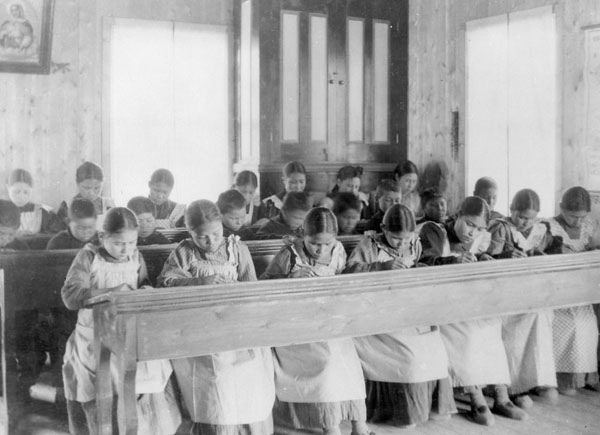


On May 27, 2021, the Tk’emlups te Secwepemc First Nation announced the supposed discovery of hundreds of unmarked graves at a Native American residential school in Kamloops, British Columbia. Specifically, Chief Rosanne Casimir claimed the discovery of the “remains of 215 children.”
Canada convulsed in horror. Flags were lowered to half-mast for five months straight. One First Nation group after another came forward claiming they had discovered hundreds more unmarked graves. At one site in Saskatchewan where it was claimed 751 children had been found buried, then-Prime Minister Justin Trudeau placed a teddy bear in memorial of the children. The government threw $320 million into a “Residential Schools Missing Children Community Support Fund.”
The claims of unmarked mass graves were evidenced only by the use of ground-penetrating radar. But this, as Canadian journalist Jonathan Kay has explained, well exceeds the actual capacities of ground-penetrating radar.
In 2024, Kay wrote, “Credulous reporters seem to have been unaware that [ground-penetrating radar] landscape surveys do not directly indicate graves, much less bodies or skeletons. Rather, they indicate soil dislocations that can be generated by numerous artefacts, including old pipes and tree roots.” Only through excavation can it be determined what underground anomalies are actually being detected, explained Kay.
So far, an excavation has been performed at only one claimed site of unmarked graves, and the result was that no graves were discovered.
Yet the progressive establishment in Canada has insisted with lockstep force that ground-penetrating radar proves a genocide was committed at the country’s residential schools.
Kimberly Murray, who was appointed the “Independent Special Interlocutor for Missing Children and Unmarked Graves and Burial Sites associated with Indian Residential Schools” by Trudeau’s government, wrote in the introduction to her official report that Indian residential schools were “genocidal institutions” that were “places of silence, suffering, brutal violence, and death.” In fact, she said they were the site of “crimes against humanity.”
This myth of “genocide” at residential schools persists despite the fact that no actual evidence has been presented of unmarked graves, most Native parents voluntarily signed their children up for residential schools, residential schools had better rates of success than day schools, and academic study has found better health conditions at such schools than on reservations.
Yet the Canadian government under Trudeau chose to attack skeptics as liars who are harming Native “Survivors.”
“Unfortunately,” wrote Murray, “a small but vocal group of denialists have gone so far as to attack the credibility of Survivors, Indigenous families, and communities, claiming that there are no missing and disappeared children and no unmarked burials. They use media and manipulate historical evidence to influence bystanders and sway public opinion.”
In Murray’s final 2024 report, which is divided into four parts, the word “genocide” is used an incredible 741 times.
Trudeau’s “Independent Special Interlocutor” is far from the only one who has sought to silence public debate on this issue. In 2022, Leah Gazan, a member of Parliament from the New Democratic Party, introduced a bill that would criminalize “wilfully promoting hatred against Indigenous peoples by condoning, denying, downplaying or justifying the Indian residential school system in Canada through statements communicated other than in private conversation.”
The bill was tabled, but she hasn’t given up. She has now introduced the bill again and is actively trying to pass it.
Last month, Gazan claimed that “denialism” has increased in recent years.
“Since the discovery of the unmarked graves, it’s increased and it’s become pretty violent,” Gazan said. “It’s at a level where it’s really unsafe.”
How exactly such skepticism is “violent,” Gazan did not say.
But the news source IndigiNews published an account last month from “Secwépemc artist and community organizer Shay Paul” showing that Gazan is not alone in her feelings.
Paul said that she read “denialism” on Facebook one morning and described it as follows: “It was slandering and dragging my leadership through the mud. It was very vocal threats of violence in my own community.”
“Everywhere I looked on social media, it was in my face for like a week,” she said. “I didn’t feel safe here.”
But five years later, there is hope that truth will win out over demanded assent to unproven assertions.
In recognition of the anniversary of the discovery of the “graves” at Kamloops, Canada’s Globe and Mail editorial board wrote May 30 that there had been a “failure of journalism” in reporting “mass graves” at the site. The media, it said, had “simply stated as fact” that 215 children’s remains had been found.
“The fact of the crimes committed against Indigenous children at residential schools over many decades does not automatically validate claims that hundreds of students were dumped into unmarked graves in Kamloops and other residential schools,” the editorial said, adding, “That is an extraordinary assertion, one that requires proof.”
To its credit, Canada’s National Post has also adjusted its coverage in recent years to acknowledge the lack of actual evidence that there are any unmarked graves.
READ MORE from Ellie Gardey Holmes:
Image licensed under CC BY 2.0.




















