In classrooms across America today, too many young people are being taught to view their country not as a force for good, but as a source of injustice. The heroes of history are recast as villains. National pride is replaced by shame. The result is not a generation prepared to lead a free people, but one too often uncertain whether America is a nation worth defending at all.
This article is from The American Spectator’s summer 2026 print magazine. Subscribe to The American Spectator to receive the magazine.
That uncertainty would have deeply troubled George Washington. In his farewell address, he urged the American people to “guard against the impostures of pretended patriotism” and warned that narrow interests and factionalism could erode the unity essential to the survival of the Republic. Washington understood that the success of this great experiment in liberty would depend not only on our institutions, but on the character and convictions of the American people.
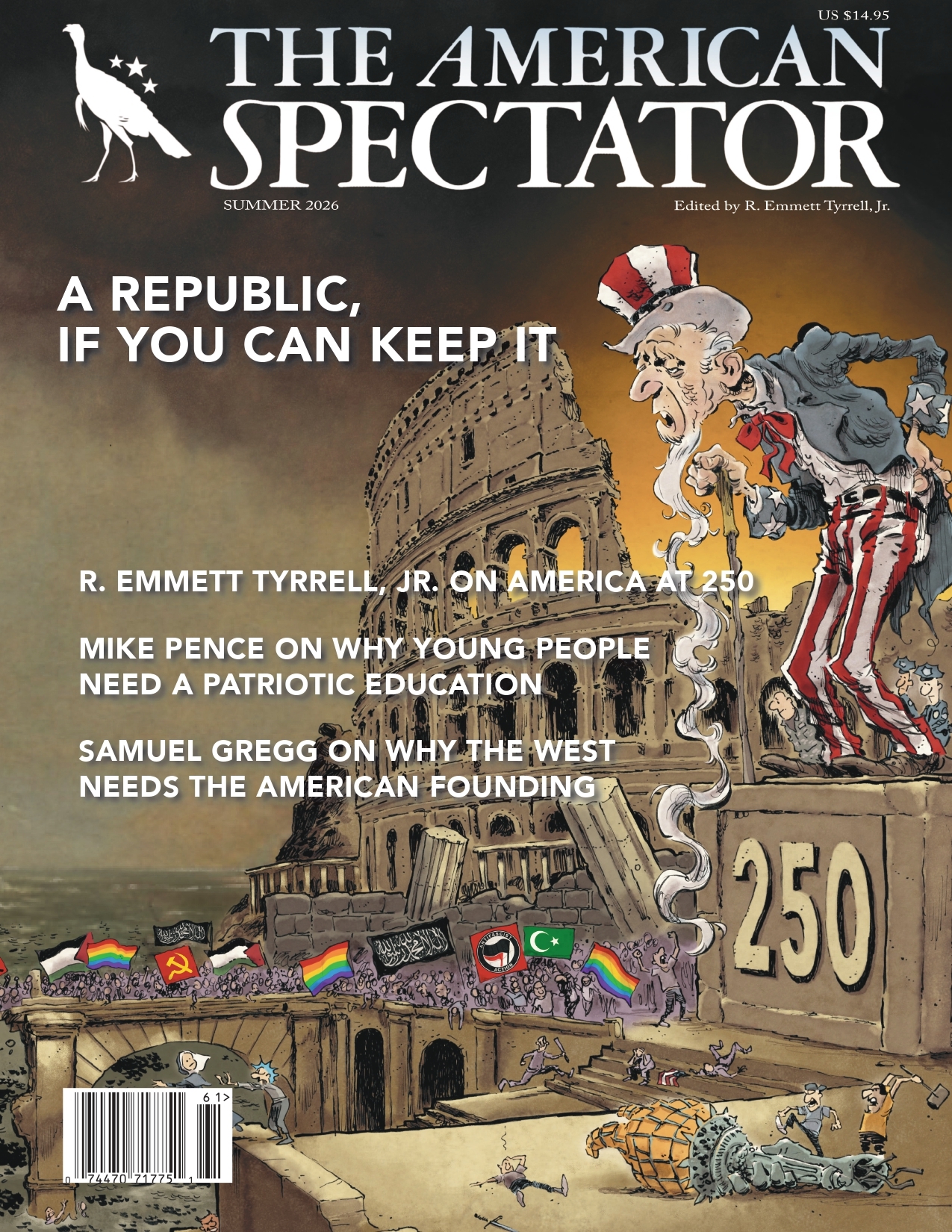
Subscribe to The American Spectator to receive our summer 2026 print magazine.
Today, the United States faces a crisis of civic confidence. For too long, elements of our education system have advanced a narrative that diminishes American ideals, emphasizing our failures while neglecting the extraordinary achievements that have defined our history. The answer is not a shallow or uncritical nationalism, but something far more enduring: a patriotic education rooted in truth.
As C. S. Lewis noted in The Four Loves, “[I]t is possible to be strengthened by the image of the past without being either deceived or puffed up. The image becomes dangerous in the precise degree to which it is mistaken, or substituted, for serious and systematic historical study.”
That is precisely the task before us. A patriotic education does not ignore the imperfections of our national story. It places them in the context of a nation that has, time and again, striven to live up to its highest ideals.
At its core, patriotic education must begin with a serious study of America’s founding principles. Students should know the words of the Declaration of Independence and understand the enduring genius of the Constitution. They should learn how the separation of powers safeguards liberty, how federalism preserves local self-government, and how the rule of law protects the rights of every citizen. These concepts are the very framework of freedom.
But patriotic education must go further. It should introduce young Americans to the men and women who have shaped our nation — from giants like Washington and Lincoln to the countless soldiers, workers, and everyday Americans whose sacrifices built and continue to sustain this Republic. It should tell the story of a people who crossed oceans in search of liberty, who tamed a vast continent through grit and perseverance, and who ultimately carried the cause of freedom beyond our shores.
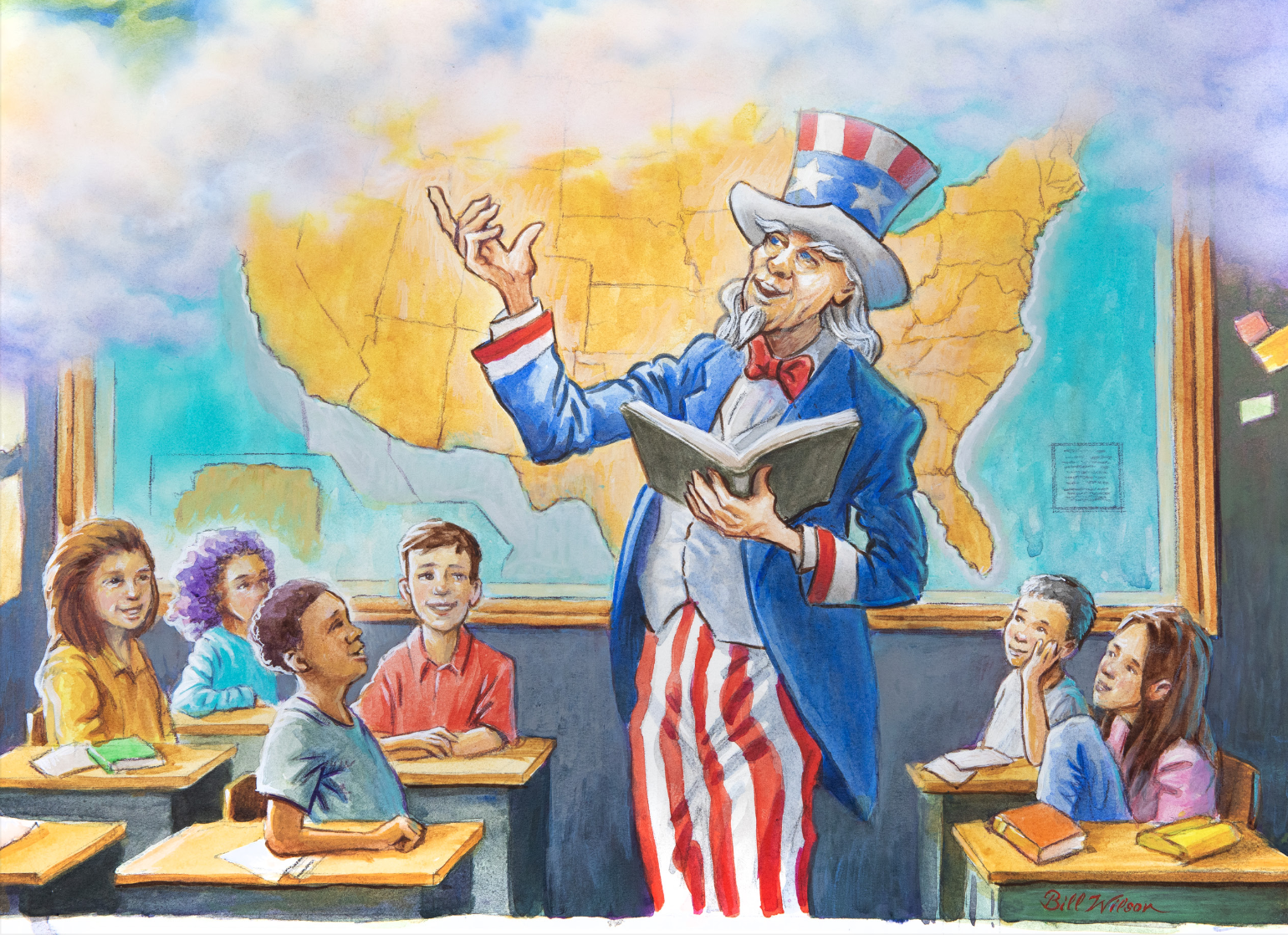
Art by Bill Wilson for The American Spectator
In the twentieth century, the United States helped liberate Europe from Nazi tyranny and Asia from imperial domination. We defeated the menace of global communism in a long and bitter Cold War. These were not the actions of a perfect nation. They were the actions of a good nation, full of decent and kind people, who chose to use their strength to expand the reach of liberty in the world.
We must also teach, with honesty and humility, the chapters of our history that fall short of our ideals. But the defining feature of our nation is not simply that we tolerated injustices for a time, but that Americans fought — often at great cost — to overcome them. We are a nation that waged a war against itself to vindicate the truth that all men are created equal, and then labored for generations more to ensure that promise would be fulfilled.
As a visiting professor at both George Mason University and Grove City College, I have seen firsthand both the challenges and the promise of the next generation. I have met students who arrive with only a faint understanding of the Constitution. But I have also seen something deeply encouraging: when young Americans are introduced to the story of our nation in its fullness, they respond with genuine admiration, gratitude, and even a renewed sense of purpose.
They want to believe in their country. They want to be part of something greater than themselves. And when we give them an education that is honest, rigorous, and rooted in the truth, they are more than ready to rise to that calling.
The stakes of this effort could not be higher. We are living in a time of renewed global competition, as authoritarian powers like China seek to expand their influence and offer the world an alternative vision to the principles of freedom and self-government. In such a world, a people who lose confidence in their own ideals will struggle to defend them abroad. A nation that forgets why it is free will not remain free for long.
Patriotic education, rightly understood, is therefore not only a domestic imperative — it is a national security necessity. It forms citizens who understand what is at stake, who appreciate the blessings of liberty, and who are prepared to defend them for future generations.
Encouragingly, there are signs of renewal. Across the country, families, educators, and some local schools are working to restore robust civic education to the American classroom. Homeschooling communities, classical Christian schools, and institutions like Hillsdale College are leading the way, developing a K–12 curriculum that emphasizes the principles and history that have made America a beacon of hope to the world. Quietly and faithfully, many individual teachers in classrooms across the nation are doing the same.
These efforts remind us that the future of American education, like the fate of our nation itself, is not fixed. It will be determined by the choices we make today.
The Bible tells us that a house built on sand will not stand, but a house built on the rock will endure. The same is true of a nation. A civic education that teaches young people to reject their own country rests on the most fragile of foundations. But an education that instills a well-ordered love of country is a house built on a rock.
As G. K. Chesterton wrote, “Men did not love Rome because she was great. She was great because they had loved her.”
If we would preserve the blessings of liberty for ourselves and our posterity, we must begin by teaching the next generation to love this land we call home.
Mike Pence served as the 48th vice president of the United States from 2017 to 2021.
Subscribe to The American Spectator to receive our summer 2026 print magazine.