
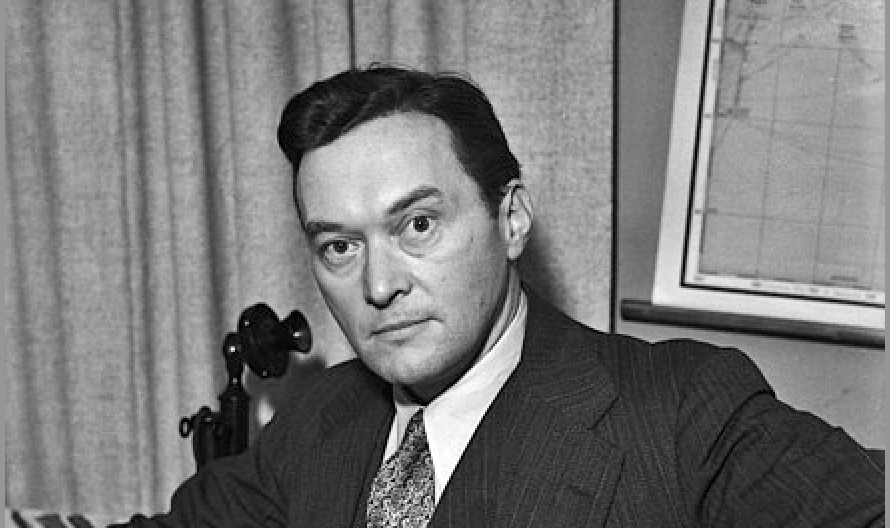


Walter Lippmann: An Intellectual Biography
By Tom Arnold-Forster
(Princeton University Press, 368 pages, $35)
Walter Lippmann was at one time the most influential American writer on politics and world affairs. His writing career spanned the time period from the Progressive Era to the middle of the Cold War. He wrote about every U.S. president from Woodrow Wilson to Lyndon Johnson. His career, writes Tom Arnold-Forster in his book Walter Lippmann: An Intellectual Biography, “was a six-decade commentary on the vicissitudes of politics.”
Interestingly, facts later emerged that Lippmann’s onetime secretary Mary Price was a communist agent.
Arnold-Forster calls Lippmann a “liberal,” but also notes that his intellectual journey “involved many changes of mind, new starts, false starts, idiosyncrasies, and disputes with contemporaries.” Lippmann was both a proponent and critic of democracy; a supporter of Wilsonian foreign policy who evolved into a foreign policy realist; a crusader during the Second World War who became a critic of what he viewed as an overcommitted Cold War America; and, finally, a disillusioned liberal who thought that the Vietnam War helped destroy liberalism at home.
Arnold-Forster describes Lippmann’s Harvard education and early involvement with New York’s Socialist Party. He began writing for what the author calls “bourgeois publications,” including beginning in 1912, reviewing books for the New York Times.
He was at that time, writes Arnold-Forster, a “prolific and rising political writer” on the ideological left. He wrote his first book in 1913 — A Preface to Politics — which was reviewed positively in newspapers throughout the country. It was a psychological-political promotion of progressivism which called for shaping public opinion to favor political reforms.
His model political leader at that time was Theodore Roosevelt, the former president who had again entered the national political arena to save the country from the conservatism of his chosen Republican successor William Howard Taft. All Roosevelt accomplished, however, was to subject the country to the progressive academic notions of Woodrow Wilson, who won the election of 1912 because Roosevelt split the GOP vote.
Lippmann soon formed friendships with ideological soulmates like John Reed and Emma Goldman. Arnold-Forster believes that the most formative intellectual influence on Lippmann at that time was his old Harvard teacher Graham Wallas, author of The Great Society: A Psychological Analysis, who promoted progressive reform instead of revolution.
Wallas’ ideas, Arnold-Forster writes, were at the root of Lippmann’s next book Drift and Mastery. Here, Lippmann praised unions who sought not to overthrow capitalism but to work within capitalist democracies. Lippmann’s work caught the attention of Herbert Croly who hired Lippmann as an editor at The New Republic.
Soon domestic politics took a back seat to international relations, as the First World War eclipsed all other political issues. Lippmann, Arnold-Forster notes, was an early advocate of intervention, like his hero Theodore Roosevelt. President Wilson, however, was at least initially determined to stay out of the war. This put Wilson at odds with Lippmann, who decried American isolationism, arguing, Arnold-Forster writes, “for U.S. intervention into the European war for both strategic and civilizational reasons.”
This was Lippmann’s first foray into geopolitics, a subject he would periodically return to for the rest of his career. He wrote in Mahanian terms of securing the “Atlantic highway” from German continental power. He described the western world — principally North America and Western Europe — as a single strategic community. When the Wilson administration turned interventionist, Lippmann hired on as a wartime propagandist in Newton Baker’s War Department to promote “democracy.” And The New Republic “embraced wartime propaganda.”
Perhaps Lippmann’s most substantial work during the war was to join what became known as “the Inquiry,” a group of academics established “for planning America’s position on the postwar world.” Arnold-Forster notes that the Inquiry’s leading voice was Isaiah Bowman, who viewed world politics through a geographer’s lens. Lippmann would later during World War II and the Cold War employ geography as an aid to statecraft.
Most notably, Lippmann helped draft Wilson’s famous Fourteen Points that set forth American war aims in idealistic terms. This was in essence the birth of Wilsonianism — the idea that American foreign policy should be conducted for disinterested purposes based on universal ideals. It was no longer sufficient to just win the war; now the world had to be made safe for democracy. Empires were evil; self-determination was a moral good. We have been living with the unintended and unhappy consequences of Wilsonianism ever since.
Lippmann had been making “notes” on public opinion since the early nineteen-teens, and after the war he collected them in book form with the title Public Opinion, which Arnold-Forster calls Lippmann’s “most enduring work of democratic theory.”
Here, the author claims, were “new ways to understand the social and psychological dynamics of democratic opinion formation.” This is the weakest part of Arnold-Forster’s book which unfortunately on this topic devolves into academic jargon and psychological theories. But Public Opinion did manifest Lippmann’s growing acceptance of the need for experts to influence governing elites and shape public opinion. In some ways, it anticipated James Burnham’s The Managerial Revolution which envisioned countries throughout the world being ruled by scientific- technocratic elites.
Between 1922 and 1931, Lippmann wrote for the Pulitzer’s New York World, where he covered urban politics but also wrote about international affairs. He also found a new political champion in Alfred E. Smith, the Governor of New York and later Democratic presidential candidate. When the World folded, Lippmann began writing a column for the New York Herald Tribune, which Arnold-Forster describes as a “liberal conservative paper,” whatever that means. Lippmann’s column was now syndicated, reaching a national and international audience. His column was titled “Today and Tomorrow,” and he continued writing for the paper until 1962.
For the next decade, Lippmann wrote about the twin crises of economic depression and the rise of totalitarianism. Lippmann endorsed Franklin Roosevelt over Herbert Hoover in the 1932 election, and supported granting emergency powers to FDR (a “constitutional dictatorship”) in the midst of the economic crisis. He would later become a critic of FDR and drift toward conservatism in the late 1930s.
This shift was most clearly set forth in his book The Good Society, which portrayed the New Deal and FDR as opponents of constitutionalism. Lippmann was now in the company of Friedrich Hayek and Ludwig von Mises, who joined him and other notables in Paris to discuss The Good Society.
Soon, however, all economic arguments were eclipsed by the Second World War. War, Randolph Bourne once wrote, was the health of the state. Lippmann was more than willing to see the state assume greater and greater powers to defeat the Axis powers. State planning was essential for winning the war, and Lippmann believed that planning would also play a major role in postwar America.
Arnold-Forster claims that the war reinvigorated Lippmann’s “imperialism” which had emerged during the First World War and in his inter-war writings. During the Second World War, he wrote two books: U.S. Foreign Policy: Shield of the Republic and U.S. War Aims. Both books, the author claims, evidenced Lippmann’s “imperial realism,” yet also “warn[ed] against the dangers of imperial overreach.”
Lippmann the realist recognized that the United States was an empire which exercised hegemony in the Western Hemisphere and had colonies and territories in the Far East and the Pacific Ocean. The United States, Lippmann wrote, had an imperial destiny, like Rome and Great Britain before it. And war’s exigencies justified emergency powers like those used for the internment of Japanese Americans.
But, as Arnold-Forster recognizes, in U.S. Foreign Policy Lippman conceived of what became known as the “Lippmann Gap.” U.S. foreign policy, he wrote, had to align its commitments with its power and resources. When a gap emerges then widens between our commitments and resources our foreign policy is insolvent. He understood that America’s first line of defense was on the shores of Europe, Asia, and Africa, but not all of the world’s regions were of equal importance to American security. This became much clearer in Lippmann’s postwar book The Cold War.
The Cold War grew out of a series of columns Lippmann wrote in reaction to George Kennan’s essay in Foreign Affairs titled “The Sources of Soviet Conduct.” Although written under the pseudonym “X,” it soon became widely known that the author of the essay was none other than Kennan, who then served as the State Department’s Director of Policy and Planning.
Kennan in the essay argued that the Soviet Union’s global ambitions could be contained by the “adroit and vigilant application of counterforce” at shifting positions along the periphery of the Eurasian landmass. Containment, Kennan argued, would produce systemic change within the Soviet empire if the U.S. and its allies were patient and prudent.
Lippmann shared Kennan’s view of an expansionist Soviet Union, but he called Kennan’s solution a “strategic monstrosity.” Lippmann thought Kennan put too much emphasis on the Soviet’s communist ideology and committed the U.S. to responding to Soviet moves in too many places. The Soviet Union, Lippmann believed, was just the latest great continental power that sought hegemony in Eurasia, like Germany, Czarist Russia, and Napoleonic France before it.
Kennan’s containment doctrine and the pledges of the Truman Doctrine reflected a crusading spirit, Lippmann argued, that would overextend America’s resources and exhaust American will. Kennan subsequently agreed with Lippmann’s criticism, claiming that his recommended containment policy had been militarized by successive administrations. Lippmann and Kennan, it turned out, shared a realist geopolitical world view against international crusades, which would later manifest itself in their joint opposition to the Vietnam War.
Arnold-Forster praises Lippmann’s condemnation of “McCarthyism,” which Lippmann viewed as a threat to democracy even as he supported the government’s loyalty program and supported congressional investigations into domestic communism. Interestingly, facts later emerged that Lippmann’s onetime secretary Mary Price was a communist agent. Arnold-Forster acknowledges the truth of the charges against Price, yet appears to sympathize with her plight as a victim of McCarthyism.
Lippmann’s last major work was The Public Philosophy, a book Arnold-Forster calls a “polemic against McCarthyism,” but also a promotion of “political elitism.” In that sense, Lippmann and Kennan both ended up supporting rule by elites in a “democratic” country. Lippmann flirted with the “best and the brightest” of the Kennedy administration, supported Lyndon Johnson’s Great Society, but viewed the Vietnam quagmire that they led us into as “futile, unnecessary, and domestically harmful.” In international relations, if not in domestic politics, Lippmann’s realism won out, evidenced by his support for Richard Nixon in the 1968 election.
Arnold-Forster’s book — his first — is marred by his own progressivism which shines through on almost every page of Walter Lippmann: An Intellectual Biography. In this respect, it suffers in comparison to the previous major work about Lippmann by the late liberal writer Ronald Steel, Walter Lippmann and the American Century, which remains the definitive biography of Lippmann.
READ MORE from Francis P. Sempa:
Operation Grenade: 80 Years Ago Hitler’s Western Wall Crumbles



















