

A little while ago, I had a column in this space that challenged the groupthink wisdom that assumes 2026 is going to be a bad year for President Trump and Republicans on Capitol Hill. One of the items on which I rested my challenge is worth repeating today. (RELATED: Five Not-So Quick Things: The Green Shoots Which Will Only Get Greener)
What I predicted was that the ruling regimes, both Iran and Venezuela, would go by the boards, and the benefits coming to everybody in America not affiliated with the Democrat Party would be manifold.
Iran, I noted, is going to collapse on its own, mostly because the ayatollahs are so incompetent at the basic functions of government that they’ve allowed the reservoirs which supply water to the 15 million people who live in and around Tehran to go almost completely dry. And with a pretty rough drought hitting that country, they’re now talking about moving Iran’s capital and relocating — assumedly by force? — most of the population elsewhere. (RELATED: Unmasking Iran’s Hidden Footprint in the Americas)
This is quite possibly the single most pronounced confession of governing failure in world history.
This is quite possibly the single most pronounced confession of governing failure in world history. Especially in light of all the money wasted by the Iranian regime on utterly idiotic things like Hezbollah, Hamas, the Houthis, and a nuclear program that American and Israeli airstrikes reduced to ash last year. The desalination plants and water pipelines Iran desperately needs could easily have been built over the course of the past couple of decades, and everyone knows it. (RELATED: Trump’s Declawing of Iran Is Reshaping the Middle East)
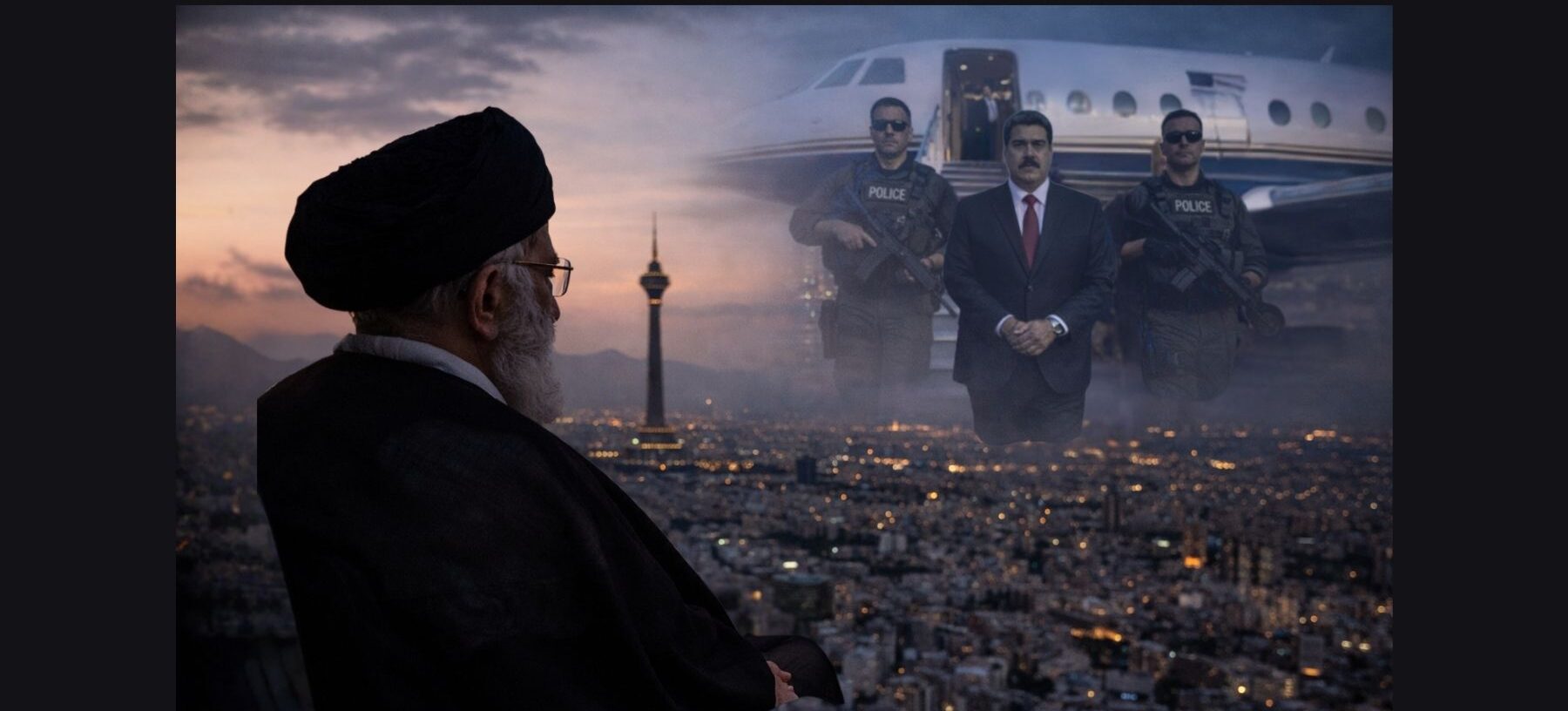
Which is why they’re in the streets in Iran again, and this time it’s serious enough that the head ayatollah in charge is apparently making travel plans…
Iran’s Ayatollah Ali Khamenei has a back-up plan to flee the country should his security forces fail to suppress protests or desert, according to an intelligence report shared with The Times.
Khamenei, 86, plans to escape Tehran with a close circle of up to 20 aides and family, should he see that the army and security called on to quell the unrest are deserting, defecting, or failing to follow orders.
“The ‘plan B’ is for Khamenei and his very close circle of associates and family, including his son and nominated heir apparent, Mojtaba,” an intelligence source told The Times.
Beni Sabti, who served for decades in Israeli intelligence after fleeing the regime eight years after the Islamic revolution, told The Times that Khamenei would flee to Moscow as “there is no other place for him.”
…
Nationwide protests triggered by economic hardships have gripped cities across Iran, including in the holy city of Qom, over the last week.
Protesters accuse anti-riot forces — made up of the Islamic Revolutionary Guard Corps (IRGC), the Basij militia, the police and the army — of using violent means including live fire, tear gas and water cannons to suppress the demonstrations.
The forces are under the total command of Khameini, who is the supreme source of power in the Islamic republic, overruling the army, courts and media. He relies on the IRGC to enforce his bidding as a central source of power.
The escape plan will be activated should Khamenei feel his security forces are not following orders. Desertion and defection are not easily undertaken, with Khamenei protecting loyalists, controlling key appointments and their safety, according to a psychological profile of the leader done by a western intelligence agency and seen by The Times.
But the same assessment said Khamenei was “weaker, both mentally and physically” since last year’s 12-day war with Israel. He has barely been seen in public and, notably, has not been seen or heard from during the last several days of protests. For the duration of war, Khamenei holed up in a bunker, avoiding the fate of several other high-level IRGC officials and feeding his “obsession with survival.”
Yes, we’ve been here before. This is probably the fourth — or maybe fifth — time the people in Iran have taken to the streets in an effort to topple that government. But it’s the first time it’s happened when there was somebody in the White House who chose the Iranian people over the ayatollahs. (RELATED: Iran Is Not Iraq, Afghanistan, or Libya)
And that somebody also knocked out a bunch of the bowling pins holding that regime together last year.
Plus the water thing. As I said last month, hungry people are angry people. Thirsty people go crazy, fast.
And then there’s the inconvenient fact that the Iranian regime is about to be very broke.
The U.S. capture of Nicolas Maduro, a staunch ally of Iran’s theocratic rulers, has cast doubt on whether Venezuela will ever pay its reported two-billion-dollar debt to Tehran should Caracas flip into an ally of Washington.
Following a U.S. attack on Venezuela on January 3 and the arrest of Maduro, its economic muddle is unchanged. Unpaid debts, legal claims and arbitration rulings total between $150 billion and $170 billion.
The scale of liabilities far exceeds the capacity of Venezuela’s collapsed economy, casting doubt on whether creditors will recover their losses.
Iran is among the countries exposed to the fallout. Analysts say the Islamic Republic is not just a conventional creditor but potentially one of the main financial losers of any transformational change in Caracas, especially as it is sanctioned by the United States.
Over nearly two decades, Tehran spent around 2 billion of dollars in Venezuela according to Iranian media.
The economic projects ranged from joint automobile production projects launched in 2007, housing schemes estimated at about 23,000 units, banking cooperation and oil and logistical exchanges carried out under sanctions.
Iran also used Venezuela as a political and logistical base to bypass international sanctions and advance regional objectives.
According to Heshmatollah Falahatpisheh, a former head of Iran’s parliamentary national security commission, Venezuela’s debts to Iran reflect only officially recorded investments and assistance.
No estimates exist for the value of undeclared financial flows linked to what the U.S. calls smuggling networks or military and security cooperation between the two allies, due to their classified nature.
Gosh, that’s really too bad, isn’t it? The above doesn’t include the Venezuelan participation in the “ghost fleet” of oil tankers, which move sanctioned oil all over the world, most principally from Venezuela and Iran to China.
And Cuba.
The Cubans are sustained on Venezuelan oil. The Cuban communist regime is very much akin to a vampire with its teeth sunk into the collective neck of the Venezuelan people, providing the Maduro regime, and that of Hugo Chavez before him, with an army of some 15,000 military and intelligence operatives who spared not a jot or tittle of brutality in defending it from the dissatisfied masses in return for free oil shipments to that imprisoned island.
Those shipments have dwindled as the Venezuelan oil industry has faltered — amazingly, communists aren’t so good at oil exploration and production, the single most capitalistic pursuit on earth! — and they’re now going to end altogether. And with them goes electric power and transportation fuel, as well as any hard currency the Cuban communists might have to trade for basic goods they’ve never been able to provide to their people.
Friday night, when our military accompanied law enforcement officials in their mission to arrest Nicolás Maduro and his wife on a five-year-old drug trafficking indictment, it’s said there were 32 Cubans killed in the raid. That’s proof of how close the Cubans are to Maduro.
Why no one is talking about this is a mystery, sort of. You’ll hear an awful lot from the Democrats, including New York’s new anti-American mayor whose inaugural words about exchanging the “frigidity” of individualism for the “warmth” of collectivism (it’s very warm in Cuba, you know; nobody other than the commissars has access to air conditioning), decrying American “imperialism” with respect to the Maduro raid.
But as I noted at The Hayride on Monday, that’s a pretty shoddy argument…
So it’s OK for the Cubans to exercise imperialism over Venezuela but not for the U.S. to do it?
Which is not at all in evidence, by the way. When Trump said “we’ll run it,” he was rather inartfully describing the restoration of the badly-deteriorated Venezuelan oil infrastructure and putting that industry back into full production after the communists had mostly destroyed it, giving the Venezuelan people a chance to profit from the estimated $17 trillion in oil and gas reserves under the ground there, and making the American companies whole who’d had their assets stolen from them. We’re well within our rights to do that, and it’s certainly in our national interest to do so.
It should be understood that when Venezuela’s oil industry was the envy of the Western Hemisphere a couple of decades ago, a large amount of that oil was refined on the Gulf Coast here in America. That mostly serviced the U.S. market. Don’t be shocked if those refineries roll back in to full capacity and we start exporting gasoline and other petroleum-based finished goods to the world.
Perhaps that means Venezuela’s future is as an economic colony of the U.S.A. Are you really upset at the injustice of that when the alternative is they’re a colony of Cuba and/or China? Because those are the options. You’ve seen what happens to an “independent” Venezuela.
Fundamentally, we’re charging ourselves with restoring market democracy to a country which has been fighting a war against us from inside our own borders. Trump didn’t start a war with Venezuela; hopefully he finished one.
That we allowed the Maduro regime to remain in place, at least nominally and temporarily, in the person of Maduro’s VP Delcy Rodriguez — who is just as dirty as Maduro is when it comes to selling out her country to foreign villains and covering herself in filthy cocaine-trade lucre — is an indication of how rapacious the president is in trying to effect “regime change” in Venezuela. Rodriguez talked a pretty defiant game over the weekend in decrying the Maduro raid, but it took very little time for that to change.
Delcy is pretty docile now that the work week has begun, and she’s pledging “collaboration” with the Americans.
Those flights from Caracas to Havana, once the airport reopens, will be full. The ones back to Caracas? Not so much.
And if by spring they’re trying on brand new leadership in Iran, Cuba, and Venezuela, this is going to be a very different world than it’s been for pretty much all of our lives — and in ways that we will benefit from very greatly.