


With all the hullabaloo relating to the extraction and arrest of Venezuelan narco-dictator Nicolás Maduro, it is easy to forget that in recent years — and even recent months — good things have been happening in the southern hemisphere without America’s helping hand.
Shortly before the recent election in Chile, I visited that country to attend a wedding. However, during my two-week stay, I heard nearly nothing about the election or politics in general unless I raised the subject myself. On the other hand, we talked incessantly about the wedding, not only because it was more personal but perhaps because a wedding is generally more promising than an election. The common experience in most countries today is that people go to the polls in the wake of false promises and outright lies.
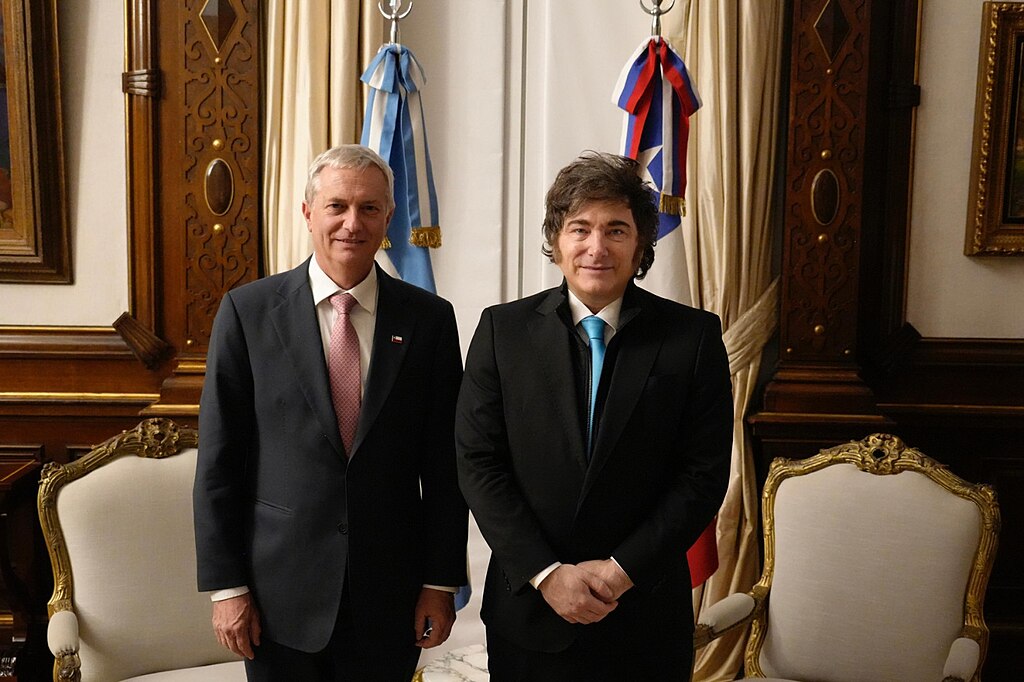
That being said, the majority of the Chilean public were yearning for a real change. Chile has a history of great pendulum swings in its politics, moving dramatically from left to right and back again. Rather than being a choice between Tweedledum and Tweedledee, this election once again gave the country the chance to vote for real change. The leading candidates in the runoff, which took place on December 14, were Jeannette Jara of the Communist Party and José Antonio Kast of the Republican Party. The final tally was not even close; Kast soundly beat Jara with 58 percent of the vote against her 42 percent.
The most prominent election issues — crime, border control, and social values — are also familiar to North Americans, and demographically, the election results reflected what has by now become a recognisable pattern in which the gender divide was most telling. Jara drew support from the existing coalition base of outgoing leftist President Gabriel Borić, from the public sector and the unions, and from significant segments of both younger and older women (that is, women under 35 and over 54).
It appears to be a legacy of the feminist movement that females are attracted to the left like moths to a flame.
On the other hand, Kast performed best among men in all age groups and also among women in the 35-54 age bracket. In this context, it is noteworthy that this election somewhat reflected a trend in the West where women more than men are throwing their support behind leftist candidates — think New York City, where women in all age brackets disproportionately voted for newly minted mayor Zohran Mamdani. It appears to be a legacy of the feminist movement that females are attracted to the left like moths to a flame. (RELATED: The Spectator P.M. Ep. 167: Are Women to Blame for Mamdani’s Win?)
Chile’s election followed a recent trend in South America of electing conservative governments. Ecuador re-elected right-wing incumbent Daniel Noboa last April; in Bolivia, center-right candidate Rodrigo Paz Pereira won the presidential runoff in October, ending nearly two decades of leftist rule; Honduras elected conservative Nasry Asfura in November; Nayib Bukele was first elected president of El Salvador in 2019 and re-elected in 2024; and, of course, most famously, libertarian Javier Milei of Argentina won election in 2023 and also had a mid-term victory in 2025.
The mainstream media have characterized José Kast as being alt-right, which, of course, is what they do today with any conservative leader. Kast’s family originated in Germany, and they like to mention that his father joined the Nazi party at the age of 18 at the beginning of World War II. This is unremarkable. It is something that almost every young man of that age would have felt compelled to do at that time. After the War, Kast’s father immigrated to Chile, and the family has lived there ever since.
More serious is the fact that in 1988, when he was a law student, José Kast openly supported Augusto Pinochet in a plebiscite in which the military dictator asked the public to extend his regime for another 8 years. More recently, even as late as 2017 during his first presidential bid, Kast stated that if Pinochet were alive, “he would have voted for me” and they would “have tea together.” (I’ll never know why on earth certain politicians insist on making such flippant remarks). And this is serious. Members of the older generation whom I spoke with still remember the unforgivable abuses of the Pinochet era, but this still did not prove an impediment to Kast being elected by a solid majority. It appears that guilt by association is not always perceived to be the crime that it is often made out to be.
Today, by a wide variety of measures, Chile is the most prosperous country in South America, and it shows in its well-maintained infrastructure, classy shopping venues, and an abundance of well-appointed housing stock. Nevertheless, as is typical of South America, middle-class houses as well as institutions such as schools are all protected by gates, high walls, and guard dogs. Chileans talk openly about the nation’s crime problems. Our hosts warned us that when out in public, we needed to keep our wallets and phones well hidden and close to our bodies. We were also told that crime has gotten worse with the recent influx of migrants through the northern border, and therefore, closing that border and law and order were major issues in the election. When we expressed an interest in visiting Valparaíso, which has long been famous for its art and festivals, we were told to avoid it because crime has dramatically increased there, as it is a port city.
But Chile has many other cultural attractions. Pomaire is a town located in Melipilla Province, about 70 km southwest of Santiago. It specializes in making pottery using local clay from the surrounding hills. During the Spanish conquest, Jesuits taught this craft to the indigenous population in order to make them financially viable, and the cottage industry continues to thrive to this day. Pomaire’s main street consists of one pottery shop after the other, with a few other crafts thrown in for good measure. It reminded me of a similar village around Kyoto based on the same craft that we visited about a year and a half ago, but as one would have expected, the product is very different. The Pomaire crockery is rather more rough-hewn than its Japanese counterparts and reflects a very different but equally charming culture.
After visiting Pomaire, we stopped for lunch at a nearby restaurant where a member of our party ordered a fish dish called Pablo Neruda soup. Neruda had not invented this culinary delight, but had enjoyed it so much that he wrote a poem about it, and now it is famous all over the country. Unfortunately, it arrived at our table much later than the other entrees and was steaming hot in a huge crockery bowl of the kind that was abundantly available in the village. By the time it arrived at our table, we had to leave, and for lack of an appropriate take-out container, the management asked us to take it with us in the bowl it had been served in, and moreover told us to keep it. We ended up taking it with us, wrapped in towels, someone’s lap, and laughing our heads off, crept all the way home with hazard lights flashing.
Parochially, one often thinks of Western civilization as existing mainly in North America and Europe, but it is also flourishing in large segments of South America.
It was very pleasant to spend time among ordinary Chileans. They are a very warm, polite, and welcoming people. They are also hard-working and have strong family values. I love the sound of Spanish, which I think is the most musical of all the Romance languages with its muted tones, gently rolled r’s, and cadences of sustained vowels. It is unfortunate that South and Central Americans have been given a bad rap due to the organized illegal entry into North America of the most undesirable elements that have been deliberately foisted upon us. If we can kick the bad guys out, the ordinary good people have a lot to contribute to Western culture, especially because of their hard work and family values. Parochially, one often thinks of Western civilization as existing mainly in North America and Europe, but it is also flourishing in large segments of South America.
Chile also has much to offer the North economically. It has vast resources of copper and lithium, which are much in demand in modern economies. China, which is resource-poor, has expressed interest in acquiring rights to exploit these reserves. With Chile’s present conservative regime, now would be a good time for President Trump to make one of his famous deals that ensure that those resources are exploited for the benefit of both countries in the Western Hemisphere.
READ MORE from Max Dublin:



















