
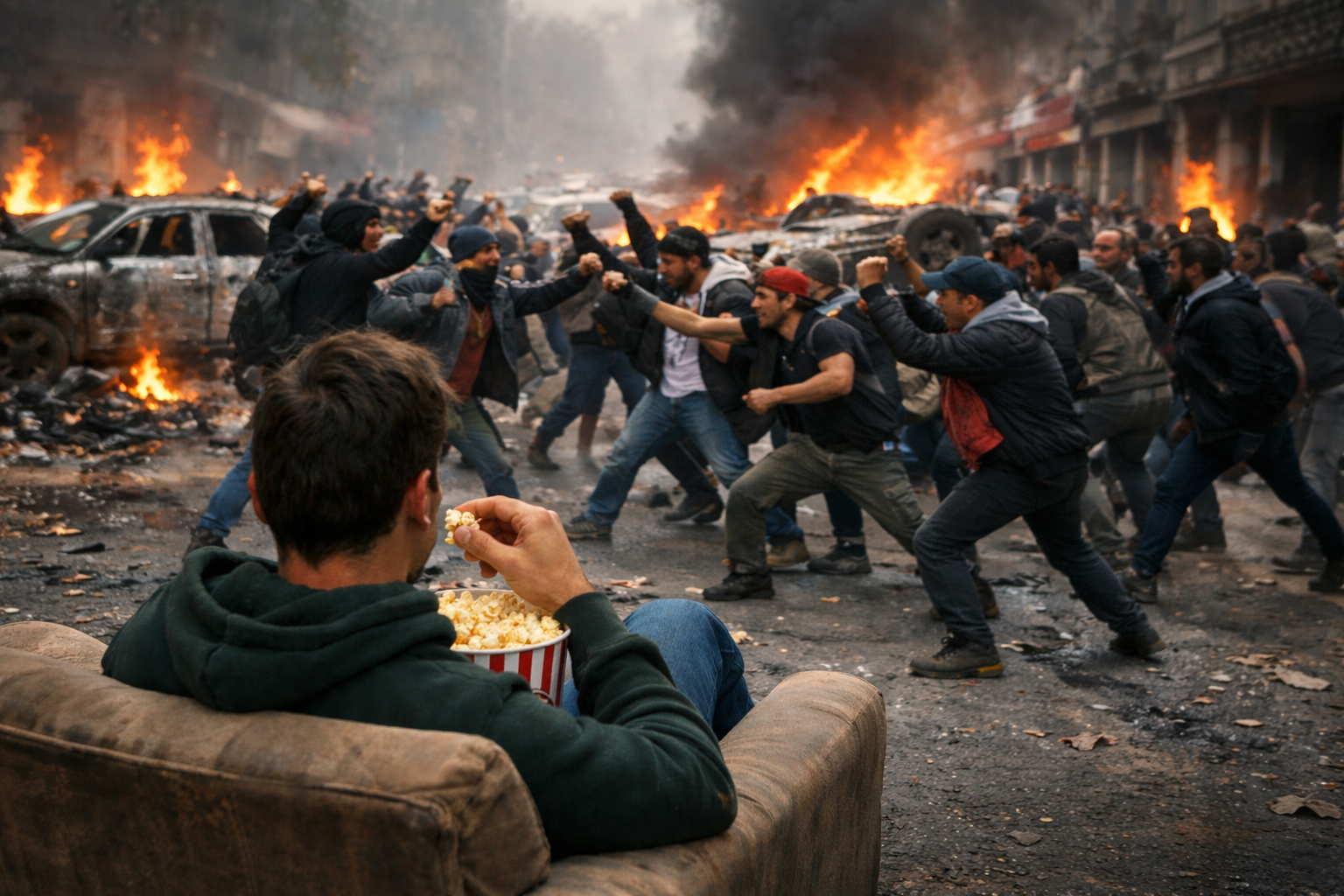


Americans are radicalized, not because they care too much about politics, but because they’re bored. In our culture, stripped of meaning, community, and restraint, politics has become a substitute for dealing with yourself.
Eric Hoffer, the longshoreman, autodidact, and moral philosopher, was deeply suspicious of the hunger for belonging. In his must-read book, The True Believer, he argues that mass movements — left, right, or religious — are fueled less by ideas than by boredom, bitterness, and the desire of frustrated and shallow individuals to fulfill themselves. “Freedom aggravates at least as much as it alleviates frustration,” he writes. “Freedom of choice places the whole blame of failure on the shoulders of the individual.” This is about as conservative a statement as one can make.
David Foster Wallace saw this coming, too. In his 1,100-page darkly comic 1996 novel, Infinite Jest, which centers on an avant-garde film known simply as “the Entertainment,” the film is so perfectly stimulating that anyone who watches it wants only to keep watching — until they die. A character describes witnessing a man so consumed by the film that he “couldn’t even stand to be in the same room… Begging for just even a few seconds — a trailer, a snatch of soundtrack, anything. His eyes wobbling around like some drug-addicted newborn.”
The novel’s central metaphor feels all too real, especially given how many Americans are consuming politics as an immersive distraction to ward off boredom and to feel emotionally attached to something—anything.
Sadly, politics is now a major form of entertainment in America, delivered as “content.”
Politics used to be a contest of ideas; it has become a battle for clicks. Persuasion and reason are viewed as quaint. Rhetorical restraint is a weakness. Logic is a losing message. Seriousness is mistaken for elitism. In politics, the goal is no longer to persuade, but to capture voters’ attention — and today could not be a better time for that, with a 24-second news cycle and a post-literate constituency hooked on “the Entertainment” — TikTok, Instagram, Facebook, YouTube Shorts, likes, shares, comments — fully personalized and interactive 24/7, all in the palm of your hand.
Politics lies in wait to fill the void — the perfect stand-in for transcendence.
The same diagnosis advances, from the external to the internal, in Martin Gurri’s 2024 essay “Mistaking Politics for Religion” in The Free Press. Gurri depicts a culture stripped of churches, civic associations, stable families, and durable sources of meaning. Politics lies in wait to fill the void — the perfect stand-in for transcendence. Citizens watch the implosion of their own expectations with a bucket of buttery popcorn. As Gurri writes, “Hungry for a loftier state of being, many somehow imagine they have found it in bashing the dull machinery of representational government. These seekers have mistaken Leviathan for God, the will to power for the state of grace.” Politics becomes a salvation drama, in its own way, “the Entertainment.”
Gurri’s warning now feels all too real in the behavior of the post-Cold War progressive left, as documented in Noah Rothman’s precise essay “A Clockwork Blue: How the Left Has Come to Excuse Away and Embrace Political Violence,” in Commentary. Rothman reveals the pathologies of “the Entertainment” addiction in the wake of the cold-blooded murder of UnitedHealthcare CEO Brian Thompson. The left and their confrères in the MSM carried water for the murderer: “I don’t condone violence…and yet…” Rothman cites the influence “the Entertainment” plays on left-wing social media and activist circles in the 2010s and 2020s — the WTO riots, Occupy Wall Street, and the Black Lives Matter movement. Journalists stood alongside rioters and rationalized violence. All of this is a symptom of a culture addicted to “the Entertainment” as it produces clicks, likes, shares — cash. Step right up! (RELATED: Luigi Mangione’s Cognitive Dissonance)
The right is not immune and has its own “Entertainment” addiction to contend with. Too many “conservatives” bathed happily in the boiling cauldron of grievance and conspiracism. The thrill of outrage delivers the same dopamine hit as the left’s virtue signaling. Different costumes, same stupid pageant.
Ben Shapiro recently delivered two major speeches — one at the Heritage Foundation and one at Turning Point USA’s (TPUSA) AmericaFest 2025 — both of which called out these political developments. “Victory — true victory — cannot be achieved without truth,” he argued. But the truth, unfortunately, is very boring and takes effort to arrive at. Victory without seriousness, without the allure of “the Entertainment,” will be the ultimate victory.
In Infinite Jest, ‘the Entertainment’ consumes its audience and paralyzes agency. In real life, excused political radicalism — aestheticized by elites — serves as a useful feel-good form of entertainment. But all it really does is unmoor the audience from personal responsibility.
“You can be shaped, or you can be broken,” Wallace writes. “There is not much in between.”
And here is where American conservatives can diverge from the novel’s logic. One can think independently, pay attention to the truth, and remember that American conservatism should always be unfashionable — and kind of boring.
READ MORE from Pete Connolly:
The Inevitable Result of Government’s Addiction to Spending Other People’s Money



















