


I
Anna Yaroslava, daughter of Yaroslav the Wise and granddaughter of Volodymyr the Great, passed her youth among the golden-domed cathedrals and gold-tipped terem-style towers of medieval Kyiv, but in 1050 she found herself betrothed to Henri I, the widowed king of distant France, who was twenty years her senior. Leaving her eastern homeland, she made her way from Kyiv to the cathedral city of Reims, from the glittering, mosaic-encrusted Byzantine Commonwealth to the still-barbarous West, in the company of two French bishops, a train of attendants, and chests brimming with her sumptuous dowry.
The wedding of Henri I and Anna of Kyiv took place in Reims on May 19, 1051. Les Grandes chroniques de France, a 14th-century illuminated manuscript now in the possession of the British Library, depicts the occasion. Anna, with her doe-eyes and contrapposto pose, and her crown perched uneasily atop a mass of curly blonde locks, looks somewhat nonplussed by it all, and numerous myths would grow up around her experience of culture shock. It was said that she was unimpressed with the paltry three courses served at her wedding feast and that she found Parisians to be “unwashed,” their houses “gloomy,” their churches “ugly,” and their customs “revolting.” Most of these juicy quotations seem to have been hallucinated by later historians like Maurice Druon, but it is true that Anna’s royal husband was basically illiterate, and his capital confined at that time to a small island surrounded by fetid swamps, while the Slavic princess, hailing from a cosmopolitan metropolis at the crossroads of East and West, had been classically educated in the Byzantine fashion, and was conversant in Greek, Latin, Old East Slavic, Old Church Slavonic, and French. It would be understandable if she felt at sea in her new home.
Still, the marriage proved to be a good match. Anna Kyivska provided France with gold, gemstones, and, in the words of the medievalist Jean Dunbabin, “a much-needed touch of the exotic to the homespun Capetian dynasty.” Henri I’s dynastic ties were extended across the entire length of Europe, and not just to the lands of the Kyivan Rus’, for Anna’s siblings had themselves been married into the royal families of Byzantium, Hungary, Poland, England, Norway, and the Hanseatic City of Stade. Evidently a capable ruler, Anna was named co-regent, participated in the royal council, and her Cyrillic signature on the charter for the Abbey of Saint-Crépin-le-Grand — АНА РЪИНА, or Ana Reina — represents the only surviving autograph of a Capetian queen or a member of the Kyivan Rus’ ruling family.
She outlived Henri I, served as regent on behalf of her son Philippe, and controversially re-married, only to outlive her second husband, Count Raoul IV of Valois. Her own passing occurred sometime between 1075, the date of her last decree, and 1079 when her son Philippe I made a donation on behalf of the souls of his parents. The final resting place of Anna Kyivska remains unknown. In the 17th century, a Jesuit priest and antiquarian by the name of Claude-François Menestrier claimed to have discovered her grave in an obscure abbey at Villiers-aux-Nonnains, but the inscription Hic jacet domina Agnes, uxor quondam Henrici regis [Here lies Lady Agnes, once the wife of King Henri] was almost certainly forged or subsequently altered. The 12th-century Historia Franciae, meanwhile, tells us that after her second bereavement the Queen Mother “returned to her native land,” which is possible but improbable.
While we may not know when or where she died, we do have ample evidence of her enduring legacy. Philippe Delorme, in his superb biographical study Anne de Kiev: Epouse de Henri I (2015), remarked upon Anna’s considerable genetic benefaction:
Anne of Kyiv — to give her the name consecrated by tradition — nevertheless constitutes one of the irreplaceable links in the long Capetian chain. But she is not just the ancestor of the only French dynasty! Her blood still flows today in the veins of almost all the princes of Europe, from Philip of Edinburgh to Philip I of Belgium, including Philip VI of Spain, all three of whom perpetuate the first name of their eldest son. Even looking beyond the Almanach de Gotha, she appears as one of our great grandmothers. More than six hundred thousand of her descendants, illustrious or anonymous, have already been recorded on the Capedia genealogical database. Among them — sticking to women — are Bernadette Chirac, Ségolène Royal, Brooke Shields and Céline Dion…
Her cultural afterlife is equally substantial. Anna has been the subject of novels (Antonin Ladinski’s 1961 Ярославна, королева Франции, or Yaroslavna, Queen of France), movies (Igor Fiodorovitch Maslennikov’s 1978 adaptation of Ladinski’s book), operas (Antin Rudnytsky’s Anna Yaroslavna, which premiered at Carnegie Hall in 1969 in honor of the Ukrainian National Association’s 75th anniversary), and plays (Valentyn Sokolovsky’s 2004 Ми будемо жити вічно, or We Will Live Forever). She has graced the Ukrainian two Hryvni coin, with her figure framed against the background of Saint Sophia’s Cathedral of Kyiv on the obverse, and against the background of the Abbey of Saint-Vincent, which she founded, on the reverse. At Senlis, on the grounds of the Abbey of Saint-Vincent, stands a bronze monument to the queen, designed by the influential Ukrainian sculptor Valentyn Znoba. Striding forward, her right hand outstretched, her long tresses flowing in the wind, she looks considerably more composed than she was on her wedding day.
Cultural politics being what they are in central and eastern Europe, Anna has also been the subject of acrimonious diplomatic rows, such as when Vladimir Putin referred to her as “Russian Anna” — a historically illiterate conflation of Russians and the Kyivan Rus’ — during a state visit to Paris in 2017. Then-Ukrainian president Petro Poroshenko accused his Russian counterpart of trying to “hijack” Anna’s Rus’ but distinctly non-Russian legacy “in plain view of all Europe,” while another Ukrainian official, Dmytro Shymkiv, informed his “dear French friends” that “the Russian president has tried to confuse you: Anna of Kyiv, the queen of France, was from Kyiv and not from Moscow,” and moreover “at that time, Moscow didn’t even exist.” President Emmanuel Macron did his best to smooth down raised Ukrainian hackles, putting out a statement that Anna’s reign proved that the Kyiv-Paris relationship was “anchored in the depths of the past millennium.”
II
As Russia’s war on Ukraine grinds on into its fourth year, the French Republic remains one of Kyiv’s most stalwart allies, evidence of a unique diplomatic relationship that indeed dates back nearly a thousand years. France has provided billions of euros in humanitarian aid, security assistance, export and trade finance guarantees, infrastructure support, war risk and export insurance, and various other loans, grants, and guarantees to Ukrainian public and private enterprises. All the while, billions of euros worth of military hardware, ranging from personal equipment and optical systems to armored vehicles and artillery, have been making their way from French arsenals to the Ukrainian front. The grandest French gesture of all, however, must be the formation and training of an entire Ukrainian mechanized infantry brigade in France and at French expense — the 155th Infantry Brigade, which was given the rather august title of the 155-та окрема механізована бригада імені Анни Київської, or the 155th Separate Mechanized Brigade named after Anna Kyivska, better known as the Anne de Kyiv Brigade.
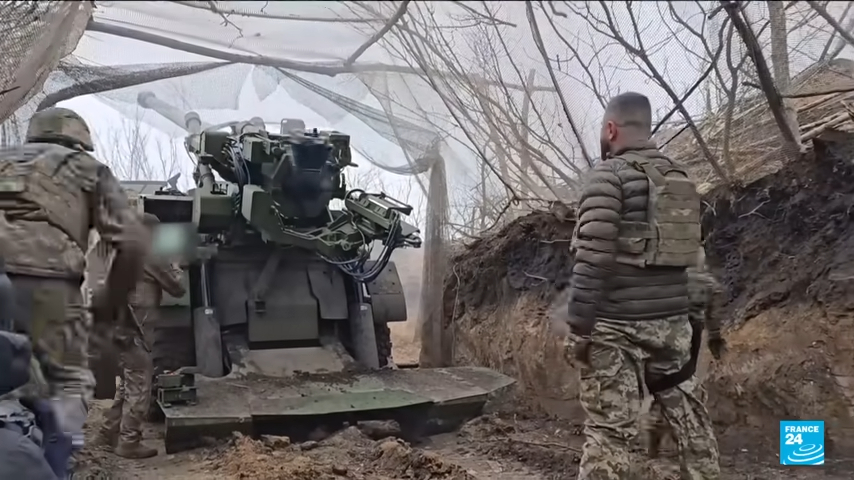
The first of 10 new infantry brigades created after the passage of a new Ukrainian mobilization law lowering the conscription age from 27 to 25, the 155th was officially announced at the 80th anniversary of the D-Day landings on June 6, 2024. Members of the Anne de Kyiv Brigade were trained at the Camp de Châlons military base in France’s eastern Marne department, located appropriately enough just southeast of the city and cathedral of Reims, where Anna Yaroslava was crowned queen of France. In October of 2024, Emmanuel Macron paid a visit to the camp, where he supervised Ukrainian soldiers learning to operate some of the best equipment the French military had to offer, including the estimable Caesar 155mm howitzer, the MILAN anti-tank missile, the Mistral man-portable air-defense system, the VAB (Véhicule de l’Avant Blindé) armored personnel carrier, and the AMX-10 Roues-Canon armored fighting vehicle. It was envisioned that the mechanized light infantry brigade, some 5,800 strong, would be paired with a powerful artillery division, giving it the ability to carry out a wide range of combined arms attacks against the invading Russian horde. Its motto was altogether suitable — Вони не пройдуть!, or They shall not pass!, a reference to the French WWI slogan Ils ne passeront pas — and its nickname further underscored the deep history of Franco-Ukrainian relations. The Anne de Kyiv Brigade, together with the nine other newly-formed brigades, figured to play a critical role in defensive and counter-offensive operations going forward.
In the coming months, a far more troubling picture of the brigade would come to light, one very different from the stirring videos produced after the French president’s Oct. 9 visit. It became clear that until September 2024 the brigade existed mainly on paper, yet the unit was returned to Ukraine as early as mid-November, where it joined its integral Leopard 2A4-based tank battalion, which had been training during that period in Poland. (The brigade’s headquarters would return from France at the end of November.) During the wars in Afghanistan and Iraq, it was found that the 90-day-long mobilization training given to National Guard units was often insufficient to prepare them for combat roles. If three months of supplementary training were inadequate for the National Guard, then the even more truncated time afforded to the conscripts of the 155th Brigade left even more to be desired.
Aside from the fact that the much-lauded training at the Camp de Châlons had been suspiciously brief, it turned out that, according to the Ukrainian journalist Yuriy Butusov of Censor.net, only 1,924 troops were actually provided instruction there, far fewer than the 5,800 the unit had on paper, with only 51 of them having performed military service for more than a year, not much of a backbone for a formation composed mainly of recent conscripts. One of the Ukrainian recruits, currently imprisoned for desertion it should be added, would later inform Radio Svoboda that the conditions at the French base were prison-like: “The territory where we lived was completely fenced off. The French walked around with dogs. Drones were launched over the area at night. The fence was barbed wire.” Despite French efforts to patrol the camp’s perimeter, several dozen of the Ukrainian trainees, it has been revealed, went AWOL while in France, though the French military insisted that these numbers were “extremely insignificant, given the number of people who have been trained.” Yet the real problems for the 155th came when the unit was precipitously dispatched to the eastern front.
III
The Anne de Kyiv brigade was sent into the fray immediately upon arriving in theater when it was deployed to Shevchenko, a rural settlement just south of the beleaguered city of Pokrovsk in Donetsk Oblast. Baptism by fire is never easy, but the experience of the 155th could be likened to a veritable bloodbath. Casualties quickly mounted. So did desertions. The brigade’s Leopard tanks and VAB personnel carrier were put out of action by Russian drones, and the French AMX-10 armored fighting vehicles proved difficult to service in the field. Most shockingly of all, Yuriy Butusov reported, “a brigade fully equipped with infantry, artillery, and armored vehicles lacked drones — the primary tools for reconnaissance and control in modern warfare — making it effectively limited in its ability to conduct combat operations.” Somewhere between 50 percent and 80 percent of Russian casualties are inflicted by Ukrainian drones, meaning that the Anne de Kyiv Brigade never had any chance of functioning as an effective unit, and a concomitant “complete lack of electronic warfare systems” to combat Russian drones only made matters worse.
The Ukrainian People’s Deputy Maryana Bezugla has alleged that the Anne de Kyiv Brigade was, in fact, a “zombie” or “paper” brigade ultimately meant to be dismembered and parceled out to other units facing manpower shortages: “They are endlessly created just for reporting purposes: people are herded there, but the management structures are not coordinated. And then the unit is simply torn to pieces, seconded to others, mostly to serve as stormtroopers.” Bezugla additionally provided testimony from one of the members of the brigade, who gave a troubling update on his brigade:
The bottom line is that this new brigade was essentially not needed by anyone from the very beginning (although people were urgently driven from all over Ukraine in order to man it). It was equipped by the French, who made a show of providing weapons for it. But now, upon returning to Ukraine, this brigade is being disassembled, like donor organs for other brigades.
It was initially reported that the remnants of the brigade were to be disbanded in the early days of 2025, with its former members sent to more experienced units like the 25th Separate Airborne Brigade “Sicheslav” and the 68th Jaeger Brigade “Oleksa Dovbush.” Yet on Jan. 23, 2025, Oleksandr Syrskyi, the commander-in-chief of the Armed Forces of Ukraine, described how “particular attention was being paid to the 155th Separate Mechanized Brigade,” and that “it is worth noting that the brigade is gradually acquiring certain combat capabilities. All negative aspects and difficulties that arose during its deployment in Ukraine have been analyzed, conclusions have been drawn that will be taken into account during the further training of military personnel.” In recent days, footage of drone strikes against Russian forces on the Pokrovsk front, carried out by the 155th, have emerged, a sign that a redemption arc may still await the ill-fated unit.
IV
The Anne de Kyiv Brigade has become the subject of official inquiries by the State Bureau of Investigation, the office of the Commander of the Land Forces of the Armed Forces of Ukraine, and even the office of the President of Ukraine. Yuriy Butusov, whose unflinching coverage of the brigade’s trials and tribulations had an ultimately salutary effect, has divulged that President Zelensky “received reports on the situation in the 155th brigade and ordered the suspension of the creation of new brigades, directing reinforcements to already experienced and combat-ready units.” Those in the increasingly depleted formations manning the trenches and fortresses on the Ukrainian frontlines doubtless welcomed the news, but whether this truly constitutes a change in policy is unclear, since the members of the Anne de Kyiv Brigade, and the nine other alleged “paper” brigades, were evidently already being shared out to infantry-starved frontline units. Renewed conscription efforts were supposed to produce well-trained, well-armed reserves that could spearhead future counteroffensives, but now those forces will be parceled out to pre-existing brigades all along the 3,000-kilometer-long line of contact with Russian forces. It may be “sheer idiocy to create new brigades and equip them with new technology while existing ones are undermanned,” as Lt. Col. Bohdan Krotevych, of Ukraine’s hard-fighting 12th National Guard “Azov” Brigade, has understandably attested, but at the same time an inability to produce functional reserve units will condemn Ukraine to a permanent defensive posture.
Ukrainian leadership has been careful not to blame their French counterparts for the shortcomings of the Anne de Kyiv Brigade, but the situation nevertheless implicates not just the Ukrainian, but also the French military. To equip a mechanized brigade so lavishly, and to provide the best training the French military has to offer, but send it off to war against Russia undermanned and without first-person view drones or electromagnetic energy weapons to fend off Russian drones, is profoundly irresponsible. Ten days after the brigade began fighting on the Pokrovsk front, it finally received 17 million hryvnias (roughly $400,000) from the Ukrainian Ministry of Defense to procure the drones with which it should have been equipped and trained to use back in October. This oversight on the part of the French army leads one to wonder whether Western militaries have fully grappled with the vast, transformative, and often disturbing ramifications of drone warfare, particularly with respect to exceedingly vulnerable infantry units.
Serhii Filimonov, an officer in the 108th Separate Mechanized Battalion “Da Vinci Wolves” named after Dmytro Kotsiubailo, has warned that Western training is proving wholly inadequate in preparing conscripts for life in the trenches:
In Europe, soldiers may learn basic skills like shooting rifles and throwing grenades, but this accounts for only 10-15 percent of what is needed to survive. To endure on the battlefield, an infantryman must know how to camouflage, maneuver, set up positions, counter drones, provide medical aid, conduct surveillance, report accurately, and coordinate with comrades. Trust in leadership, which ensures comprehensive planning and support, is paramount. Unfortunately, such vital training is often neglected abroad and exists in Ukraine only within seasoned units …. When a soldier joins a unit equipped with adequate resources and confident leadership, he will do everything to stay. Conversely, soldiers sent to positions immediately after European training or basic military training in Ukraine, without further preparation, often face fatal outcomes or abandon their posts.
Western training methods and military doctrines, blithely predicated on total technological and air superiority, are generally inapplicable in the Ukrainian theater, leading Filimonov to conclude that “foreign training, unless adapted to Ukrainian conditions and integrated with unit practices, is not only ineffective but dangerous.” Given the possibility that the United States and other NATO member states will find themselves in a peer or near-peer conflict featuring ubiquitous drone warfare at some point in the future, then the fate of the 155th Brigade should represent an important object lesson not just for the Ukrainian government, but the rest of the free world.
V
The Savoyard diplomat philosopher Joseph Marie, comte de Maistre, in his 1821 Les Soirées de Saint-Pétersbourg, ou Entretiens sur le Gouvernement Temporel de la Providence, often translated as the St Petersburg Dialogues, discussed the fog of war, and the role of morale in armed conflicts:
Opinion is so powerful in war that it can change the nature of the same event, and give it two different names, for no other reason than its mere pleasure. A general throws himself between two enemy bodies, and he writes to his court: I cut them off from each other, they are lost. His opponent writes to his own court: They have put themselves between two fires, they are lost. Which of the two was mistaken? The one who will let himself be seized by the cold goddess [celui qui se laissera saisir par la froide déesse]. Assuming all the circumstances, and that of numbers especially, to be equal on both sides, at least in an approximate manner, show me a difference between the two positions which is not purely moral … It is the imagination that loses battles.
The Russo-Ukrainian War has, since it began nearly three years ago, been enshrouded in the fog of war. Depending on one’s point of view, either participant can at almost any particular moment be considered, like de Maistre’s hypothetical combatants, to be either cut off or placed between two fires. Is the training of the Anne de Kyiv Brigade a flagship program meant to turn the tide of the war, or a cynical propaganda exercise to create a paper/zombie brigade and some good publicity? Ukraine has been ceding ground in the east, but shouldn’t the loss of 3,600 square meters of territory in 2024, roughly the size of the Belgian province of Liège, be weighed against the hundreds of thousands of Russian casualties incurred in seizing those land-mined fields, hut-clusters, and obliterated towns and minor cities? The Ukrainians have prevented Putin from achieving his maximalist goals (regime change, the capture of Kyiv, Kharkiv, and other oblast capitals, the destruction of the Ukrainian military), have castrated Russia’s vaunted Black Sea fleet, and still have less than 100 kilometers between their lines and the Sea of Azov, a more than respectable showing all told, but the incubus of conscription continues to squat menacingly over the Ukrainian body politic, and the already uncertain demographic future of Ukraine would be imperiled by the conscription of 18-25-year-olds. Ukrainians are (quite condescendingly) told by National Security Adviser Mike Waltz that they must conscript hundreds of thousands more young men from the 18-25 demographic, since, “look, if the Ukrainians have asked the entire world to be all in for democracy, we need them to be all in for democracy.” But in the fog of war, it is difficult to see whether the risk to Ukrainian social cohesion, future demographics, and the wartime economy would outweigh the benefit on the battlefield, especially since Western military aid is flowing too slowly to equip even those already conscripted, let alone hundreds of thousands more. (The Biden regime’s reprehensible slow-walking of meaningful military aid, in the interests of “escalation management,” is something that should never be forgiven or forgotten in pro-Ukrainian circles.)
The Russian economy, meanwhile, appears resilient in the face of the economic sanctions leveled at the global pariah, but labor shortages, inflation, a weakening ruble, and unprecedented military spending all pose existential risks to the Russian financial system. The Kremlin’s war efforts are only made possible by a secret financing system in which Russian banks are forced to give hundreds of billions of dollars worth of loans to military contractors, on a scale thought to be equivalent to the entire official budget, and exceeding the state’s considerable petroleum and natural gas revenue stream. The fog of war prevents us from knowing how long this scheme can persist. Russia’s war machine remains formidable, but its armored reserves have been seriously depleted, and an increasing reliance on North Korean cannon fodder for its trademark “meat wave” assaults certainly bodes ill.
When two opponents find themselves on equal scales, de Maistre argued, morale is everything. Fatal is the grip of what he dubbed la froide déesse, the cold goddess. The ancient Greeks did not conceive of this phenomenon as a goddess but rather as a god or a daemon: Phobos (Φοβος), the personification of panic, rout, and fear, depicted by Hesiod as “staring backwards with eyes that glowed with fire,” his mouth “full of teeth in a white row, fearful and daunting.” The Romans called him Pavor, the faithful companion of Mars and ashen-faced Pallor, and they sacrificed to him during plagues and before battles. Call it what you will, Phobos or Pavor or the cold goddess of fear, but the Comte de Maistre’s point is undeniable. It is often morale, a function of the collective imagination, that wins and loses battles and wars.
Hence the role of symbolic politics and propaganda during wartime. We have seen how, since the Russian invasion of Ukraine in 2014, the government in Kyiv has emphasized the legacy of Anna Yaroslava Kyivska, Queen of France. Her coin was issued by the National Bank of Ukraine in 2014, and three years later she was the subject of an angry diplomatic exchange with the Kremlin. In 2005, just after the Orange Revolution, a monument to Anna was unveiled at Senlis, and in 2016 another monument was installed on Kyiv’s Lvivska Square, a short walk from the French embassy. And, last year, her story again came to the forefront of Franco-Ukrainian relations, as the wonderfully named Anne de Kyiv Brigade was conceived as a flagship project that would demonstrate the value of Western training and equipment in Ukraine’s war of national survival. Yet the French-trained brigade, the subject of so many tremendous photo-ops, became a victim of the cold goddess, and in the words of Mykhailo Drapatyi, commander of Ukraine’s Ground Forces, came to serve as a “negative lesson, a negative experience,” though he insisted that it must still be “converted into some kind of preventative action,” and there still remains every chance of that coming to pass.
Beautiful illustrations in illuminated manuscripts like Les Grandes chroniques de France are one thing, but the “purple testament of bleeding war” is a different matter altogether. Anna of Kyiv has long represented the Ukrainian dream of Western integration; the brigade named in her honor, unfortunately, now represents the messy reality of that process. The initial reverses suffered by the 155th Separate Mechanized Brigade, the result of poor French and Ukrainian decision-making and the inescapable challenges of modern warfare, resulted in a stark lesson, one that could not have come at a worse time for the hard-pressed Ukrainian state. The Ukrainian people have fought too well and for too long to be sacrificed on the altar of de Maistre’s “cold goddess,” and it is for this reason that the object lesson of the Anne de Kyiv Brigade must be acknowledged and confronted by Kyiv if the dream embodied by Anna Kyivska’s glorious life and afterlife is to be fully realized.
The same lesson must also be learned in the halls of power in Paris, Washington, D.C., and elsewhere in the democratic world. It was the poet Wendell Berry who, in 1969, remarked that “wars invariably serve as classrooms and laboratories where men and techniques and states of mind are prepared for the next war.” This was meant as a criticism of the Vietnam War, but a broader truth was contained therein. The Russo-Ukrainian War is many things — a crime, a tragedy, a heroic struggle for national survival against a grotesque Eurasian empire — but it is also a laboratory for the coming wars of the twenty-first century, in which crucial lessons and warnings abound.
READ MORE from Matthew Omolesky:
Bauhaus and the Cult of Ugliness





















.jpg)