
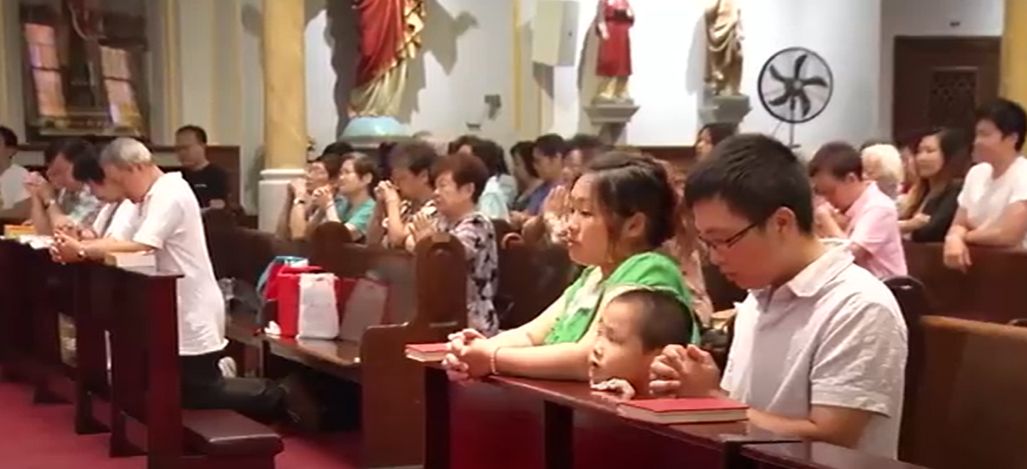


U.S. Catholic bishops are once again opposing President Donald Trump’s immigration agenda, but they may want to examine Catholic teaching on immigration and national sovereignty first. The U.S. Conference of Catholic Bishops (USCCB) recently published a document lamenting many of the President’s latest actions to restrict immigration into the U.S., criticizing his suspension of “refugee resettlement” programs, the restoration of the “Remain in Mexico” policy, the revocation of “humanitarian parole” programs, and mass deportations, including the President’s controversial use of the Alien Enemies Act.
While the Catholic Church has emerged in recent years as one of the most prominent voices urging that immigrants be treated with respect and dignity, it is crucial to remember that the Church has far more vocally demanded respect for just laws, the preservation of the nation’s well-being, and the importance of a nation’s social order, provided that it facilitates or fosters virtue. In other words, the Catholic Church has always encouraged and endorsed a balanced and reasonable approach to the issue of immigration, not a civilizationally suicidal open borders mandate.
[T]he Catholic Church has always stood firmly against this warping, perverting, and inverting of justice.
In the early fifth century, Doctor of the Church St. Augustine of Hippo addressed the state’s role in maintaining order in his treatise The City of God. “The peace of the earthly city is a temporal peace… It is the business of the state to ensure this peace by just laws and measures, even if such measures involve restrictions on certain freedoms,” he wrote. While the USCCB complains that “legal pathways” to permanent residency or U.S. citizenship are being restricted, Augustine actually suggested that immigrants should not be eligible for citizenship until they have proven, over the course of several generations, that they have assimilated and can and do contribute meaningfully to society.
Another Doctor of the Church, St. Thomas Aquinas, pointed in the Summa Theologiae to Sacred Scripture’s instruction on the issue of immigration. In the Old Testament, he observed, the Hebrews were told to treat foreigners differently based on their national origin and relationship to the Hebrews. “Foreigners who wished to settle among the Jews were permitted to do so, but they were not immediately admitted to the full rights of citizenship,” Aquinas wrote. He noted that some foreigners, such as the Ammonites or Moabites, were either prohibited from citizenship or even immigration at all. “For the common good, it was deemed necessary to make some distinction between those nations that were friendly and those that were hostile.”
In his 1891 encyclical expounding on Catholic social teaching Rerum Novarum, which has garnered much attention of late, Pope Leo XIII wrote bluntly, “The State has the right and duty to protect its citizens and to regulate the conditions under which foreigners may enter, so as to ensure the welfare of its own people and the stability of the social order.” Decades later, Pope Pius XII would write in Exsul Familia that the “sovereignty of the State … must be respected,” and that efforts ought to be made to protect and shelter refugees who are in actual need, “provided of course that the public good, considered in its totality, permits this.”
Today, it does not. U.S. immigration law is largely just, but has often been abused, especially in recent years, culminating in an existential crisis for the nation. Crime is rampant, American families are jeopardized, the American taxpayer is being deprived of hard-earned wages in order to fund the comfort and leisure of noncitizens, American workers are denied jobs that eventually go to foreigners — either legal or illegal — and the demographic makeup and stability of the nation is thrust into chaos.
This is a result of just laws being ignored, often in the name of some misguided concept of compassion. Despite his self-proclaimed Catholicism, then-president Joe Biden enabled his administration to wantonly, categorically expand “humanitarian” immigration programs intended to benefit those who are actually in need to include millions of third-world denizens who are in no real danger, or at least not the sort of danger that would be considered a humanitarian crisis.
Economic difficulty, gang violence, and even “climate change” all became valid reasons to import refugees, with little to no vetting, into the U.S. and dump them in small towns across the country, not only disrupting but demolishing the social order which had been carefully cultivated and tended to over generations.
Recent popes have recognized this reality. In 1996, Pope St. John Paul II acknowledged that refugees fleeing humanitarian crises such as genocide must be afforded compassion, dignity, and respect, but stipulated, “The Church recognizes that every state has the right to control its borders and to regulate immigration in the interest of the common good.” Even the late Pope Francis, who was often at odds with President Trump on the subject of mass deportations, admitted, “Every country has the right to regulate its borders, but this must be done with justice, solidarity, and respect for the dignity of all persons.”
Catholic teaching demands that all people be treated with dignity and respect, but it does not demand that all be given homes in the U.S. The insidious effort to make borders so broad as to cease to have any meaning, or the definition of an American so vast and nebulous that being an American no longer means anything, coincides with an effort to redefine dignity, respect, charity, and need.
Treating immigrants with dignity and respect, according to the diabolical new standards of the unbounded, means allowing them to violate national laws and destroy societies with impunity. Where charity once meant seeking and trying to achieve the ultimate good of another’s soul, it now means valuing the temporal comfort of complete strangers over even the safety of one’s own countrymen and family. It was once understood that true humanitarian crises consisted of genocide, religious persecution, or the brutalization of war. Need is now understood as mere appetite, wanting a job, wanting an iPhone, not liking your neighborhood.
No matter what progressives in the USCCB may say, the Catholic Church has always stood firmly against this warping, perverting, and inverting of justice, truth, charity, dignity, and respect.
READ MORE from S.A. McCarthy:



















