
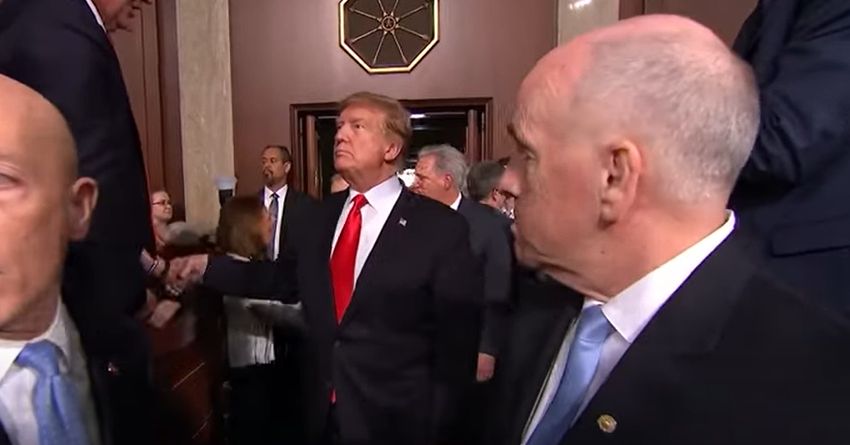


Just last week, President Trump fired a large number of inspectors general. He had done much the same thing in 2020, seeing them as a major source of the swamp fever that plagued his rookie administration.
Taft weighed in on the Tenure of Office Act as well, ruling it unconstitutional, even though it had been long gone.
In his reincarnated presidency and no longer a rookie, Trump has hit the ground running. He hasn’t waited years before addressing entrenched forces within his administration which he believes are ready to hobble him and slow his agenda any way they can. Trump can hardly be blamed for wanting to avoid a term in which far too much of his energy was drained to deal with endless investigations that resulted in not much more than draining his time and energy.
Senator Chuck Grassley, Chairman of the Senate Judiciary Committee, last week took a stand against the way the IGs were fired. Together with the ranking minority member, he wrote to the president to object, stating that there is statute law governing how IGs can be fired. They wrote:
The law must be followed. The communication to Congress must contain more than just broad and vague statements; rather, it must include sufficient facts and details to assure Congress and the public that the termination is due to real concerns about the Inspector General’s ability to carry out their mission.
This is a matter of public and congressional accountability and ensuring the public’s confidence in the Inspector General community, a sentiment shared more broadly by other Members of Congress.
Grassley supported Trump strongly in this election. He has been a stalwart throughout the Biden years, doing his best to thwart the woke madness. But as a senior senator, he stands firm for the privileges of the Senate and the Legislative Branch and is willing to form a bi-partisan coalition to protect those privileges.
Tensions between the three branches of the federal government are a design feature of our Constitution. The original government of independent America, set up under the Articles of Confederation, had only Congress and no administrative branch. It set up departments to take care of things like foreign affairs and these departments were answerable only to the Congress and served at its pleasure.
The flawed Articles gave way to the Constitution, which took administrative power away from the legislature and gave it to the executive. Article Two begins by vesting the executive power in the president and gives no qualification to that power except that for some offices, his appointments require the advice and consent of the Senate.
When the First Congress set about establishing the departments of the executive branch, its members saw that even though the Constitution clearly gives the president appointment powers, it says nothing about his power to get rid of officers. Congress had to make sense out of this omission as it debated the issues surrounding the form of this new executive branch. The results of their debate and deliberation is called by historians the Decision of 1789. What that decision was has been interpreted in following generations by the courts.
The president’s power to fire was the target of the Tenure of Office Act of 1867. Congress and President Andrew Johnson were at loggerheads. Congress was controlled by Republicans intent on forcing the defeated Confederacy to accept not only the outlawing of slavery but also strong civil rights legislation.
Johnson was a Democrat from Tennessee who Lincoln put on his 1864 ticket to appeal to those who supported the Union but were not enthused about expanded civil rights. Many were sure that were Lincoln to lose, his opponent, George McClellan, would have made peace with the Confederacy. Above all, Lincoln wanted to preserve the Union, and Johnson was an important part of branding his re-election effort as that of the National Union Party.
With the war won but the nation deprived of Lincoln’s superb political skills by an assassin’s bullet, Congress and the new president began a struggle to the death. Johnson was deeply opposed to the policies of some of Lincoln’s Cabinet appointees. Johnson wanted those men gone. Congress tried to forestall this by passing the Tenure of Office Act, which declared that presidential appointees, even in the Executive Branch, should continue to serve in their office until a successor be appointed with the Senate’s advice and consent.
What that meant was that if the Senate refused to consent to a new appointment, the old appointee would continue to serve until the end of the president’s term. Johnson saw the limit it would put on his power, believed it unconstitutional, and vetoed the bill. The House and Senate overrode that veto, passing the law. Johnson then fired the Secretary of War, and then the House impeached Johnson, seeing that breach of the Tenure Act as a high crime or misdemeanor. Johnson was acquitted in the Senate by a single vote.
Though the struggle with Johnson was very much Republicans against Democrats, the Tenure of Office Act was also objected to by Republicans Ulysses Grant and James Garfield for the limits it imposed on their power. The issue was resolved during the presidency of the first Democrat to be elected to that office after the Civil War, Grover Cleveland. He successfully pushed for a repeal of the law, and it was taken off the books in 1887.
To this point, the issue of the president’s power to fire had not been settled by a court decision. The Decision of 1789 was made by Congress; the Tenure of Office Act was made by Congress; a President in turn asserted what he felt his powers were under the Constitution on his own; and Congress in 1887 decided to negate its own assertion.
The Supreme Court finally had its say in 1926 in the Myers case. The majority decision was written by the only man to serve as both Chief Magistrate and Chief Justice of the United States, William Howard Taft. Such service gave him a unique perspective. His decision was based largely on his understanding of the Decision of 1789, which he read, along with Alexander Hamilton and John Marshall, as agreeing that the Constitution gave the President full removal authority. He quoted at length the argument of James Madison, then a congressman, in the 1789 debate:
Vest this [firing] power in the Senate jointly with the President, and you abolish at once that great principle of unity and responsibility in the Executive department which was intended for the security of liberty and the public good. If the President should possess alone the power of removal from office, those who are employed in the execution of the law will be in their proper situation, and the chain of dependence be preserved, the lowest officers, the middle grade, and the highest, will depend, as they ought, on the President, and the President on the community.
Taft weighed in on the Tenure of Office Act as well, ruling it unconstitutional, even though it had been long gone. With this, he sought to bring all three branches of government to agree that the President’s power to dismiss executive branch officers is virtually unlimited.
This recognizes something that is sometimes forgotten due to the genius of John Marshall, who so established the power of the Supreme Court in Marbury that we tend to think that the only branch that has a say in what the Constitution means is the Judiciary. Taft helped show that what the Congress had to say about how the Constitution in 1789 established ruling precedent. In his article on the Decision of !789, Saikrishna Prakash reminds us that presidents have weighed in on constitutional issues. The example of Lincoln in overruling the Supreme Court and asserting that the constitutional power to suspend habeas corpus was his is the most powerful of the examples he lists.
Taft’s ruling was contested by strong voices, both in his court (Brandeis and Holmes wrote dissenting opinions that proved influential) and beyond. A later SCOTUS decision, Humphrey’s Executor, seemed to walk back Taft’s decision, but the 2020 Seila Law decision strongly affirmed the President’s ability to fire someone even when Congress had passed a law severely limiting his ability to do so in this case.
So what stands now is something extraordinary: the Supreme Court acknowledges an Executive power based on a decision made by Congress to affirm the power of the Executive Branch against its own.
What a precedent this is! What makes our nation work is a devotion to an authority that transcends the power base of any one person or branch. It is a kind of musical sensibility to the harmony of the whole. Like music, it does not silence the voice of any instrument or singer, but it does require of every musician a dedication of their own genius to the genius of the whole ensemble.
So today, we can see Trump’s assertion of his power and Senator Grassley’s counterpoint as two musical themes, which will at times be dissonant but will ultimately resolve harmoniously. Amidst all the chaos of the past decade, engendered largely by contemptuous dismissal of the Constitution in favor of woke ideology, this is refreshing. Instead of envisioning an America in which dissent must be dismissed, throttled, or even criminalized, we return from Jacobinism to something more humane, broader in conception, and truly inclusive in vision.
This is the reappearance of a harmonious spirit capable of reviving a lively national consensus in which our differences challenge each other to rise higher, as we united our varied gifts in service of a united commonwealth.
A resurrection of constitutionalism — and not a moment too soon!
READ MORE from Shmuel Klatzkin:
With Trump’s Return, the Mullah’s Nazi Dreams Are Dead
Rights, Responsibility, and the LA Wildfires



















