
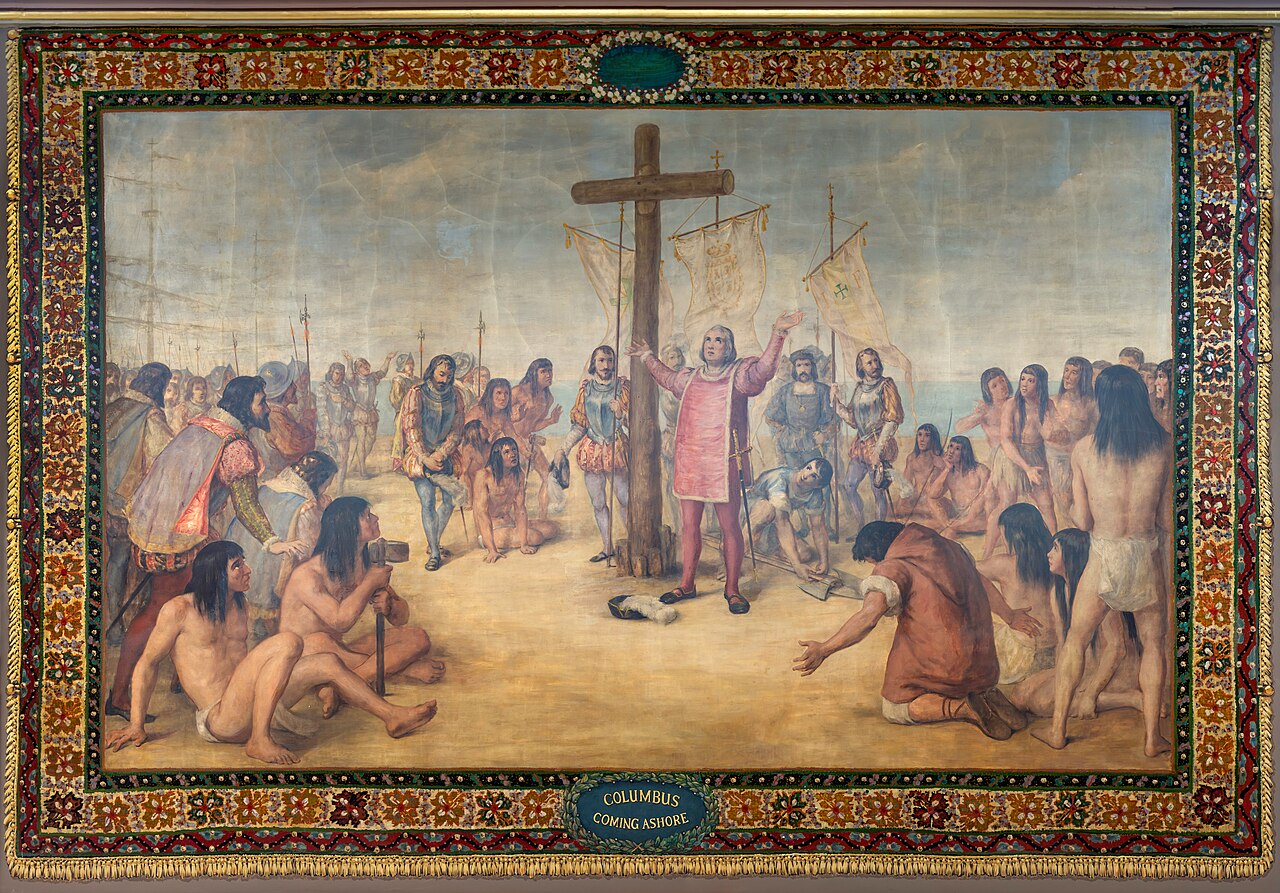


University of Notre Dame alumni and faculty members are calling on the school’s new president and other recently installed leaders to uncover paintings of Christopher Columbus in the center-hall foyer, under the famed Golden Dome.
Under a previous administration, 12 murals depicting the Catholic explorer and his voyages to the Americas were covered up in 2019. In a letter explaining the decision, Rev. John Jenkins, then the university’s president, said he was responding to critics who found the murals offensive and demeaning toward Native Americans.
But alumni familiar with the controversy see “a narrow, small sect of woke ideologues” at work who do not speak for the school’s broader community. Current faculty members who were present when the murals were covered see an opportunity for the school’s new president, Rev. Robert A. Dowd, to reverse course.
Correcting the Record
The murals, located in Notre Dame’s main administration building, are at the heart of the university’s campus with its Golden Dome.
Commissioned by Notre Dame’s founder, Rev. Edward Sorin, the three-year project was completed from 1882 to 1884 by Italian artist Luigi Gregori. Gregori was a resident artist at the Vatican and later became a professor and resident artist at Notre Dame.
Felipe Fernandez-Armesto, a Notre Dame history professor, says a dispassionate and informed view of the murals makes it clear that the native people are, in fact, portrayed in a very positive light:
Natives are depicted in the three paintings in which they appear: first, as models of innocence and goodness; then as grand, noble envoys from the New World to the Old, bestowing gifts that — in a material sense — the Europeans can’t match, and dominating the court of the King and Queen of Spain; finally, as exemplars of moral superiority, pitying and comforting Columbus on his downfall, while my fellow Spaniards skulk shamefully. The positive depiction of Natives, including the Potawatomi representative who makes a “guest appearance” in one mural, along with Gregori’s self-portrait, was crucial to the painter’s and patron’s plan of advocating for America as a better place than Europe, a New World where Catholicism could do more good.
Even if the murals needed to be covered for their own protection, this would need to be done in a way that does not damage them, Fernandez-Armesto explained. The coverings should be “cheap and easy to uncover,” he said, for research, teaching, and maintenance purposes.
Fernandez-Armesto also emphasized the importance of preserving “the whole of each mural,” including the borders and the cartouches, which can contain important information.
“The present method fails on all counts,” he said. “It has damaged the paint areas; it permanently obscures parts of the works because not all parts of the coverings are removable; and it’s laborious and costly to remove and replace.”
But the upshot here, the professor suggested, is that the murals may no longer need to be covered at all.
“The misunderstandings that made some people hostile to them in the heat of past controversies are surely remediable,” Fernandez-Armesto said. “I’d like everyone to see how important the murals are for understanding — inter alia — the histories of Notre Dame and of U.S. Catholicism. Above all, I’d like everyone to see how Gregori and Father Sorin wanted to use the walls of Main Building to celebrate the grandeur and moral greatness of Native Americans.”
Alumni Decry Leftward Shift
In interviews, several alumni expressed their displeasure with the murals’ concealment.
Werner Graf, a 1986 graduate with a degree in accounting and a secondary teaching degree from St. Mary’s, attributed the decision to “a woke sect of Domers in positions of power who have had no reservations about injecting their liberal politics into school operations.”
“It aggravates a good many alumni when they read that ‘Notre Dame’ covered up our beautiful murals or ‘Notre Dame’ has repeatedly honored pro-abortion politicians or ‘Notre Dame’ changed the fight song,” Graf said in an email. “It’s actually not ‘Notre Dame’ but rather a woke sect of domers in positions of power who have had no reservations about injecting their liberal politics into school operations. This lack of humility, unfortunately, tarnishes the entire community and actually alienates a large portion of the Notre Dame family.”
Graf, a former IBM and Procter and Gamble executive and current CEO of Graf Dairy, recalled how Jenkins assembled a committee to discuss how criticism of the mural might be handled.
“By all accounts, this committee was charged with how to assuage the administration’s liberal insecurities, not debate whether this idiocy should be undertaken at all,” Graf said.
He noted that the committee initially decided to display high-resolution images of the murals in a nearby room to allow visitors a chance to admire them. “As inadequate as it was, even this never happened.”
Graf said he would like his alma mater to uncover the artwork and reassert its Catholic heritage. The murals’ core purpose, he said, is to depict “the introduction of Jesus to the New World.” He argued that concealing them “not only deprives current Domers, but also condemns Sorin and all preceding leaders who admired and revered the art.”
There is also the matter of Italian pride. David Bregande, a 1995 design graduate, remembers “what a big deal” Columbus Day was growing up in Fredonia, New York, not far from Buffalo.
“There was terrible prejudice against Italian immigrants at one time, and having Columbus Day as a national holiday was recognition of this horrible mistreatment,” Bregande said. In the eyes of Italian Americans around the country, “Columbus became an important symbol for us.”
Bregande also finds it disturbing that the university is depriving its own community of art and history that, as an educational institution, it should highlight and promote.
“As a visual artist, I will say it’s a beautiful piece of work with some profound historical ties,” he said. “The decision to cover the art was made because Notre Dame didn’t want to offend someone, but someone will always be offended. They seem to forget that the university also has ties to American Catholics and Italian Catholics who have experienced their own persecution.”
Columbus, Bregande added, was “a man of his time” and was not unique in his way of thinking. “But he was a huge catalyst for spreading Western civilization into this hemisphere, and that has been very good for all of us.”
Peter Dumon, a 1990 graduate and real estate investor based in Chicago, said he fears Notre Dame has put itself on a highly compromising path by capitulating to the demands of what he calls “a small vocal minority.”
“What if we had a group of atheists on campus who were offended by the basilica?” he asked. “Are we going to tear it down?”
Changing Course
Rev. Bill Miscamble, another Notre Dame history professor, agrees that the antagonism toward Columbus appears to be part of a broader shift toward political correctness across college campuses. “The murals were an effort to celebrate the bringing of the Gospels to the new world, “Miscamble said in an interview. “It’s quite extraordinary that at Notre Dame, a place where we celebrate the presence of the Gospels in the new world, these murals have been covered over.”
He expressed concern that a “highly skewed view of Columbus” has taken hold that “ignores the complexities of history.”
Still, Miscamble remains hopeful that Notre Dame’s new leaders will revisit the previous administration’s decision.
“I hope and pray this new administration will remove the coverings and accept the fact that these murals are an essential part of Notre Dame’s history, and that they celebrate the very events that brought about Notre Dame’s existence,” he said.
Notre Dame did not respond to our inquiries about the murals’ status.
The school’s new president, Dowd, was elected in December 2023 and assumed office on July 1, 2024. Other new administrative appointments include John T. McGreevy, who became the Charles and Jill Fisher Provost in July 2022, and John F. Crowley, who was elected to the Board of Trustees, effective July 1, 2025.
With so many new leaders in place, Graf, who describes himself as “an early and hopeful admirer of Father Dowd,” would like to see him and others address what he views as policy inconsistencies.
“A small sect of complainers does not represent the whole of Notre Dame,” he said. “Notre Dame will not restrict access to pornography on its online infrastructure on campus but feels obligated to restrict access to art in its foyer. Does this make sense?”
Graf also made the point that “the sect” he identifies does not speak for all Native Americans.
Linda Capps, vice chair of the Potawatomi Nation based in Shawnee, Oklahoma, made that clear.
“Different Native American groups have different views,” she said. “But you can’t change the fact it [the mural] is a legitimate work of art, and it’s truly beautiful.”
Capps added that she is in favor of uncovering the murals “because it goes back to a point in history. I think it’s a shame to do away with quality artwork.”
Miscamble, meanwhile, argued that Notre Dame — as a Catholic university devoted to the pursuit of truth — should tackle history in all its complexities. Putting Columbus back on display and acknowledging all the good he achieved, despite any human imperfections, is very much in line with that mission, he said.
READ MORE from Kevin Mooney:
Trump Reloads an ‘America First’ Energy Agenda While Reasserting Sound Science
The Stock-Trade Ban That Has Democrats Squirming
A July 4th Gift to America: Get the US Out of the UN
Kevin Mooney is a senior investigative researcher for Restoration News.



















