



When the House passed the Safeguard American Voter Eligibility (SAVE) Act on April 10 it took a good first step toward the restoration of election integrity, assuming the Senate also passes it and President Trump signs it into law before the 2026 midterms. Nonetheless, until Congress imposes major reforms on the U.S. Census Bureau and its hopelessly Byzantine methods of gathering data for the constitutionally mandated census, it can’t be relied upon to produce accurate results. In the era of Big Data this bureaucracy’s aging systems and institutional inertia all but guarantee the kind of inefficiency and corruption that DOGE has discovered in other federal agencies.
This one agency employs nearly 4,300 people, yet literally takes 14 years to plan and execute a single decennial census.
The purpose of the census is, of course, to determine the number of seats each state will have in the U.S. House of Representatives, how much of our federal tax money will be distributed to these states, and the number of Electoral College votes each state commands. Consequently, the post-census reapportionment can have a profound effect on the outcome of presidential and congressional elections. Indeed, during major population shifts such as the increasing tendency of Americans to flee Democrat-leaning states for Republican-leaning states, the 2030 census may well produce a decades-long realignment in Washington.
This migration from blue to red states began long before the 2020 census and was expected to produce greater power shifts in Congress and the Electoral College than actually materialized. Thus, when the House Committee on Oversight and Accountability examined the Census Bureau’s Post-Enumeration Survey (PES), it revealed significant miscounts in 14 states. Moreover, a statistically implausible number of the overcounts favored Democrat-leaning states and an equally unlikely number of undercounts penalized Republican-leaning states. Committee Chairman James Comer (R-Ky.) outlined their findings in the following terms:
Six of the eight states benefiting from overcounts tended to favor Democrats in awarding congressional apportionment and Electoral College votes. Meanwhile, five of the six states that were unfairly penalized by undercounts tended to vote for Republicans.… It is very important that all the thousands of employees at the Census understand that we expect a better product than what we got in this last Census. The 2020 Census was a failure. It was political. We need to determine now if we can have confidence in the Census moving forward.
The following map from the PES shows overcounted states in green and undercounted states in purple. A quick glance at it immediately reveals a blindingly obvious partisan pattern: Delaware (+5.45 percent), Hawaii (+6.79 percent), Massachusetts (+2.24 percent), Minnesota (+3.84 percent), New York (+3.44 percent) and Rhode Island (+5.05 percent). As Chairman Comer points out above, only two of the eight overcounted states lean Republican — Ohio (+1.49 percent) and Utah (+2.59 percent). These eight states have been receiving a far greater share of federal largesse than they are entitled to — much of it at the expense of the five undercounted states.

These include Arkansas (-5.04 percent), Florida (-3.48 percent), Mississippi (-4.11 percent), Tennessee (-4.78 percent), and Texas (-1.92 percent). Only one of the six undercounted states, Illinois (-1.97), leans Democratic. In addition to costing these states much needed federal funds, the Census Bureau’s convenient miscalculations almost certainly deprived them of additional seats they should now hold in the House of Representatives and the Electoral College, while allowing others to retain seats unjustified by their populations. As Hans von Spakovsky of the Heritage Foundation writes, the damage is nearly impossible to exaggerate:
The harms flowing from these mistakes impact more than just congressional representation, which also affects the number of electors from those states since they are calculated by the number of Senators and Representatives in each state. Because the Treasury and other federal departments will continue to use the original, official Census numbers … these errors will affect $1.5 trillion in funding received by states in federal appropriations during the next decade in disbursements that are distributed based on the population of each state.
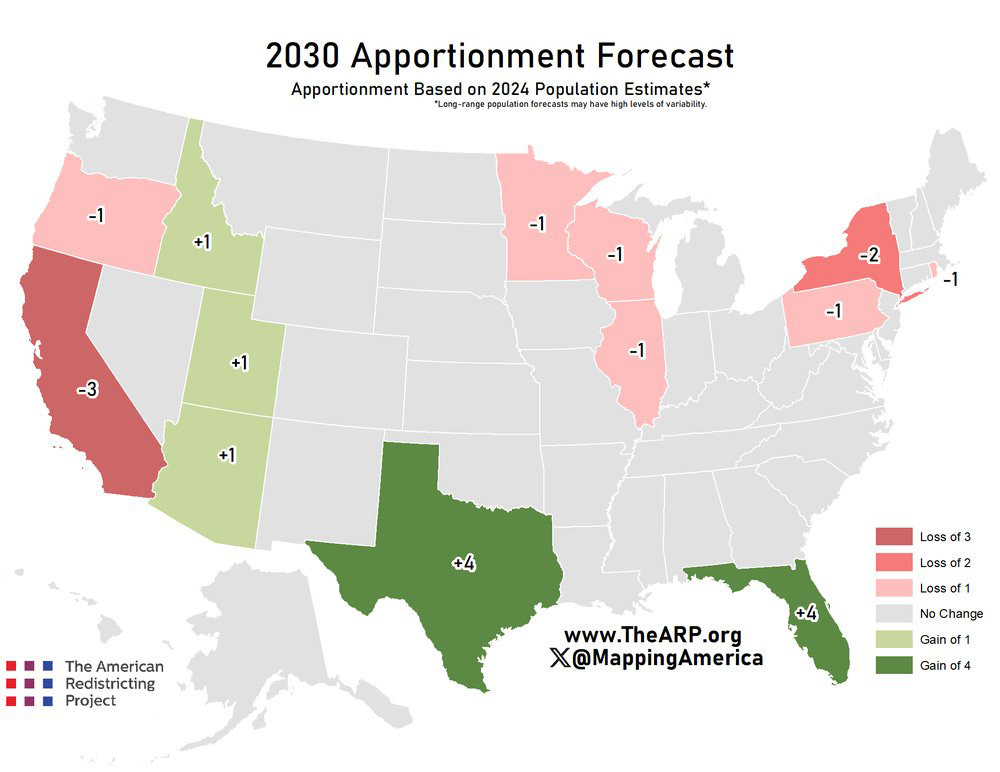
If the Census Bureau can be reformed to the extent that it is capable of producing a reasonably accurate population count the next time, the 2030 reapportionment should look like the following map from the American Redistricting Project. The ARP uses a weighted average growth rate that is “applied to the July 1, 2024 estimates of the resident population of the United States from the Census Bureau to produce a forecast for the 2030 apportionment.” The majority of Democrat-leaning states are projected to lose population to their Republican-leaning counterparts. Texas and Florida have gained nearly 3 million residents between them since 2020.
 Can the Census Be Fixed?
All of which brings us to the $64 trillion question: Is it really possible to reform the U.S. Census Bureau? This one agency employs nearly 4,300 people yet literally takes 14 years to plan and execute a single decennial census that lasts three months — from January 1 to April 1 — once every decade. No. Really. For the 2030 census, for example, the ” Early Planning Phase” lasted from 2019 to 2021. The “Design Selection Phase” lasted from 2021 to 2024. The “Development and Integration Phase” will last from 2025 to 2029. The “Peak Production and Close-Out Phase” will last from 2029 to 2033. Then, with luck, we might receive the final product.
This absurdly protracted and inaccurate process would never be tolerated in any private sector enterprise that hopes to survive in the real world. Nor can the SAVE Act restore election integrity unless the U.S. Census Bureau is also completely overhauled. In an upcoming column we will discuss how it can be reformed in a way that saves the country and stops the framers from spinning in their graves. Yes, it really is possible to clean up this unholy mess.
READ MORE from David Catron:




















