


In a world of angels, peace is natural. As a very old Jewish prayer asks, “May He who makes peace in His high places make peace for us.” What is meant, says one master, is that in Heaven, even the Angel of Fire and the Angel of Water pull together and do not extinguish each other. May He who sustains that harmony help us to see our oppositions here below as complementary polarities and so find peace.
Those who envision the redeemed world see it as a world of peace. The prophets speak of it and teach of it. Isaiah and Micah tell of a world in which the weapons of war will be turned into farming tools, and war shall no longer be learned.
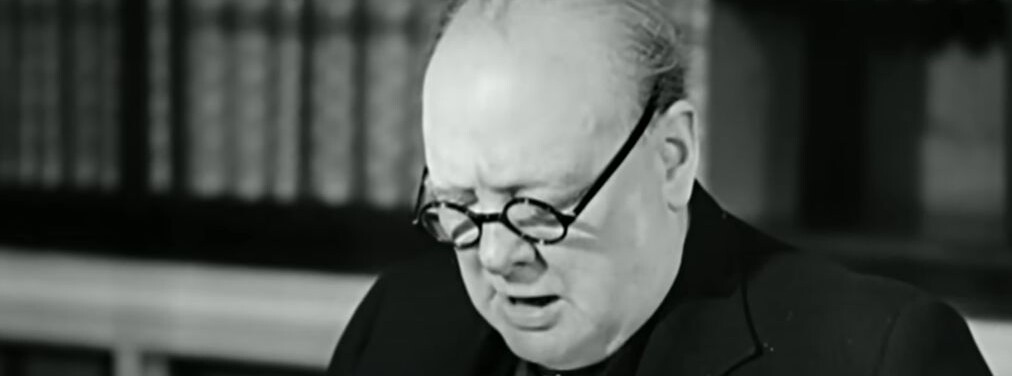
What can one do, though, when faced with the murderous idolatry of the modern Total State? This was the question with which Winston Churchill wrestled when he took the lead in mobilizing the world to smash Hitlerism.
Churchill understood well the political role of religion. Nothing has more power in mustering the will of people to take a self-sacrificial stand than religion. He wrote about religion’s role in the decisive seventeenth century battle against King Charles I to establish the liberties of Parliament and of the people from despotic rulers.
When Parliament met again at the beginning of 1629 there was no lack of grievances both in foreign and domestic policy. Yet it was on questions of religion that the attack began…. [The] harassed Parliamentarians found in the religious prejudices of England a bond of union and eventually a means of war.
As all sides of this war found religious motivation, it was a long and bloody civil war. It resulted in fifteen years of Cromwell’s military dictatorship, though it also saw a decisive end to the pretension of British monarchs to have unlimited prerogative to govern as they pleased. (It is also worth noting that it was this rigid Puritan Cromwell who ended the centuries-old prohibition of Jewish settlement in England.)
Churchill’s youthful engagement with modern religious skepticism resulted in his abstention from denominational wars and regular worship attendance. He considered himself, rather than a pillar of the church, “a buttress … supporting it from without.” By that he meant something not much different than Richard Dawkins’ recent commitment to “cultural Christianity,” though Churchill did not engage in religious controversy, as Dawkins has in spectacular fashion.
What Churchill believed in was “Christian civilization,” a concept which figured prominently in his battle of ideas against Nazism and its barbarous atavism. It is a concept that is relevant and necessary in the war against Hitlerism’s current mutations on the horseshoe ends of the far left and alt right, in the moneyed palaces of Qatar, and in the feverish counsels of Teheran, Sanaa, and Gaza.
There is perhaps no better example of Churchill’s concept of Christian civilization than in the speech he gave in the House of Commons after the fall of France, in June, 1940, only a few weeks after his becoming prime minister: “What General Weygand called the Battle of France is over. I expect that the Battle of Britain is about to begin. Upon this battle depends the survival of Christian civilization.”
With that phrase, he powerfully defined the fight as one that commands total commitment. The phrase was used to identify the distilled essence of what people will sacrifice to uphold, their purest sense of religious value, stripped of everything inessential. But whereas in Cromwell’s day, this step had been taken to drive what was largely a battle between Christian denominations, Churchill was invoking something so broad and deep that it transcended divides even greater than denominational differences within a faith.
Churchill was well aware of the strong pacifism in the culture he invoked, a major element of the historical Christian message. He believed, however, that that love of peace still required the ability to defeat those psychopathic realms who saw love of peace as weakness to be exploited. He fiercely believed that one could not grant victory to the psychopaths. He defended the righteousness of his stance memorably: “The Sermon on the Mount is the last word in Christian ethics. Everyone respects the Quakers. Still, it is not in these terms that ministers assume their responsibilities of guiding their States.”
In this passage from his history, The Second World War, Churchill laid out his powerful argument against retreat and appeasement as the moral response to totalitarian aggression. What, then, did Churchill propose as superseding that which he admitted was the “last word” while still being true to the Christian civilization for which he was fighting?
He continued, a bit further along:
There is however one helpful guide, namely, for a nation to keep its word and to act in accordance with its treaty obligations to allies. This guide is called honour. It is baffling to reflect that what men call honour does not correspond always to Christian ethics.
Another Englishman held the key to relieve at least some of the bafflement. John Selden lived in Cromwell’s day. His religiosity was much like Churchill’s. His intellectual hero had been Hugo Grotius, the Dutchman who helped establish a new political order in Europe after the failure of Catholics and Protestants to establish such a unity through decades of religious war.
Grotius and his allies invoked the concept found in the Jewish law tradition of the seven universal Noahide Laws, which alone expressed divine law for all humanity, as opposed to the bulk of biblical law which legislated only for Israel. This concept allowed the Peace of Westphalia to be established, ending the Thirty Years War. The new continental wars would be pushed by new religions – Jacobinism, nationalism, Communism, and Nazism.
To the Seven Noahide Laws, John Selden added one more principle which he felt was universal and was the prerequisite for any settled life: the honoring of obligations one has assumed. He argues that without this, no biblical law would be binding. It was the living core of the biblical covenant and of all lawful human life. Selden wrote: “The force of obligation which is inherent in every human law (however it may have been introduced) is founded, as I have already pointed out, in the commanded law of God, from which it draws most of its authority.”
Selden worked to diffuse the warring denominational claims of his time by proposing a constitution that was based on the Seven Laws and the law of honoring one’s pacts. This alone, he believed, could end the endless denominational battles and bring a wide peace to England. He even spoke carefully for toleration of Catholics when in the Protestant circles of the time, that was not popular and probably dangerous.
His love and respect for Jewish teachings also was most unusual for a country whose hatred of Jews and Jewishness found expression not only in its exclusion of Jewish settlement but where Marlowe’s violently antisemitic The Jew of Malta was a great hit. Selden labored to show through his masterful scholarship the commonalities of Jewish law and the Common Law tradition that was the guardian of everyone’s liberties.
Selden’s constitutionality won out in Britain, as did his broad view of religion. It is not a battle fully won, as the resurgent antisemitism in Britain and other places makes clear. Yet Selden’s broad view of religion and its place is the very emblem of the culture of freedom. If it will survive today’s challenges, it will be because we will fight for it with Churchillian tenacity, and realize that such tenacity is a sacred task.
Tucker Carlson has recently been a leading advocate of a return to Christian passivity in world affairs. As a counter to belligerence and absent a threat comparable to the Nazis’, his is a welcome emphasis. Yet the ideological heirs to the Nazis are making their bid to enforce their hellish vision on whomever they can overpower, and Carlson and those less eloquent and smooth in that camp have not given evidence that they consider Churchill’s testimony more than a neocon cliché. That is a failure both religious and political.
Selden and Churchill gave a vision of a Christian civilization that was cleansed of the hatred of all things Jewish that had so stained its achievements for centuries. Selden’s efforts had some part in the opening of Britain’s doors to Jews only a brief time after his death. He had made a public case for the acceptance of core Jewish values as a grounding for British constitutional life. Churchill fought the regime that had made its war against the Jews its central and definitive cause, and Churchill defined that fight as the fight for Christian civilization.
This is a fight still worth fighting. The first to lose if this fight goes down would be those very values of peace that were Churchill’s as well. In his era, weakness compromised Britain’s honor and made war inevitable. May it be that our firm, clear, and deeply thought resolve to stand as he did makes such a war, or any war, unnecessary.
READ MORE from Shmuel Klatzkin:
Constitutional Order and Existential Threats
Wendell Berry’s Plea to Sustain Ourselves



















