
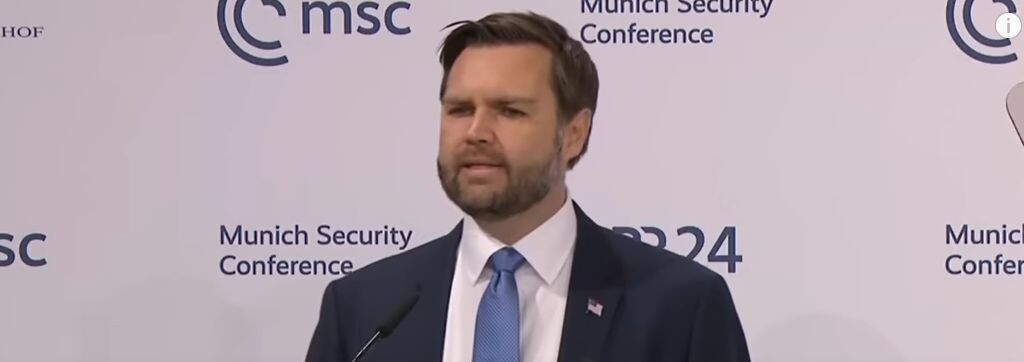


Vice President J.D. Vance has been widely criticized in the mainstream media, both at home and abroad, for his remarks at the Munich Security Council on February 21. In that speech, Vance criticized Europe’s democratic governments for imposing excessive restrictions on the expression of political opinions, in speech, in print, and online.
In fact, the much-admired … democracies of Western Europe have long been far less responsive to the people’s wishes than our own government.
The immediate context of the controversy was the February 23 elections for the German parliament, in which the right-wing Alternatives for Germany (AfD) party was forecast to come in second. Even though no party is likely to win an absolute majority, Friedrich Merz, the candidate of the leading conservative-centrist party, the Christian Democrats, has vowed that he will not enter a formal coalition with the AfD.
Merz has taken this position because the AfD stands against the mass Muslim immigration encouraged by previous Chancellor Angela Merkel and has in the past sometimes downplayed Adolf Hitler’s atrocities. Some AfD members have been arrested for plotting to overthrow the government.
There can be no question of where Vance’s sympathies lie with regard to Nazism: the day before his Munich address, he laid a wreath at the Dachau death camp, and stated that his deep hatred for the “unspeakable evil” of the Holocaust had been fortified by the visit.
Nonetheless, his Munich address was condemned by ex-Neocon and Never Trumper Bill Kristol as “a humiliation for the U.S.” and as proof that the Trump administration “isn’t on the side of the democracies.” Going further, CBS anchor Margaret Brennan went after Secretary of State Marco Rubio over the vice president’s support for freedom of speech, given that he was “standing in a country where free speech was weaponized to conduct a genocide.”
Of course, Brennan’s remarks were absurd, as Rubio pointed out, since well before Hitler launched his genocide, one of his first acts upon attaining power was to crack down on free speech and criminalize all political dissent.
Nonetheless, looking at things from the standpoint of Germany’s history, one must grant the necessity of setting legal limitations on the open espousal of Nazism, along with other doctrines (Communism, Islamism) that specifically advocate the violent overthrow of the government or the commission of violent crimes against other groups of citizens.
(In the immediate aftermath of World War II, when the U.S. government was found to have been infiltrated at high levels by Soviet agents, it enforced the Smith Act, originally enacted in 1940, which criminalized the advocacy of the violent overthrow of the government, or membership in a group dedicated to such advocacy, against leaders of the American Communist Party. The conviction of those leaders was upheld by the Supreme Court in 1951, since, as Justice Robert Jackson had famously remarked in an earlier case, our Constitution “is not a suicide pact.”)
The problem with the criticisms made by Kristol, Brennan, and others, however, is that they blur the crucial difference between outlawing the advocacy of doctrines aimed at violently overthrowing democratic government, or at violating the essential legal rights of others, and the truly antidemocratic extreme to which regulations of “politically incorrect” speech have gone in countries like Germany, France, and Britain.
In Britain, for instance, as George Washington University law professor Jonathan Turley pointed out in the New York Post, the suppression of speech has gone so far as to engender the arrest of citizens for “praying to themselves near abortion clinics.” Turley adds that “the British have doubled down on censorship with new sweeping laws,” so that “hundreds have been arrested recently for speech crimes like spreading ‘fake news’ or disinformation that could lead to ‘non-trivial’ psychological harm.”
Previously, “British citizens were arrested for criticizing religious groups or opposing homosexuality or immigration.” And in one case, a neo-Nazi was given a four-year prison sentence for what the court called the “toxic ideology” embodied in “the contents of his home.”
As regards Germany, Turley highlighted an interview on CBS News’s “60 Minutes” by correspondent Sharyn Alfonsi with German state prosecutors on how easy their country’s laws make it to prosecute individuals for “hate crimes.” In answer to her questions, they acknowledged that it is a crime in Germany “to insult somebody in public” or online, with the latter being a potentially “higher” crime since the insult remains on the Internet. “Netizens” can be jailed as well “for spreading gossip or fake quotes on social media by reposting it,” according to Post reporter Josh Christenson.
The unacknowledged danger here isn’t merely the violation of personal liberties, or the potential for hypersensitive individuals or partisan judges to take advantage of the law to persecute their enemies. Rather, the deepest threat from these antiliberal policies is to democratic government itself.
To the extent that European voters have been drawn to far-right parties like AfD or Jean le Pen’s National Rally in France, they have done so not because many of them are Nazis, but because “mainstream” parties have simply been ignoring their fundamental concerns. As British historian Dominic Green points out in the Wall Street Journal, “no one voted for mass immigration or to dissolve freedom and national identity into an unelected bureaucracy” like that of the European Union.
Yet even after an Afghan “asylum seeker … rammed his car into a crowd of union demonstrators in Munich the day before” Vance’s speech, “killing a 2-year-old girl and her mother and injuring more than 30 people,” the German Defense Minister termed Vance’s remarks “not acceptable,” the vice president of the European Commission accused him of “trying to pick a fight,” senior European diplomats labeled the speech “mad,” “dangerous,” and “outrageous,” while an “unnamed source” in Britain’s Labor government called Vance himself “bats—.”
US and Europe ‘Commonality’ on Speech
While the legal suppression of political speech has not yet gone so far in the U.S., and “cancel culture” seems to be entering a decline (thanks partly, but not only, to the Trump administration’s ban on DEI indoctrination), Green concludes his column by observing a “commonality” between this country and Europe: “the popular search for what Mr. Vance called ‘a new direction,” turning government away from “swollen welfare budgets, speech controls, and a willed failure to defend borders.”
In fact, the much-admired (by American intellectuals) democracies of Western Europe have long been far less responsive to the people’s wishes than our own government. For instance, in a recent National Review essay on criminal punishments in the U.S., comparing them to those in Europe, Paul Robinson and Jeffrey Seaman cited a 2015 Eurobarometer survey showing that “86 percent of the European public wanted tougher criminal punishments” than those in force.
In England and Wales, a 2023 House of Commons survey found that 71 percent of respondents thought that criminal sentencing was too lenient; a 2013 Swedish study similarly found 69 percent of respondents maintaining that sanctions were “too mild,” with only 2 percent judging them “too severe”; and a 2022 French poll found 65 percent of respondents, including majorities of both the political Left and Right, holding that “criminal punishments were not strict enough.”
Vance’s advice to his audience to relax its restrictions on political speech, then, was not irrelevant to the theme of European (and American) security. Endeavoring to suppress dissent from what political and cultural elites regard as “acceptable” policies — whether the theme is immigration, taxes, transgenderism, or racial preferences — is the route not to supporting democratic government, but to undermining it.
Indeed, former E.U. commissioner Thierry Breton told French TV in January that if the AfD were to win the German election, the E.U. might have to “cancel” the result.
We Americans are fortunate that thanks to our Constitution, which includes our federal system, our government is less able to insulate itself from what The Federalist Papers call “the deliberate sense of the majority.” And we must be thankful that our government has not attempted to subordinate our sovereignty to that of a foreign body like the International Criminal Court.
But there remains ground for Americans to worry about how far their own elites care about the principles of freedom. In a just-published book, Seven Things You Can’t Say about China, Arkansas Senator Tom Cotton depicts the abasement that Hollywood producers like Disney and Sony have practiced towards the Chinese despots, such that American studios “haven’t released a movie featuring China as the villain” since 1997.
The production that year of two films criticizing China’s genocide of the Uighurs and the favorable portrayal of the Dalai Lama led to immediate retaliation from Beijing, causing Disney to suppress its release of Martin Scorse’s Kundun, with the Disney CEO traveling to the Chinese capital to offer a “groveling apology” for his “stupid” mistake.
Sony made amends for Seven Years in Tibet by “lobbying for China’s entry into the World Trade Organization” and “plying Chinese officials with gifts.” Ever since, in order to keep profiting from Chinese markets, American studios have had to represent East Asian-looking aggressors as North Koreans. And an American actor, John Cena, while promoting the film Fast & Furious 9, had to apologize profusely in Mandarin for his error in calling Taiwan a “country.”
To preserve our country’s freedom will require not only that our government abide by the Constitution rather than constrain our speech lest they “offend” some favored group. It will demand as well that our corporate leaders and tycoons forego the sort of profit that can be earned only by suppressing the truth about the most fundamental issues.
READ MORE from David Schaefer:
Should Tom Friedman Celebrate Jimmy Carter’s ‘Achievements’?
Resist a Constitutional Convention — and Gillibrand’s Skullduggery



















