
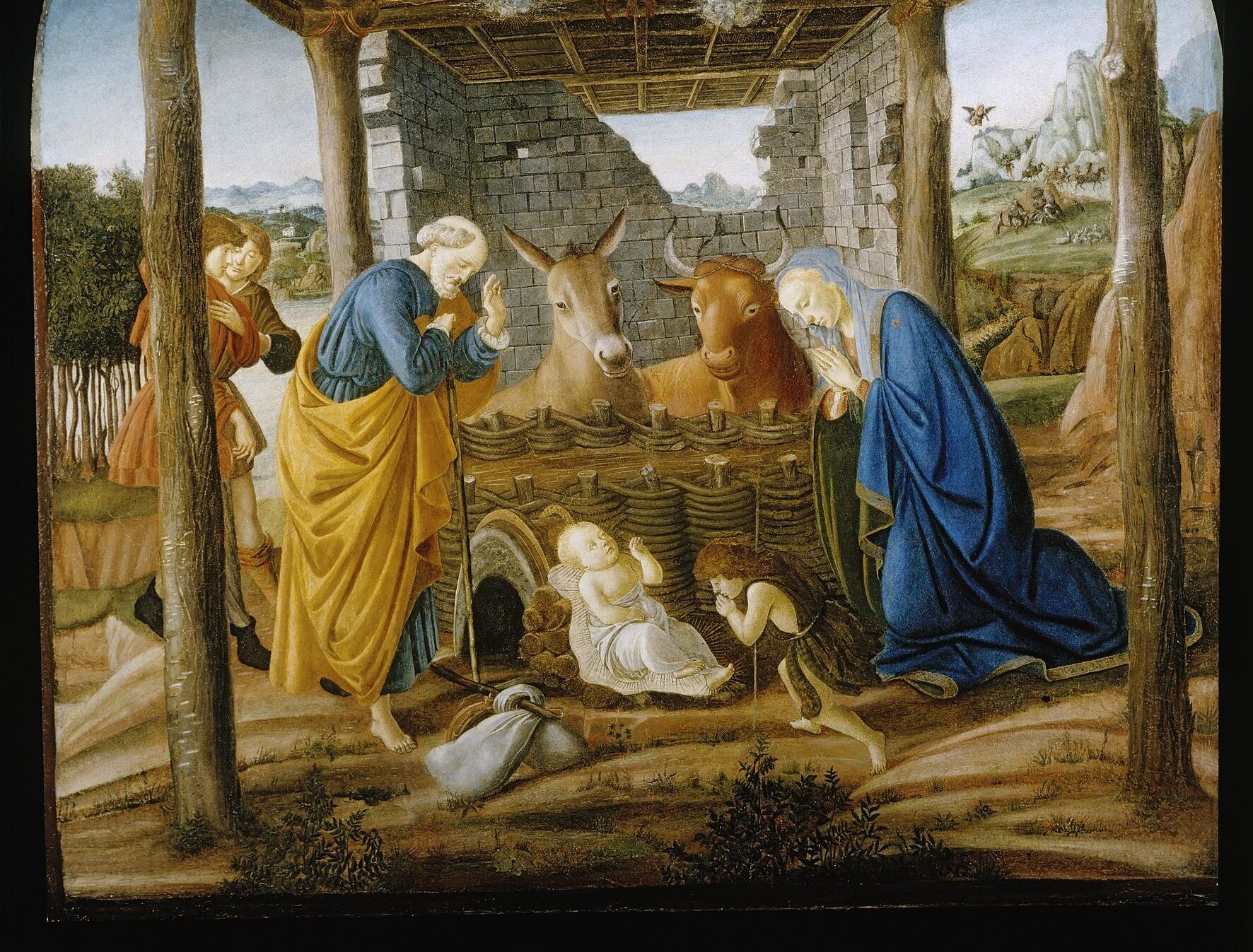


Night fell dark, harsh, and cold. Mount Gilboa, in northern Israel, rose above the Jezreel Valley, about 25 kilometers from the Sea of Galilee and near the city of Afula. Beneath the frost that whitened the fields and mountains, the story of salvation unfolded at the slow pace of a donkey. It was no ordinary dawn, nor merely another journey. Joseph walked on foot, while Mary rode a donkey that followed the trail of the youngest animal, leaving behind the comfort of their home in Nazareth. Everything would have been easier there, in the warmth of their family hearth. But Joseph knew that the census ordered by Caesar Augustus required him to register in the city of his family, and as a man of the house and lineage of David, he had to travel to Bethlehem, the city of David, in Judea.
Thus, under the shade of ancient terebinths and in the solitude of a borrowed grotto, all prophecies were fulfilled.
They crossed a landscape of arid scrubland, treading on the small cones of Aleppo pines, in a land the ancients considered “cursed.” Yet the couple’s gaze, fixed on the slow awakening of the shoots, already anticipated the future bloom of the Gilboa Iris. In the Virgin’s heart echoed the distant angelic words “Do not be afraid,” while in Joseph’s heart, responsibility manifested itself in constant vigilance, as befitted an old-fashioned knight whose first concern was always to find a place where his wife could rest.
At the top of a hill, they stopped to rest, shivering from the cold. Joseph comforted Mary by speaking of friends he had in Bethlehem, assuring her they would soon be helped to find a proper place to stay. They ate fruit and bread, and after resting, resumed their journey at first light.
What could have been a six-day journey was prolonged by Mary’s advanced pregnancy. They crossed the valleys of Shechem, seeking shade under a centuries-old terebinth tree, a silent witness to sacred history, where they paused to drink from a nearby spring. There, amidst the scent of thyme and vineyards, the Holy Family experienced the duality that would mark those days: the hostility of some and the charity of others. While the owner of a nearby farm refused them entry, his wife and some shepherds, moved by the travelers’ dignity, offered them food and a barn prepared for them to spend the Sabbath. Mary, with the natural ease of someone who makes any place a home, embraced the warm welcome of these people and taught their children, planting a seed of light in those who, when seeing them leave, felt the melancholy of having been touched by mystery.
After days of arduous walking and brief, precarious stops and overnight stays, the outline of Bethlehem appeared. The city, crowded due to Caesar Augustus’ census, did not present itself as the safe harbor Joseph longed for, but as a fortress of indifference. Not even the relatives of his acquaintances bothered to recognize the man who had spent so many hours as a child on those streets.
Joseph wandered the city, knocking on doors of acquaintances and relatives of the House of David, but found closed faces and wary eyes, like Nathanael wondering if anything good could come from Nazareth. Defeated and embarrassed by his failure to find shelter for his family, Joseph suggested leaving the city for the Valley of the Shepherds. It was there, in the darkness of the night and the biting cold, that the donkey stopped in front of a rock grotto. One look from Mary, full of burning sweetness, was enough to confirm that this was the place chosen from eternity.
The carpenter from Nazareth, driven by urgency, transformed misery into dignity. The cave, used as a stable, was filled with tools and straw. Joseph swept, partitioned rooms with wattle and daub, hung lamps on the stone walls, and lit a fire. He fetched water from a nearby spring and coals from the village, working in prayerful silence. He arranged the animals’ trough as a cradle, decorating it with flowers and setting out the quilts and clothes Mary and Saint Anne had woven in Nazareth.
Near midnight, a sharp unease rippled through the air; the animals grew restless, and Joseph, after a final inspection, prostrated himself with his forehead to the damp ground at the entrance, praying. Then a special light — a simple, joyful peace — illuminated the shed, radiating outward into the world. Mary, radiant, called to her husband. Joseph rushed in such haste that he tripped over a sack of coal and spilled the water, but the clumsy accident vanished instantly at the sight of the Child. The holy patriarch, moved to tears, was the first to kneel. Taking the Child in his arms, hands calloused from carpentry, he lifted his face to heaven, his prayers tumbling out in a cry of gratitude.
Meanwhile, in the hills of Beit Sahur, the night took a strange turn. A group of shepherds keeping watch by the tower felt an inexplicable euphoria. Nature seemed to have regained its lost vigor, and the sky shone with unusual intensity. Suddenly, their unease turned to awe when an angel — perhaps Gabriel, wrapped in the fragrance of lilies and clothed in light — appeared. After calming their fear with a fatherly authority, he announced the great joy: “A Savior has been born to you.”
Those weathered men, barefoot and familiar with the thorny paths, ran toward Bethlehem, forgetting the cold and their weariness. Upon reaching the grotto, they found the Child wrapped in swaddling clothes and Mary, greeting them with a welcoming smile. One shepherd, overcoming his humble shyness, crawled across the sandy ground to kiss the Messiah’s feet, eliciting a charming babble from the Child that filled the Virgin with joy.
In that moment, the squalor of the cave vanished before the majesty of the scene; the sky seemed to pour unprecedented light upon the earth, and even the innkeepers who had turned the couple away approached, ashamed, bringing gifts that Joseph humbly accepted and later distributed among the poor.
The grotto became a pilgrimage site. Three elderly women, family acquaintances, arrived, followed later by three distinguished foreign women. Days later, Saint Anne’s arrival brought comfort; the grandmother broke into tears as she embraced Jesus, who reached out to touch her face. Joseph, ever foresighted, had renovated a side cave with wood and wattle, creating a more comfortable space for Mary and the Child, anticipating the visitors.
About twenty days later, the horizon heralded a solemn procession. The Magi from the East had arrived, mounted on camels and each accompanied by four men from their tribe, following the star. In front of the humble dwelling, they donned their finest ceremonial robes. Joseph opened a small door he had made for them, and seeing the Child and His Mother enveloped in a light brighter than any lamp, they fell to their knees. With heads uncovered and hands crossed over their chests, they worshipped in silence and offered gold, frankincense, and myrrh.
Thus, under the shade of ancient terebinths and in the solitude of a borrowed grotto, all prophecies were fulfilled. What began as a path of rejection and barrenness in the Gilboa Mountains culminated in the Epiphany of Light. In that forgotten corner of the world, amid the breath of beasts and the fervor of the humble, history split in two, leaving in the air, from that moment and forevermore, the echo of Gloria in excelsis Deo and the promise of peace to people of goodwill.
READ MORE from Itxu Diaz:
The Christmas Gift List for Celebrities, Politicians, and Other Animals




















