
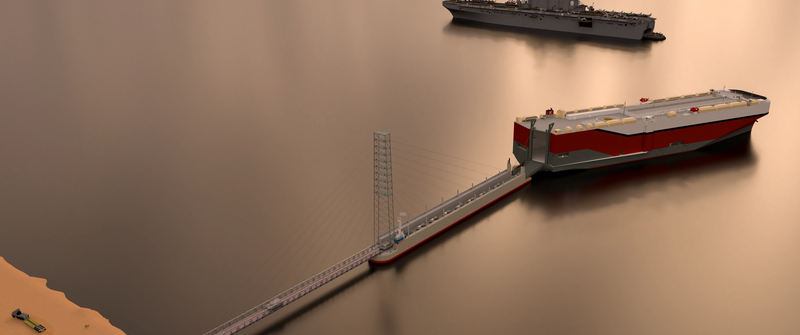


A series of news reports warn about China’s construction of specialized landing barges that may enable the PLA to overrun Taiwan’s shore defenses in the event of war in the South China Sea. Last month, the Asia Times and Naval News reported that the PLA has invested in “special purpose amphibious barges” with lengthy “road bridges” (some as long as 390 feet) that can offload military vehicles and equipment directly onto Taiwan’s roads.
Analysts have compared the barges to the Mulberry Harbors constructed and deployed on Normandy’s invasion beaches by the Allies during the Second World War. What this means is that a PLA invasion of Taiwan could land troops and military vehicles “across rocky or soft beaches,” multiplying the locations that Taiwan must defend. China’s leaders have been quite clear about their intentions toward Taiwan — unification peaceably or by force. The construction of these barges is evidence that China is building capabilities to match its intentions.
In December 2024, China deployed the largest number of warships around Taiwan since 1996. A combined force of 90 naval vessels and coast guard ships took part in this naval exercise, which U.S. Indo-Pacific commander Admiral Sam Paparo called a “rehearsal” for an invasion.
A year earlier, the Taipei Times reported that China was upgrading its missile systems that target Taiwan. The report noted “the buildup of rocket installations in Southeast China, where missiles with a range of 1,000 km were installed to be used against Taiwan and nations friendly to it in the event of a conflict in the Taiwan Strait.” In May 2024, Reuters reported that China rehearsed missile strikes and bomber attacks against Taiwan in “two days of drills in the Taiwan Strait.”
Two Taiwanese military experts writing in The Diplomat recently explained the meaning of China’s “modernization of its amphibious capabilities.” Jhih-Siang Liu and Yuan-Chou Jing of the Republic of China’s (ROC) National Defense University note that the PLA’s amphibious fleet “has grown substantially” due to China’s impressive shipbuilding capacity which dwarfs that of the United States.
The Center for Strategic and International Studies reported that China’s busy shipyards “embody Beijing’s military-civil fusion strategy, which seeks to fuse together civilian and military technological, scientific, and industrial development to strengthen China’s comprehensive national power.” Taiwan’s analysts describe this as a “multi-pronged modernization strategy” that combines large assault ships with small craft, giving the PLA “the ability to stage multi-point landings and project force beyond conventional beachheads.”
Increasing the PLA’s options for landing troops and military equipment on the island complicates Taiwan’s defense problems by forcing the ROC military to spread its defenses, thereby weakening each defensive position. Jhih-Siang Liu and Yuan-Chou Jing recommend improvements in Taiwan’s capabilities to “rapidly detect and respond to movements of special barges” by upgrading its “intelligence, surveillance, and reconnaissance framework.”
These improvements must be coupled with enhanced anti-ship missiles and weaponized drones that can interdict the barges before they establish beachheads on the island. Taiwan can no longer focus defense efforts solely on so-called priority “Red Beaches.”
The Trump administration has urged Taiwan’s leaders to spend considerably more for their own defense, while it has also signaled a genuine pivot to the Indo-Pacific by calling on its NATO allies to be the primary guarantor of Europe’s defense.
President Trump is intent on ending the Ukraine war and improving relations with Russia in an effort to dent the Sino-Russian “strategic partnership.” Trump’s national security team is increasingly focused on China’s threat to its interests in the western Pacific.
War clouds are gathering there.
China’s investment in invasion barges is just the latest signal that China is determined to unify Taiwan with the mainland and is acquiring the capabilities to do so. We ignore this at our peril.
READ MORE from Francis P. Sempa:
NATO Firsters vs. Elbridge Colby



















