


Imagine going to visit a relative in another country and discovering they had things that your own country did not.
Not only were goods available for sale, but varieties of food were offered at fair and reasonable prices. People seemed happier in their jobs, and there was a certain vibrancy throughout all strata of society as they enjoyed more autonomy and freedom of movement. Government was less intrusive and more in the background. Law enforcement was more partner than adversary.
This missed opportunity led to greater despotism and created an acceptance of autocracy as a proper governing regime.
Imagine further returning home after this experience and recognizing the striking differences between countries. The distinctions would prompt many people to examine the reasons and encourage them to find ways to better reflect the freedoms and buoyancy of the other nation.
Two hundred years ago, this was precisely the experience in Russia. Army officers, diplomats, and their retinue left Russia to fight Napoleon and saw the dynamic communities of Europe. Upon their return, many of these junior officers and nobility compared notes on how they might create a similar community in Russia.
Inspired by the revolutions in both America and France, they formed numerous clubs and secret societies to move Russia away from the autocracy of the czar and toward a broader, more representative government.
Initially, Czar Alexander seemed open to some reforms. In fact, he had taken steps to liberalize his country by opening educational opportunities, reforming his cabinet, and improving the legal system with a supreme court. He had plans to create a parliament and sign a constitution, but for various reasons, these initial reforms never matured into the constitutional monarchy the reformers wanted.
One key issue needing reform was the treatment and liberation of serfs. The entire idea of a serf harkened back to feudal times when laborers were basically slaves to the lands of the nobility. They were limited in what they could do and were wholly at the mercy of the Lord of the Manor. Owning property, profiting from their labors, and traveling were strictly prohibited. Even marrying required the approval of the Lord.
The officers who fought in the Napoleonic Wars realized that for Russia to progress, the system of serfdom needed to be reformed and eventually abolished. Peasants were limited with no incentive to do anything other than subsistence farming. The serf system, as practiced by Russia, was not sustainable and could not accelerate the economy for growth.
Most importantly, if Russia were to compete in Europe, it needed a growing middle class to expand its economy. Serfdom was in direct conflict with a vibrant economy, for only in granting more freedom and mobility to the serfs could Russia succeed.
But Czar Alexander had no desire to become more European. He saw no benefit in any of the reforms. Rather than look to Europe and its enlightened ideas of government, the Czar embraced a Russian nationalism. He realized that any of the liberal reforms were a direct threat to his rule. Unlike George Washington, he was not interested in relinquishing power, but wanted to maintain his authority which meant limiting, if not discarding, all reforms.
There was a tension then between the reformists with their clubs and societies and the Czar. This tension flared up on a few occasions with minor revolts and mutinies, but these were limited and the Czar could suppress any dissent with his army. The reformists continued to plot and scheme waiting for an opportune moment.
Two hundred years ago their moment came when the Czar died. Alexander’s death was not expected; he died from typhus on a trip to Southern Russia. The Czar had no children so the Empire would pass to his brother, Konstantin. Or so everyone thought. Once news of the Czar’s death reached St. Peterburg, military officers and other officials took a loyalty oath to Konstantin.
As the Viceroy of Poland, Konstantin was known for his Western tendencies and on several occasions had openly disputed his brother’s totalitarianism. The possibility that Konstantin would become Czar excited the reformed minded Russians. But, unbeknown to them, Konstantin had renounced the throne to marry a Polish Princess once his divorce was finalized.
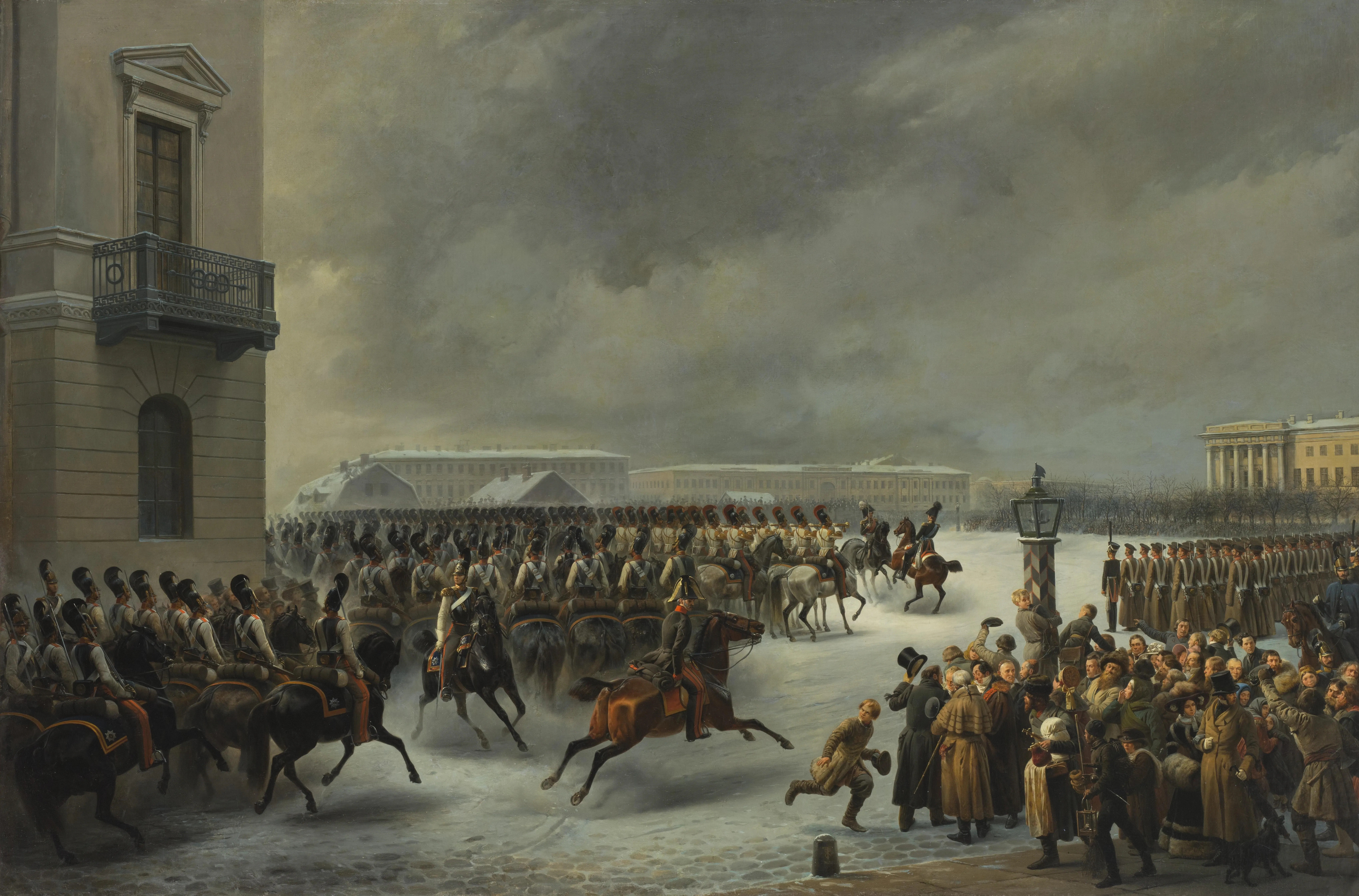
Since information did not travel fast, there was a critical lull in the news from word of Czar Alexander’s death to Konstantin’s abdication for the woman he loved. This uncertainty created an opportunity as there was no government without a Czar. Taking full advantage of this instability, the clubs and secret societies rallied and occupied St. Peterburg square on December 26, 1825.
The “revolutionaries” advocated for a constitutional monarchy and other reforms which included liberating the serfs. But, the new Czar, Nicholas, the younger brother of both Alexander and Konstantin, would have none of it. He moved decisively to put down the revolt and restore order. With no experience in liberty and with some of the revolutionaries unwilling to take up arms against the Czar, the revolt was easily crushed.
The main leaders were executed, and others were exiled to Siberia. The revolt was referred to as the Decemberist Revolt and would become a touchstone for future revolutionary movements in Russia. Its leaders would become martyrs, and the Soviets would lionize them as a key to an historic past.
The revolt initially deterred Czar Nicholas from thinking about any reform. He continued to behave as an autocrat, but over time came to accept some changes, especially as it related to the serfs. Like his brother, he would oppose anything that would bring Russia closer to Europe and would emphasize Russia’s role as uniting the Slavic people. In many ways this too became part of the justification for the Soviet Union: a gathering of Slavic countries to oppose the West in general and democracy in particular.
Two Hundred Years ago, the Decemberist Revolt marked a chance for Russia to embrace Western values with a constitutional monarch extending freedoms for its people. This missed opportunity led to greater despotism and created an acceptance of autocracy as a proper governing regime. Some things never change!
READ MORE from Will Sellers:
Heinz Rises From Bankruptcy to an American Icon
Ford and the Making of Democracy’s Arsenal
Will Sellers is a graduate of Hillsdale College and is an Associate Justice on the Supreme Court of Alabama. He is best reached at jws@willsellers.com



















