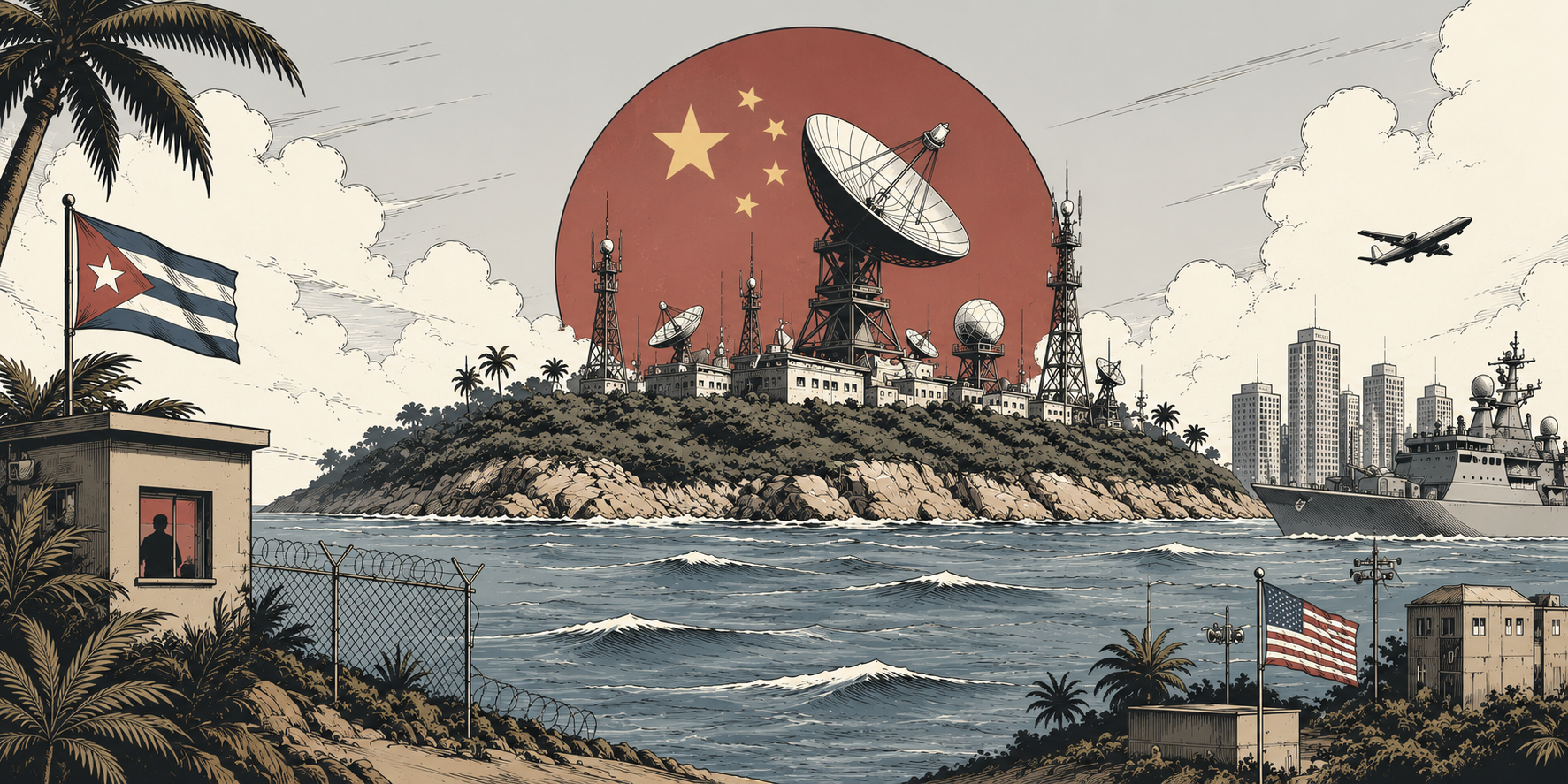


The Cold War did not end in Cuba so much as change patrons, technologies, and uniforms. The enormous Soviet listening station at Lourdes was closed more than two decades ago, but the infrastructure, trained personnel, intelligence culture, and geographic advantages that made the island valuable to Moscow survived under the control of a communist dictatorship that has now placed Cuban territory and technical capabilities at the service of the People’s Republic of China.
The presence of hostile electronic installations in Cuba has taken on new urgency following President Trump’s recent alarms over an upsurge in Chinese electronic espionage and Cuban subversion in the U.S. Fresh U.S. intelligence assessments, commercial satellite imagery and recently intensified American surveillance operations around the island indicate an extensive network of signals intelligence installations, some of which are controlled or operated by China and Russia, using Cuban territory, infrastructure, and intelligence capabilities. (RELATED: Cuba Is Prepared to Be a Second Iran)
Cuba is not merely an island from which China spies. It is a dictatorship that has once again rented its strategic geography to an enemy of the United States.
The relationship between Havana and Beijing is too often treated as an economic partnership between two distant communist governments or as an expression of Cuba’s chronic search for foreign subsidies. That interpretation misses the essential point. Cuba is valuable to China not because of the strength of its ruined economy, the productivity of its paralyzed industries, or the purchasing power of its impoverished population. Cuba is valuable because it lies at the entrance to the Gulf of Mexico, beside vital Caribbean shipping lanes, and approximately 90 miles from the most strategically concentrated region of the southeastern United States. (RELATED: Secretary Rubio Gets It)
According to U.S. intelligence assessments reported by the Wall Street Journal on May 22, 2026, 18 signals intelligence installations have been identified in Cuba. Three are actively operated by China, two by Russia, and the remainder formally operate under the Cuban military. China and Russia have reportedly tripled the number of intelligence personnel assigned to these operations since 2023, while several of the installations have received new and more sophisticated equipment.
The complete list of the 18 sites has not been publicly released. Nor has Washington declassified the identities of the five facilities attributed directly to China and Russia or the intelligence used to reach those conclusions. That secrecy limits the public’s ability to reconstruct every part of the network, but it does not erase the central finding of the assessments. China is not merely advising Cuba, selling it telecommunications equipment, or exchanging intelligence; it operates intelligence facilities on Cuban territory.
Florida, which lies just 90 miles from Cuba, is home to U.S. Southern Command, U.S. Central Command, Naval Air Station Key West, MacDill Air Force Base, Cape Canaveral, major military ports, aerospace facilities, submarine operations, extensive defense and communications infrastructure, and President Donald Trump’s summer White House in Palm Beach.
The Director of the Americas Project at Washington’s Center for Strategic and International Studies, Ryan C. Berg, told the House Subcommittee on Transportation and Maritime Security in May 2025 that intelligence installations in Cuba could provide coverage of approximately 20 sensitive bases and facilities in and around Florida, including Cape Canaveral and the headquarters of the U.S. Southern Command.
Signals intelligence, or SIGINT, does not depend only on breaking into the content of a particular conversation. It can collect frequencies, locations, transmission schedules, electronic signatures, communications patterns, and changes in operational behavior. When accumulated and studied over time, that information can reveal military exercises, aircraft and naval movements, changes in alert status, the activation of particular systems, and the technical characteristics of American defenses. Even encrypted communications can expose valuable metadata and operational patterns.
The installations also potentially place sensitive civilian activity within range. Commercial space launches, telecommunications providers, shipping companies, ports, and contractors may not possess the same communications protections as the military. Berg warned Congress that private companies operating near Cape Canaveral could be particularly vulnerable because they conduct strategically important activities while competing directly with China in space. Cuba offers Beijing a vantage point not only over military forces, but also over civilian technologies and logistical networks.
The Cuban regime runs extensive human espionage and subversive networks in the U.S. that complement China’s efforts to manipulate the U.S. political system, denounced by President Trump in his July 23 speech to the nation. Far-left groups with defined communist agendas such as Democratic Socialists of America maintain active ties with Cuba’s regime while receiving financial support from China. DSA activists regularly visit the island and meet with Cuban intelligence officials on trips arranged through the Institute of Friendship with the Peoples, currently under U.S. federal investigation for its financial ties to the Chinese Communist Party. Capabilities to hack into computer systems containing electoral information, eavesdrop on sensitive telephone conversations on unprotected private lines, and monitor internet traffic across the U.S. could crucially aid current efforts by communist groups to gain political power and leverage in the U.S. (RELATED: The Castroist Playbook Comes to America)
Defense analysts note that SIGINT and satellite tracking facilities in Cuba could double as a base for electronic jamming operations that could disrupt military tactical communications, GPS networks, and clandestinely support terrorist operations.
According to Congressional sources, during the 9/11 attacks on the Pentagon and the World Trade Center, U.S. intelligence agencies traced attempts to penetrate the signal codes of Air Force One carrying President George Bush back to Washington from Florida, triggering the decision to divert the presidential aircraft to Colorado. It’s strongly suspected that the operation was conducted from SIGINT installations in Cuba that could also now define targets and guide surgical strikes by Shahed drones recently acquired from Iran.
Successive U.S. administrations, both Democrat and Republican, have tended to downplay Cuba as a national security threat, influenced possibly by high-level Cuban moles in the intelligence bureaucracy such as a senior Latin America analyst at the Defense Intelligence Agency and a State Department ambassador who served on the National Security Council, and who could be tried and convicted as Cuban spies. But the institutional sedation over Cuba appears to be ending under the Trump administration, which has authorized more than 20 surveillance missions by manned and unmanned aircraft around the island over the past six months.
Secretary of State Marco Rubio addressed the matter directly at Miami-Homestead Airport on May 21, describing the Russian and Chinese intelligence presence in Cuba as a national security problem. The Cuban dictatorship supplies territory, protection, local personnel, decades of intelligence experience, and the cooperation of its military and security agencies. Beijing and Moscow contribute technology, resources, specialists, and access to broader intelligence systems. (RELATED: The Son of Cuba Takes on the Last Communist Neighbor)
The State Department’s 2026 report, Cuba: The Capital of 21st Century Communism, places those installations inside a broader diagnosis of Havana’s function within what the document calls an “Anti-American Internationale.” The report states that China actively operates three of the eighteen known SIGINT installations, notes that certain Russian and Chinese bases appear to be joint operations with Cuban agencies, and describes the Chinese presence as an acute danger to American military operational security. Cuba is presented not as an irrelevant failed state, but as a force multiplier that allows larger adversaries to operate from the strategic approaches to the United States.
The roots of that arrangement can be traced to a February 1999 visit to Cuba by Chinese Defense Minister Gen. Chi Haotian, who met with Raúl Castro, then Cuba’s defense minister.
According to Berg’s congressional testimony, the two governments reached an agreement granting China access to former Soviet listening stations, including Bejucal, located less than 10 miles from Lourdes. The same testimony cited reports that China helped transfer equipment intended to interfere with Radio Martí broadcasts, an early indication that the relationship combined foreign intelligence gathering with the internal and external information war conducted by Havana.
The military relationship continued to deepen. The U.S.-China Economic and Security Review Commission reported that Chinese and Cuban military officials held 33 meetings between 2003 and 2016. China assisted Cuba with communications equipment, air-defense modernization, maintenance of Soviet-era aircraft, and improvements to some MiG-21 fighters. The commission also reported a physical Chinese presence at intelligence facilities of Soviet origin at Lourdes, Bejucal, and Santiago de Cuba for the collection of signals intelligence.
Cuba’s importance to Beijing extends beyond the antenna fields. Chinese companies became central providers for the island’s telecommunications infrastructure. Congressional testimony has identified Huawei, ZTE, and TP-Link among the principal suppliers to ETECSA, the state monopoly that controls Cuban communications.
Chinese technology has helped Havana build not merely an internet network, but an architecture capable of surveillance, censorship, and politically motivated shutdowns. During nationwide protests in July 2021, the regime used its control over telecommunications to interrupt communications among demonstrators and obstruct the flow of images to the outside world. Beijing’s contribution to Cuba therefore serves two related purposes: protecting the dictatorship from its own population and expanding the technical infrastructure from which intelligence can be collected on the United States.
The Soviet precedent explains how this collaboration works. Lourdes, near Havana, was once the largest Soviet signals intelligence station outside the USSR. It reportedly housed approximately 1,500 operatives and supplied Moscow with an extraordinary volume of military intelligence concerning the United States. Cuba retained formal sovereignty over the territory, but no serious observer hesitated to call Lourdes a Soviet base because the Soviet Union supplied the personnel, equipment, technology, and operational command while Havana provided the land, political protection, and cooperation.
Vladimir Putin announced the closure of Lourdes in October 2001, and the complex ceased operating as a Russian intelligence station the following year. President George W. Bush welcomed the decision as the dismantling of a Cold War relic. Yet what disappeared was the Soviet operation at Lourdes, not Cuba’s expertise in electronic intelligence. The communist regime retained trained technicians, its own listening sites, relationships with foreign intelligence services, and an institutional culture developed through decades of monitoring the United States.
China gradually filled the vacuum left by the Soviets. In June 2023, the Wall Street Journal reported that China and Cuba had reached a secret agreement to establish an electronic listening facility and that Beijing would provide Havana with several billion dollars.
The Biden administration initially challenged aspects of that report, but U.S. officials ultimately confirmed it, explaining that it was not new. They acknowledged that Beijing had been conducting intelligence operations from the island for years and had upgraded its collection facilities in 2019, the same year in which Chinese electronic espionage against the U.S. surged, according to President Trump’s July 23 speech.
Secretary of State Antony Blinken at the time confirmed that China had modernized its intelligence capabilities in Cuba during that year. Beginning in 2024, the public record moved beyond official declarations and press leaks. Analysts at the Center for Strategic and International Studies examined commercial satellite imagery and identified four principal locations considered highly likely to support Chinese intelligence collection: Bejucal, Wajay, Calabazar, and El Salao. Three are clustered around Havana. The fourth lies near Santiago de Cuba, close enough to observe activity in the eastern Caribbean and around the U.S. Naval Base in Guantánamo.
The satellite images cannot identify every technician inside a building or disclose the terms of secret agreements. They can show the construction of antenna fields, the movement and reorientation of dishes, protected compounds, technical buildings, possible underground facilities, and the development of specialized systems designed for the interception and geolocation of radio signals. When those images are considered alongside congressional testimony, government assessments, the history of Lourdes, and two decades of records describing Chinese involvement in Cuba, they reveal a coherent strategic progression.
The most consequential evidence is at Bejucal, where a large circularly disposed antenna array containing 32 antennas now appears complete and has begun operating. It is larger and potentially more capable than any previously observed Cuban system of the same type. At the opposite end of the island, El Salao presents a more complicated picture, with a strategically located project that has advanced slowly and may have been delayed or redesigned. Bejucal and El Salao are only two parts of the visible network. Wajay and Calabazar contain different antenna configurations and may perform complementary collection, transmission, or satellite-related functions.
Cuba is not merely an island from which China spies. It is a dictatorship that has once again rented its strategic geography to an enemy of the United States. Washington’s responsibility is to expose that bargain, raise its cost, establish enforceable limits, protect the infrastructure already within range, and ensure that Beijing understands that 90 miles from Florida is not an uncontested frontier for communist expansion.
READ MORE from Martin Arostegui:
Prepare for Trump’s Midterm Surprise
Rummaging for Cash in the Ruins of Socialism
Martin Arostegui is a terrorism analyst who has reported from conflict zones around the world for various news organizations, including Voice of America, the Wall Street Journal, the Daily Telegraph, Fox News, CNN, the Washington Times, the London Times, The Sun and Diario las Américas. He is the author of a book on Special Forces called Twilight Warriors (Bloomsbury, St. Martin’s).
Luis Leonel León, executive director of the Cuban Studies Institute, is a Cuban writer, journalist, and documentary filmmaker living in exile in Florida. His work appears in media outlets across the United States, Latin America, and Europe. He has produced films and documentary series for several television networks.