

Zohran Mamdani, the Democratic Socialists of America member who currently resides in Gracie Mansion as the mayor of New York, seems to be having a summer of love within the Democrat Party. And Mamdani’s DSA allies are feeling their oats generally — releasing a radical platform which calls for things like abolishing or mutilating the presidency, the Supreme Court, the Senate, property ownership, debt, monthly bills, prisons, and other things which thousands of years of civilization would indicate a free society would need.
Mamdani, brick by brick, is giving a preview of how that DSA platform operates. In the Bronx, there is a city-owned grocery store about to open which pays no rent, and it will compete against bodegas which adhere to the rules of the real world (for how long before those private-sector operators are forced out of the market is a good question). He’s gleefully sending out letters to the owners of New York pied-a-terre housing units valued at $5 million or more, informing them that his new punitive tax on those properties which aren’t their owners’ primary residences is about to go into effect. He’s running a campaign of death-by-a-thousand-cuts courtesy of the city’s building inspectors, hammering landlords for code violations while his administration talks about the acquisition of one million housing units currently in private hands. And as this land-grab takes shape to a joyous chorus of approval by the Left, Mamdani’s Director of the Mayor’s Office to Protect Tenants, a woman named Cea Weaver who, like Mamdani, is a DSA member, looms larger and larger in the city’s future.
They won’t fill the shelves of that grocery store in the Bronx. But they can fill the library with treatises about how it’s all your fault.
Weaver has a rather outspoken social media history, the most revealing items of which have been deleted. Whether it was her 2017 call to “elect more Communists,” her 2018 exhortation to seize private property!” or her 2019 declaration that “private property including and kind of ESPECIALLY homeownership is a weapon of white supremacy,” there is little doubt that she’s in her job to communize housing in New York.
Which is only one example of what Zohran Mamdani is working on.
I’d say there’s a playbook for what’s being run, but that wouldn’t be quite accurate. It’s more appropriate to say that Mamdani and the DSA are working off a template which is a lot more focused on ends than means. And those ends are quite definite. Zohran Mamdani didn’t design them.
There’s a tell for the ideological origin of this current brand of “American” leftism, and it’s available for all to see in the DSA’s platform statement:
“End economic sanctions that impact the sovereignty of countries whose governments act independently of the United States, such as Cuba, Venezuela, and Iran.”
Note that Cuba is the first country mentioned. That’s not an accident, it’s a confession.
Particularly given that the DSA platform calling for Cuba’s economic deliverance was released in the same week the State Department published a 100-page report on the Cuban communist regime’s 67-year campaign to export its revolution throughout the Western hemisphere.
Cuban communism is a distinct brand of left-wing tyranny which borrows liberally from Soviet communism and Chinese Maoism, but is not quite the same. While the Soviet model, which was most closely derived from Karl Marx’s theories, reduced the revolutionary struggle to an economic conflict between the proletariat and the bourgeoisie, and Mao’s Chinese communism found its full flowering in the Cultural Revolution, in which society would be scoured of its Four Olds (Old Customs, Old Culture, Old Habits, and Old Ideas), Castroism is quite a bit different — and much more familiar in our current context.
The Cuban revolution didn’t invent race communism. It imported that concept from the Comintern, and closer to home the strategies of Communist Party USA — which from the 1920’s forward did everything it could to pursue racial agitation as a means of bringing down constitutional governance and market economics in the United States. For a full understanding of the CPUSA’s efforts at sowing racial division from a revolutionary perspective I would recommend several sources, among them The American Spectator editor-in-chief Paul Kengor’s excellent book The Communist, which traced the life and work of CPUSA agitator and Barack Obama mentor Frank Marshall Davis. Trace that history and you’ll find many similarities, for example, between the CPUSA’s mobilization around the Scottsboro trial and the George Floyd riots.
But what Castroism did was to seize on racial animus as the guiding revolutionary principle of its ideology. The Cuban strain of leftism agrees with the economics of the Soviet model and doesn’t quarrel with the Maoist emphasis on changing human nature in order to preserve communism against the encroachment of basic reality. Castro’s contribution, though, was to frame the revolutionary struggle not as a conflict between labor and capital, or the revolution and status-quo-ante culture and habits, but as a battle between the white supremacist Western colonizers and the poor and oppressed black and brown peoples of the Global South.
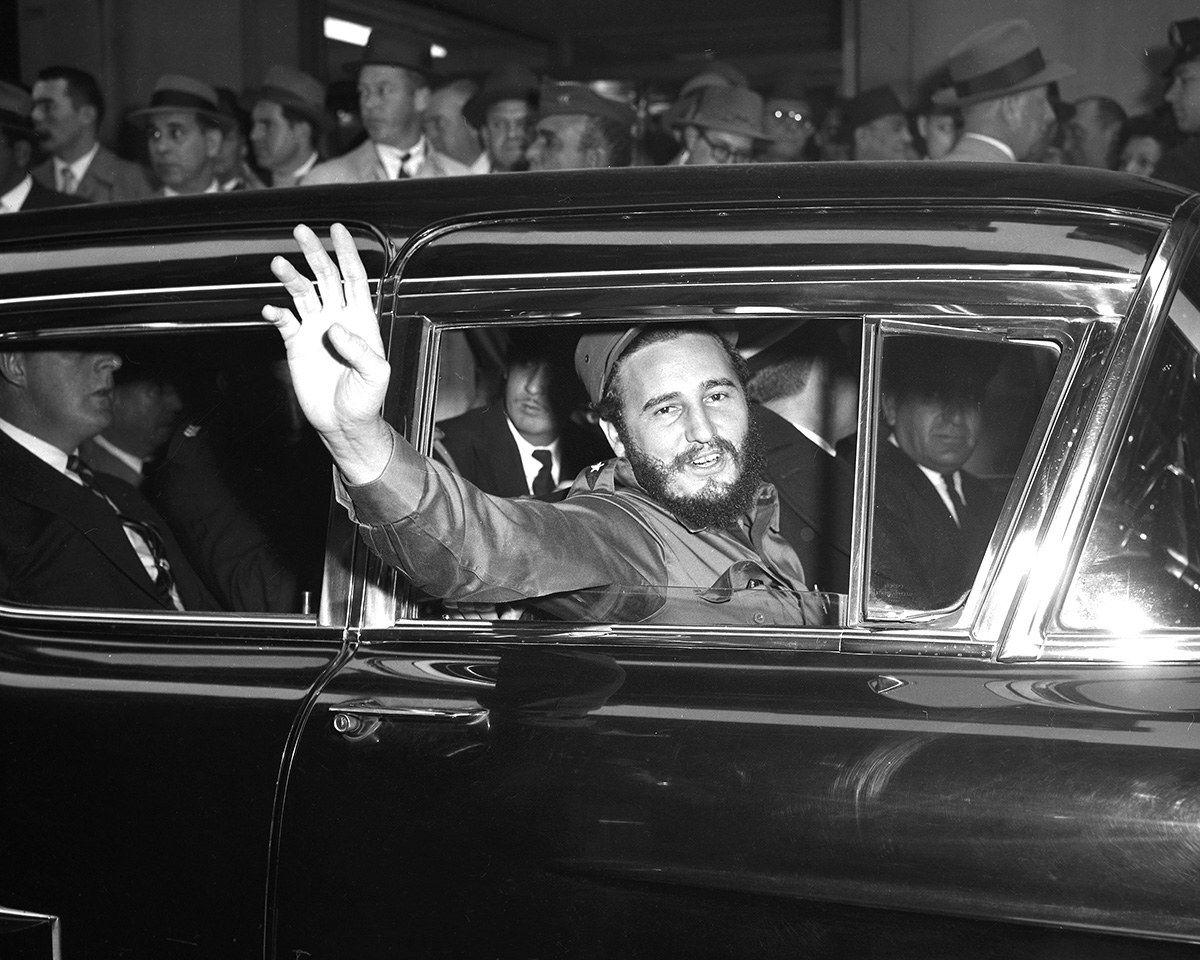
Two quotes from Fidel do much to illuminate the philosophy. Asked about racial violence in the United States in a 1960 Time magazine interview, Castro responded, “What would happen if Negroes in the Southern U.S., so often lynched, were each given a rifle?” Also that year, in an almost interminable speech given in Havana, Castro said that, “This is how democracy works: it gives rifles to farmers, to students, to women, to Negroes, to the poor, and to every citizen who is ready to defend a just cause.”
Feel free to ask farmers, students, women, Negroes, and the poor in Cuba about the ease of acquiring a rifle. We’ll get to ironies such as this a bit below.
And Castro did a lot more than talk. He welcomed every aggrieved race-hustler and revolutionary who would grace Cuba’s shores, from Robert Williams, who fled to Cuba after his dream of creating a black communist paradise in the Deep South ran him afoul of the law and who emerged as something of a Tokyo Rose as his Radio Free Dixie program, sponsored by Castro’s government, broadcast for years from Havana in the 1960s; to Stokely Carmichael, who in 1967 gave a famous speech describing Black America as an “internal colony” of American white supremacism; to Huey Newton, Eldridge Cleaver, William Lee Brent, Angela Davis, and Assata Shakur.
The innovation, then, was not the invention of race communism. It was building durable institutional infrastructure — like the Venceremos Brigade, which has recruited and trained American leftists to become revolutionaries (Los Angeles mayor Karen Bass is an alumnus) — or Instituto Cubano de Amistad con los Pueblos, the Cuban Institute of Friendship with the Peoples, which sponsors a staggering array of American leftist organizations, among them the DSA — to keep exporting revolutionary communism long after Moscow’s brand was exhausted and Mao’s brand morphed into something more like fascism after Tiananmen Square.
The State Department report is exhaustive in its documentation of Cuba’s export of revolutionary Third Worldist communism not just to America but to country after country in Latin America and even into Africa and Asia. Any study of Cuban governance, moreover, yields two observations which are difficult to get past. First is a pathological aversion to objective truth, which is surely a hallmark of all communist or tyrannical regimes but seems particularly significant within the Cuban model; and second, a certain intentional sloppiness and chaotic approach to means, in pursuit of definitive and dogmatic ends.
After all, Castro said in a 1957 interview with the New York Times’ Herbert Matthews that “I have said clearly and definitely that we are not communists.” The 26th of July Movement, which Castro led, had as its public platform the restoration of the 1940 Cuban Constitution. Castro promised free elections within 18 months, and he guaranteed freedom of the press. And yes, later he made vague promises of rifles.
But after Castro seized Havana on January 1, 1959, these promises were quickly forgotten. Eleven days after the Batista regime’s holdouts boarded the planes for Miami, the first mass firing squads began operating at La Cabaña fortress, with Che Guevara personally supervising the carnage. As for the free elections, they didn’t happen a year and a half later, or ever again.
And it wasn’t just false promises at work. The rules — of any kind — fell away soon after. The Castro regime’s theft of property owned by Cubans, Americans, and others totals to some $9 billion in then-current value, according to U.S. government estimates — interestingly enough, through a peculiar history of corporate trading and mergers and so forth, some $267 million of that $9 billion figure is owed to Office Depot, which at present value comes to more than $8 billion — and it is widely accepted that the current regime cannot and will not pay back those it stole from.
The DSA is screeching about the “economic sanctions” levied against Cuba, which first and foremost refers to the trade embargo against Havana. That embargo isn’t the product of American petulance, it’s the penalty for refusing to make good on the debts the Cuban regime owes to the victims of its theft.
This is worth recognizing when the DSA claims all they’re trying to do is to turn America into Denmark or provide free health care to the masses.
A specific portion of the DSA platform creates a definitive link to this lawlessness. “Our goal is to put workers in charge of the government through a new democratic constitution,” it says. DSA spokespeople have repeatedly advocated pulling at the basic threads holding our constitutional society, and there is a destination in mind — in a “democratic constitution,” sovereignty doesn’t flow from the agreed-upon structure of a government or a fixed social compact sitting atop a foundation of agreed-upon objective truth, but instead from the revolution’s representatives. This is the opposite of constitutionalism, not a more democratic version of it.
We don’t have to theorize how this ends. Cuban revolutionary export has produced many children, and their exploits aren’t hard to quantify.
Take elections. Castro promised them, and never delivered. Daniel Ortega, the Nicaraguan product of Cuban communist imperialism whose political longevity is as interminable and unjustifiable as Castro’s was, recently canceled them outright. Cuban ally Gustavo Petro in Colombia ran a puppet candidate who lost earlier this year and now is refusing to recognize the election results, bringing his nation to a constitutional crisis with a call for a “general mobilization.” And in Venezuela, Hugo Chavez and his successor Nicolas Maduro held elections, all right, but they simply rigged them in more and more outrageous fashion.
Venezuela isn’t alone in employing Cuban, and Cuban-trained, military, intelligence, and political operatives to prop up a Castroite regime after the public has tired of its results. That’s what a “democratic constitution” means.
Castro wasn’t the only one claiming he wasn’t a communist. “We are not going to expropriate,” said Chavez in 1998. “We are not communists.” He then won 56 percent of the vote and within eight years some 15,000 Cuban military and intelligence operatives poured into Venezuela to serve as the backbone of the Chavez/Maduro government in Caracas, their services procured with a quarter-century of free oil to Cuba — had shut down the country’s largest independent TV station, packed the Supreme Court, and drew up a new, and meaningless, constitution. Within 15 years the regime had expropriated 1,168 companies. By 2018 Venezuelan hyperinflation had reached 130,000 percent. And by 2024 GDP had collapsed 78 percent and eight million Venezuelans — a quarter of the population — fled the country.
Cuba’s official statistics bureau released numbers this week indicating that in half a decade its population has declined from 11 million to, it says, 9.4 million. The truth is almost certainly that the population is even less than that alarming figure, and the Cubans who are leaving are the people who would save the country if it can be saved —the 20-somethings, 30-somethings and 40-somethings, who still have vitality and energy left. Cubans have fled in the hundreds of thousands, many to desperate circumstances in foreign lands.
For example, a huge share of Cuban migrants in Mexico have ended up in a town called Tapachula in Chiapas, and it’s documented as a genuine dead end for them. Now that crossing the U.S. border is no longer an option, Tapachula has become a dumping ground for them and they’re legally barred from leaving Chiapas until their asylum claims are processed. Almost any job requires a residence permit the Cuban migrants don’t have and can’t get quickly. One Cuban was reported as saying, “Without papers, there are no opportunities. We migrants feel like prisoners in Tapachula.” That’s the present state of what was Cuba’s future. With those people gone, Cuba’s population is aging and dying along with the regime.
And the migrants can’t be blamed. They may be prisoners in Tapachula, but they were also prisoners back home. The average wage in Cuba? A whopping $16 per month. Some 89 percent of Cuba’s electric ratepayers pay little or nothing, as the top 11 percent are charged for virtually all of the revenue of UNE, the Cuban electric utility, but the power is theoretical rather than actual. Cuba is far past rolling blackouts — most places only have power a couple of hours a day. In Holguin Province on the eastern side of the country, they’re down to two hours a day.
For Cubans to have a standard of living and an economy comparable to America, it would require about 12,000 megawatts of power generation and a fully-functional transmission system. UNE, and its network of ancient fuel oil-based power plants and mostly-for-show renewable energy conversation pieces, generates less than 2,000 megawatts. As a result, the industrial and commercial facilities the Cuban regime stole from the producers who fled in 1959 are almost all defunct.
Yes, but this is the fault of the U.S. through our embargo! Except we are only one of 190 countries on earth. Other than captive Venezuela, which is not so captive anymore, Russia, China, and Iran, why is the rest of the world not making the investments we are not? The most obvious reason is that the Cuban regime is among the world’s biggest deadbeats, having blown through whatever credit was extended by the rest of the world and is now on a cash basis. No one will make a capital investment in Cuba, for fear of being added to the $9 billion list of crime victims. It’s a beggar regime reduced to whoring itself out to Russian and Chinese geostrategic ambitions and, increasingly, those of the various Latin American narcotics cartels.
The greatest lie — the one which has resonated among the adherents to those leftist organizations the Castroites have cultivated and supported in this country — is that Cuba bravely stands against American and Western colonialism. But no one is a more aggressive colonizer than Cuba. They’ve exported their brand of communism to Angola, Ethiopia, Nicaragua, Venezuela, Bolivia, Peru, Colombia, and countless other places. The Cuban DGI, its external intelligence agency, is almost lionized in the State Department report for its scope, reach, and aggression.
And that’s why it has never mattered that Castro’s Cuba is a domestic basket case which, after 67 years, can hardly grow sugar, tobacco, and coffee, much less make products anyone wants. None of that matters to the regime. The suffering of its people is a weapon to wield against its enemies, not a disgrace to be held accountable for. And in 2021, when nationwide protests led in no small part by Afro-Cubans — its population is one-third black — erupted, Black Lives Matter stood “unequivocally” with the regime.
Of course they did. Because the regime can do no wrong. Castro’s Cuba is the victim, and so the victims of its policies are actually the victims of Uncle Sam and his white supremacist friends.
Just like the economic collapse is irrelevant to Cuba’s failure. Castro never really promised prosperity for the Cubans, or if he did he broke that promise as quickly as the one about free elections. Instead, he promised Cuban righteousness, and that of all of the oppressed blacks and browns he claimed to represent, and he exported that promise as far and wide as he could.
And that’s the genius of the grift. When your people are reduced to less per month than Five Guys will charge for a meal, it’s not that communism has failed. Communism hasn’t been tried in Cuba because of the embargo, you see. And this excuse outlives the failure of Soviet or Chinese communism. The moral grievance lives on long beyond the end of the Cold War, just as Cuban ideological imperialism and the regime’s political and information war against the West has lost little steam despite demonstrating it can’t run an electric grid, a water system, or an industrial base.
So when you see all the same patterns and the same disrespect for objective reality, established constitutional institutions, the well-understood rules of economics and basic American history emanating from Mamdani and his DSA pals, it’s hardly a stretch to assume a very similar destination.
Nor is it a “red scare” to point out these patterns, not to mention the longstanding links between the Cuban regime and leftist outfits like Code Pink and the DSA — links which are active; let’s not forget the Nuestra America dog-and-pony show Cuba’s American clients put on in Havana earlier this year.
They’re telling you that Castroite communism is their goal, and that subjugating the colonizers, which means taking their stuff in the same way that Castro stole that $9 billion, is their solution to the economic problem of a deformed philosophy which hollows out every society on which it is inflicted.
And your pointing out to them that their results won’t be any better than Castro’s will only trigger the name-calling and vituperation.
They won’t fill the shelves of that grocery store in the Bronx. But they can fill the library with treatises about how it’s all your fault. Because rules and reality are tools of white oppression, don’t you know.
READ MORE from Scott McKay:
Five Quick Things: The Iliad Over Nolan’s The Odyssey
Zero Sympathy for the Democrats’ Political Death March
Five Quick Things: The Increasing Performative Stupidity of Our Friends on the Left