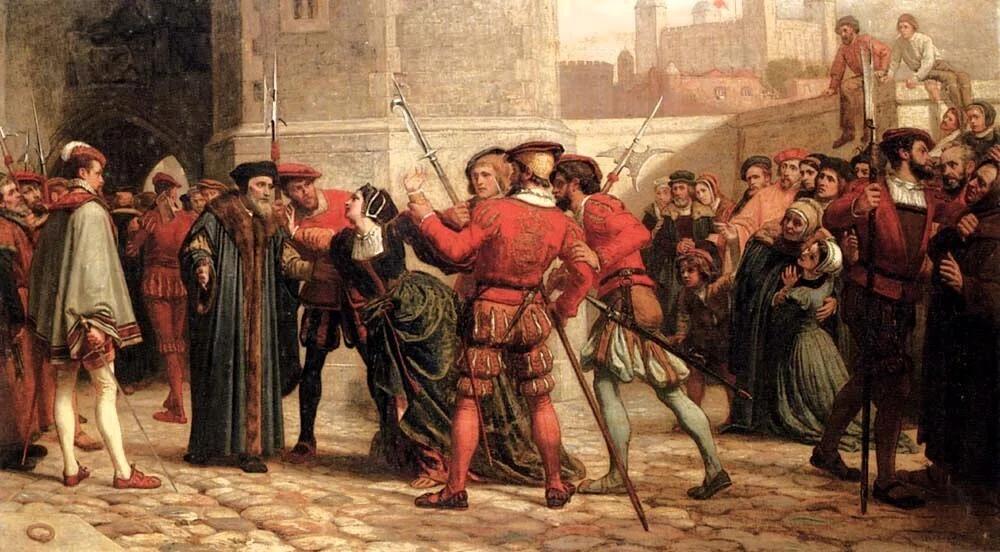


Say what you will about King Henry VIII, the man was not dense.
Although it’s true that, technically speaking, he never really received theological training, he had no problem writing a fiery treatise smacking down Martin Luther’s objections to the age-old doctrine of the Sacraments. He held back no punches, either: Luther was a “wolf of hell” and a “venomous serpent” for his rebelliousness.
As you might imagine, the whole thing went over rather well. Pope Leo X was impressed and immediately approved of the little pamphlet, Assertio Septem Sacramentorum. It was published in multiple languages and then reprinted multiple times — after all, who wouldn’t want to read what juicy things the King of England had to say about an upstart German monk?
But in the mind of the men who can be credited with our modern practice of freedom of religion … the point wasn’t separating church and state.
Just weeks after having read Henry VIII’s defense of the faith, the Pope expressed his gratitude via a papal bull granting the king the title, “Defender of the Faith.”
Years passed, and things changed. A new man sat on the papal throne, and Henry VIII was without a male heir and only getting older. His wife, the once-beautiful Katherine of Aragon, was a bit more frail and a few pounds heavier — after all, years of failed pregnancies, and the grief of losing child after child had worn her down. Henry decided to divorce her. There was just one problem: Clement VII didn’t quite buy Henry’s argument for granting an annulment to the marriage.
So Henry started his own church, divorced (and eventually beheaded) several wives, and still didn’t end up with a male heir who’d make it to adulthood. And yet, he still clung to that old title, Defender of the Faith, and so did his many heirs, at least until rather recently.
Last week, the British Royal Household released its annual Sovereign Grant Report, detailing its activities and responsibilities, and apparently King Charles has a new job description. Not only is he the “Supreme Governor of the Church of England,” but he also “protects the space for Faith within the multi-faith nation.”
To be clear, there has been no formal declaration that King Charles III is laying aside the ancient title. One imagines that, were he to die tomorrow, his successor would still be announced as the “Defender of the Faith” on the occasion of his accession. All we’ve seen is a quiet shift away from that title’s original meaning — a shift that was totally inevitable.
It’s easy enough to point to the king’s overtures towards his Muslim subjects (which make up 6.5 percent of the UK’s population), or his noted commitment to the radical European liberal ideals that animate the global elites, and conclude that this is just a bit of liberal kumbaya intended to undermine an entire Christian denomination — one that Charles III happens to co-govern.
After all, if the king is the “Defender of the Faith,” and that faith is Anglicanism, then one must conclude that, at least from the government’s perspective, Anglicanism is preferable in England to any other religion. Historically, that’s certainly true, and the fact that bishops still sit in the House of Lords at least gives the appearance that it remains true.
As it happens, however, the idea that the state would prefer Anglicanism to any other religion is offensive to modern ears.
Back when he was just the Prince of Wales, Charles did an interview in which he expressed discomfort with the old title: “I personally would much rather see it as defender of faith, not the faith, because it means just one particular interpretation of the faith.” That discomfort is perhaps somewhat justifiable.
Ever since the American Founders enshrined radical religious freedom in our country’s Constitution, the idea has been making the rounds globally. At this point, to deny the free exercise of religion or to establish any religion as being a state religion is an idea so antiquated that it appears obviously ludicrous to modern men.
One could, I suppose, read that as a statement made under the influence of global elites (given his involvement in their circles, that reading would likely be justified). It’s more charitable to read it as the realistic conclusion of a man who finds himself about to run a country with state religion in a world where a country having a state-sponsored religion is simply not done (unless that country is Muslim — freedom of religion tends to be a Western thing).
In the liberal mind, state-sponsorship of religion is not done because church and state are entirely separate entities who should bear no reference to one another whatsoever — a dogma that ceases to work when you realize that political realities make little sense without ethics, and yet ethics are the wheelhouse of religion. Either the state adopts some religion’s ethics, or it becomes a religion itself, whatever secular language it employs to disguise that fact.
But in the mind of the men who can be credited with our modern practice of freedom of religion (the Catholic Church preached a limited freedom of religion, even if Catholics weren’t good at practicing it, long before Thomas Jefferson ever conceived of the idea) the point wasn’t separating church and state. Rather, the goal was to give men the freedom to discover objective truth for themselves with the hope that conviction would follow while protecting the church from the corrupting influence of politics.
If, by describing his job as protecting “space for Faith within the multi-faith nation,” Charles means that all religions are the same and ought to enjoy the same importance and rights on English soil, then we may have a problem. If, despite the odd wording, he instead means that he will promote and protect the Englishman’s right to incessantly search for religious truth until he discovers it in union with his Creator, I’m all here for it.
One hopes, for England’s sake, it’s the latter.
Today in History
Speaking of British history, one of the men credited with helping Henry VIII write that famous theological treatise went on trial for treason today back in 1534. Why? Because Sir Thomas More wouldn’t profess the brand-new Anglican faith with Henry as its Supreme Head.
Today, Thomas More is considered to have been a brilliant man, and, more importantly, a martyr (the jury found him guilty after just 15 minutes of deliberation, and he was subsequently beheaded). The trial itself was rather famous, and Robert Bolt’s incredible imagining of it in A Man for All Seasons deserves the occasional viewing.
The Duck on the Roof
Perhaps it was a fault of the nursery books and illustrations, or maybe it was the movies, but somehow, as a kid, I developed the belief that ducks and ponds go hand in hand.
In reality, it’s generally true, but not necessarily the case.
My ignorance was enlightened sometime in high school when my parents took in a friend of a friend’s farm animals. The collection included several goats, a flock of guineas, and a number of ducks and I remember being assured that, while the ducks would probably appreciate a kid pool full of water, the amenity was not strictly necessary.
Sure enough, it was not. The ducks mostly kept to themselves and proved to be slightly more amenable to coexisting with humans than our chickens — although they also proved themselves slightly better at hiding eggs than the chickens. The temporary arrangement became permanent, and at some point (as so frequently happens on a hobby farm), the ducks slowly disappeared, probably due to the family of raccoons that lived in our barn at the time.
That was the extent of my experience with ducks until rather recently.
Sometime in March, the ducks appeared on our front lawn.
To be clear, we live in a townhome complex. There’s a river on one side (if you go hiking a bit) and a busy road on the other. It’s quiet, but not that quiet.
Apparently, it’s peaceful enough for the ducks, because they keep coming back. First to the front lawn. Then to the roof opposite our row of townhomes. And there they’ve stayed.
Every now and then the graceful coo of the mourning doves and the chatter of the robins are punctuated by a “quack.” If you look up, there’s the outline of Mr. Mallard, in stark relief against the sky as he waddles his way towards the nearest chimney.
I suppose God has to keep us laughing somehow.
READ MORE from Aubrey Harris:
Socialism Just Had a Shocking Come Back. We Need a Better Response
As America’s 250th Birthday Approaches, Let’s Talk About Patriotism