


Three years ago, Olga Pavlovsky spent her workdays crawling on her hands and knees through minefields. By the way, I’m not using her real name. Some details in this story have been changed, and Olga herself is a composite of several women I met through HALO Trust’s demining operations in Ukraine.
In a war zone, names can be dangerous and details can identify people. The events, however, are true.
Olga was in her early thirties, a mother of two, and like many people working for HALO, she had been displaced by the war. Her family came from Ukraine’s Donetsk region. When Russia’s invasion uprooted millions of Ukrainians, HALO recruited many internally displaced people into its rapidly expanding mine-clearance program. After weeks of training, Olga found herself doing one of the most dangerous jobs in humanitarian demining: searching for trip wires.
The work was slow, exhausting, and unforgiving.
Wearing body armor, protective equipment, and kneepads, she would move through suspected minefields inch by inch. In front of her she carried a slender stick about two feet long. The tip was painted white so that an almost invisible trip wire would stand out against it. She would advance a few inches, carefully move the stick through the vegetation, study the ground, then advance again.
Ninety-nine times out of a hundred she would find nothing with her probe.
The problem was the hundredth time.
The nearly invisible wire might be attached to one of the deadliest anti-personnel mines used in the war. Some are dropped from aircraft. After landing, they right themselves and shoot out four trip wires extending outward in different directions, each one stretching up to forty feet. They are designed to be difficult to see and easy to trigger.
A deer wandering through the woods can set one off. A dog chasing a squirrel can trigger it. A child taking a shortcut through a field can stumble into one.
When activated, the mine produces two explosions. The first launches the device upward to approximately chest height. The second shatters a metal fragmentation jacket into hundreds of jagged pieces, each roughly the size of a pea. The fragments spread outward at tremendous speed. Victims are often struck dozens of times simultaneously.
Survival is unlikely.
What made the work particularly difficult was not only the danger but the concentration it demanded. Hour after hour Olga would inch forward knowing that a momentary lapse in attention could cost her life. There was no room for distraction, fatigue, or daydreaming. The psychological strain could be as exhausting as the physical work.
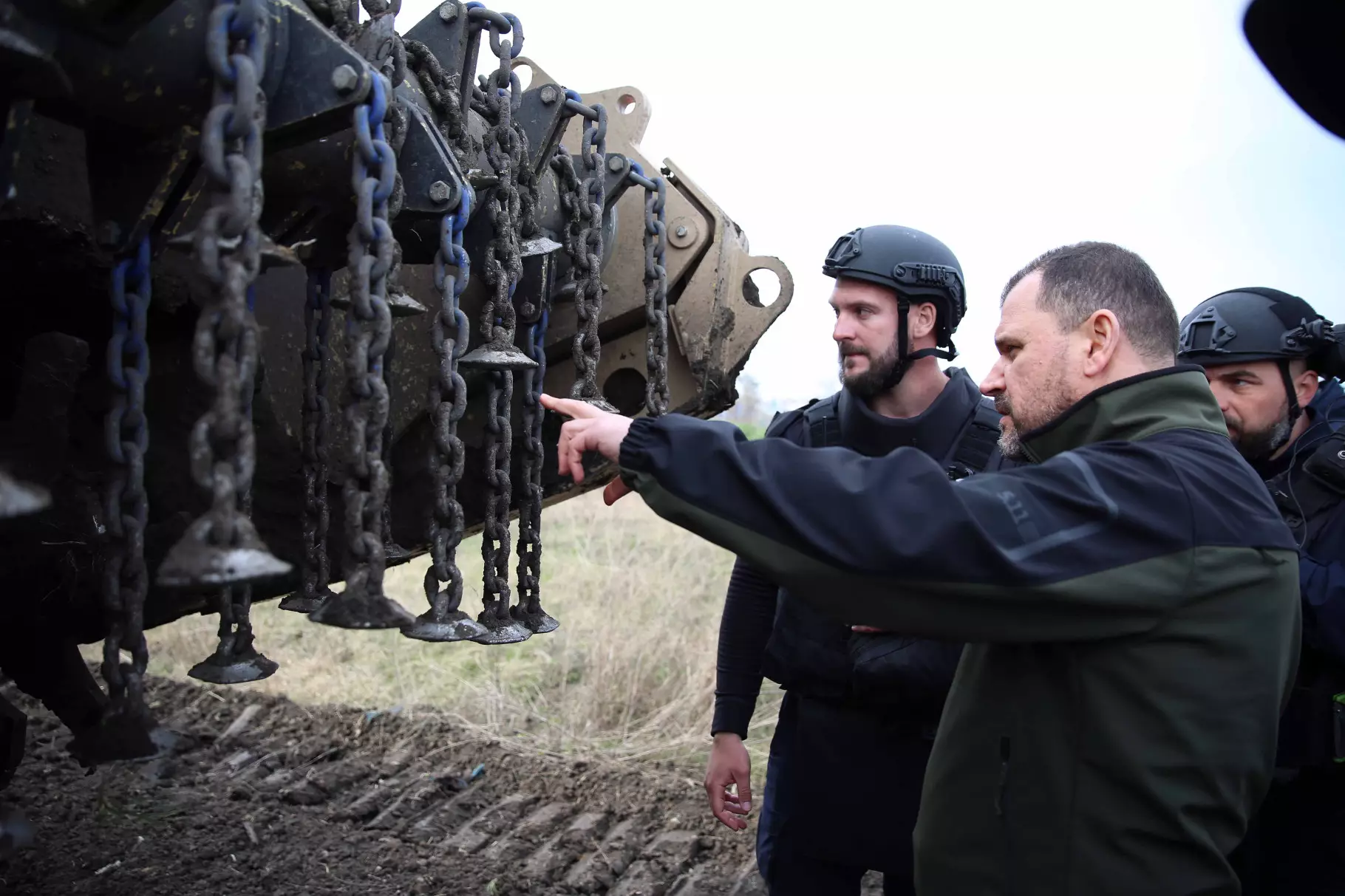
Today, much of that work is done by machines.
Today, at the HALO mine-clearance operation near Ivankiv, about forty-five minutes northwest of Kyiv, Olga is working on what should be the completion of the area she’s been working on for nine months. She’s part of two teams of nine deminers each, and in hours, it’s likely that the work here will be finished.
The situation is so different from what Olga was experiencing three years ago. Technology is making the difference.
Near the field where Olga was now working was one of HALO’s mechanical clearance systems. It looked a bit like an oversized lawn mower equipped with heavy cutting teeth capable of chewing through dense vegetation.
Tasks that once required a person to make their way through dangerous terrain can now often be performed remotely. Depending on conditions, a machine may clear hundreds or even thousands of square yards in a day. What once exposed a deminer like Olga to constant risk can now be accomplished faster and with far less danger with an autonomous machine.
That progress was visible all around us.
On a map shown to me by HALO staff, every red dot represented a mine or explosive hazard that had been discovered. Months earlier the map had been covered with them. Now nearly the entire area was green, indicating land that had been cleared and returned to the community.
The transformation represented more than efficiency. It represented hope.
When the inspectors complete their final quality checks, local residents will begin to use the land almost immediately. Children will play there. Families will gather mushrooms in the woods. People will walk their dogs without fear of hidden explosives. Because the area sits near a busy intersection, roadside vendors will set up stands selling vegetables, preserves, berries, and baked goods.
The official handover ceremony might not take place for weeks or longer, but the community gets to enjoy the land now. Olga Pavlovsky gets the satisfaction of knowing she has changed the lives of local residents, and that, thanks to better technology, she did it faster and more safely than ever before. Ukraine will need this kind of patient, dangerous, deeply human work for years to come, and supporting humanitarian demining is one of the clearest ways to help Ukrainians reclaim their homes, fields, roads and childhoods.




















