


Today, no one reasonably well-informed doubts that America faces serious perils. And notwithstanding President Trump’s strong foreign policy leadership, the greatest threats to our country still come from within, rather than from foreign adversaries.
Recent statistics indicate that violent crime has decreased from 2024 to 2025 by an estimated 9.3 percent, in categories such as murder, robbery, rape, aggravated assault, and property crime. These are conventional crime categories reported to police. However, “lawlessness” can mean different things to different people.
Clearly, we are called to stand firm for what is truthful, just, and honorable, and actively oppose deceit, falsehood, and those whose actions weaken or undermine America.
These crime statistics don’t capture things like riots, disorder, vagrancy, unlawful occupancy, public perception of unsafety, white-collar government and corporate crime, cybercrime, and fraud. In short, public perception of crime often diverges sharply from the measured data.
A study by Pew Research sheds light on this divergence by focusing on the state of trust in related and overlapping areas in both the private and public sectors. A summary of Pew Research’s findings:
- Interpersonal, social, and societal trust has been declining. A combination of multiple long-running surveys found a 23-point decline in social trust since 1964.
- Trust in the federal government “to do what is right” fell from a high of nearly 77 percent in 1964 to the low 20s in recent years. Much of that sharp decline came with COVID pandemic lockdowns, the unproven mRNA emergency use vaccinations “forced” on the public, and overt censorship by government to corral the public into accepting unprecedented violations of Americans’ civil liberties and constitutional rights.
- Trust in institutions has greatly eroded and is increasingly polarized. The decline extends well beyond government. Trust in historically respected institutions, such as the news media, higher education, and science, has taken a significant hit in the post-pandemic years — a defining feature of which is that these shifts have a partisan cast, with supporters of one party radically shifting their views and actions, even as the other remains steadfast. The result has been that institutional mistrust is increasingly intertwined with political polarization.
- Social connection and community trust have weakened. Time-use studies show Americans spend more time alone and less time socializing, spend more time at home, and even walk faster and socialize less in public than a few decades ago — trends that may have been in place before the COVID pandemic, but certainly accelerated during and after the pandemic passed.
The loss of public trust and confidence seems most concentrated in groupings, such as the “pharmaceutical-medical-industrial complex,” the “educational-media-information industrial complex,” the “technology-intelligence-surveillance industrial complex,” and “the litigation-lawfare-industrial complex.” All these groupings involve government and politics.
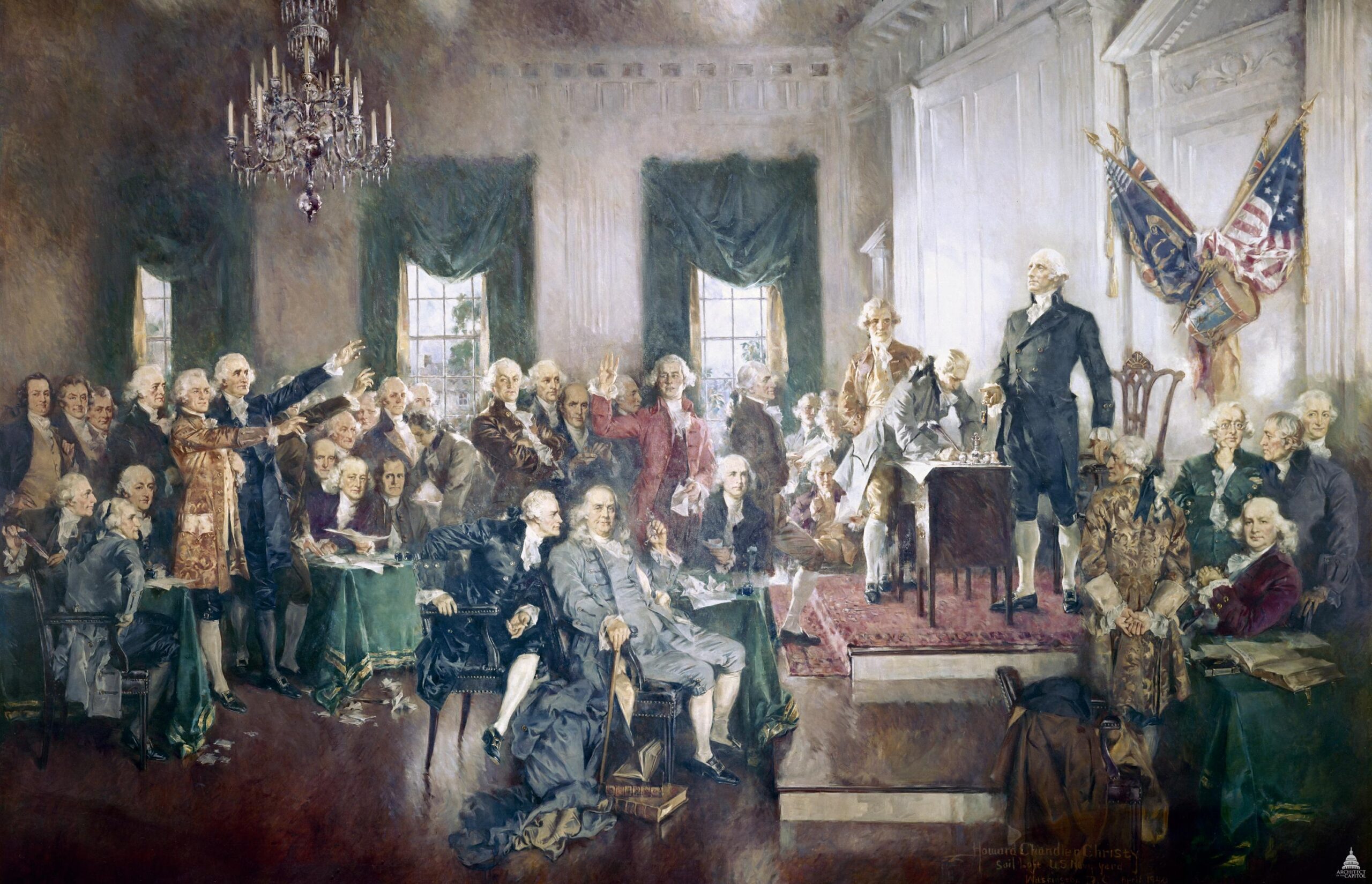
What is particularly noteworthy is how far we have departed from and how much we need to take heed of our nation’s foundation, as expressed by our early presidents, such as Washington, Adams, Madison, and Lincoln. Each understood that trust was rooted in truth and honorable people, in contrast to contemporary times in which there is a diminished shame in society and the public square for dishonorable behavior that weakens and destroys the trust factor — conduct which in turn contributes to undermining and potentially impaling America.
George Washington was direct and articulate about the internal dangers that he described in 1796. Announcing the Farewell Address as “a warning from a departing friend,” it was so profound and in demand that it was reprinted more than the Declaration of Independence. Prophetic in nature, it warned of four sources of internal peril to the American Republic. And these are more relevant now than ever before:
First, Washington was concerned that the Republic would be in constant danger if the public were poorly informed. Stating the problem in the affirmative, Washington said: “In proportion as the structure of a government gives force to public opinion, it is essential that public opinion should be enlightened.”
Second, he warned about the dangers of factionalism that would come with political parties, which could “subject the nation to the will of a party.” Worse, he warned that political parties “open the door to foreign influence and corruption, which finds facilitated access to the government itself through the channels of party passions.”
Third, Washington was concerned about excessive use of debt to finance government programs and projects, and specifically advised that debt should be used “as sparingly as possible,” to avoid an accumulating encumbrance, and “throwing upon posterity the burden which we ourselves ought to bear.”
Fourth, Washington’s Farewell Address message stated, “Of all the dispositions and habits which lead to political prosperity, religion and morality are indispensable supports.” Religion and morality were not just necessary for the political system to function properly, but also for the lives and welfare of the people, upon which their prosperity, the security of their property, oaths, and contracts all depended.
John Adams, the second U.S. president, is most famous for his national moral imperative invocation, expressed in his statement in 1798 that, “our Constitution was made only for a moral and religious people. It is wholly inadequate for the government of any other.”
James Madison, the fourth president, took a similar position, however different, that the success of self-government depended on the virtue of the people. At the time of Virginia’s Convention on the Ratification of the U.S. Constitution on June 20, 1788, Madison said, “To suppose that any form of government will secure liberty or happiness without any virtue in the people, is a chimerical idea.”
President Lincoln also recognized the need for Americans to be vigilant and cultivate civic virtue, which included the ability of citizens to recognize the enemy within. He had a long runway before becoming president in clearly explaining how “public trust [was] the essential civic bond.”
In his 1838 Lyceum Address, Lincoln said, “if [danger] ever reaches us, it must spring up amongst us; it cannot come from abroad. As a nation of freemen, we must live through all time or die by suicide.” On another occasion, Lincoln said, “The people … are the rightful masters of both congresses and courts — not to overthrow the constitution, but to overthrow the men who pervert it.”
Toward the close of the horrendously destructive Civil War, Lincoln delivered his Second Inaugural Address in which he said, “With malice toward none; with charity for all; with firmness in the right, as God gives us to see the right, let us strive on to finish the work we are in; to bind up the nation’s wounds.”
This year is, of course, America’s 250th anniversary, and we face challenges on many more fronts than during the War of Independence or the Civil War. Inasmuch as the Founding Fathers and Lincoln were all willing to give their lives, fortunes, and sacred honor to establish and save the nation, how should Americans now think about their obligations?
The upcoming July 4, 2026 holiday, the quarter-millennial celebration of America’s birth of freedom formalized in the Declaration of Independence, gives us just such an opportunity. Clearly, we are called to stand firm for what is truthful, just, and honorable and actively oppose deceit, falsehood, and those whose actions weaken or undermine America — both its moral, cultural, and spiritual base, but also the Constitution that was established on that foundation.
READ MORE from Scott S. Powell:
Memorial Day and the Meaning of American Reconciliation
Thanksgiving: Why It Is America’s Foundational Holiday
Scott S Powell is a senior fellow at the Discovery Institute. His book, Rediscovering America — a previous #1 new release in history at Amazon for eight straight weeks — captures the essence of this year’s Quarter Millennium 250th anniversary of the American Declaration of Independence (https://www.amazon.com/dp/1637581599). Reach him at [email protected]




















