
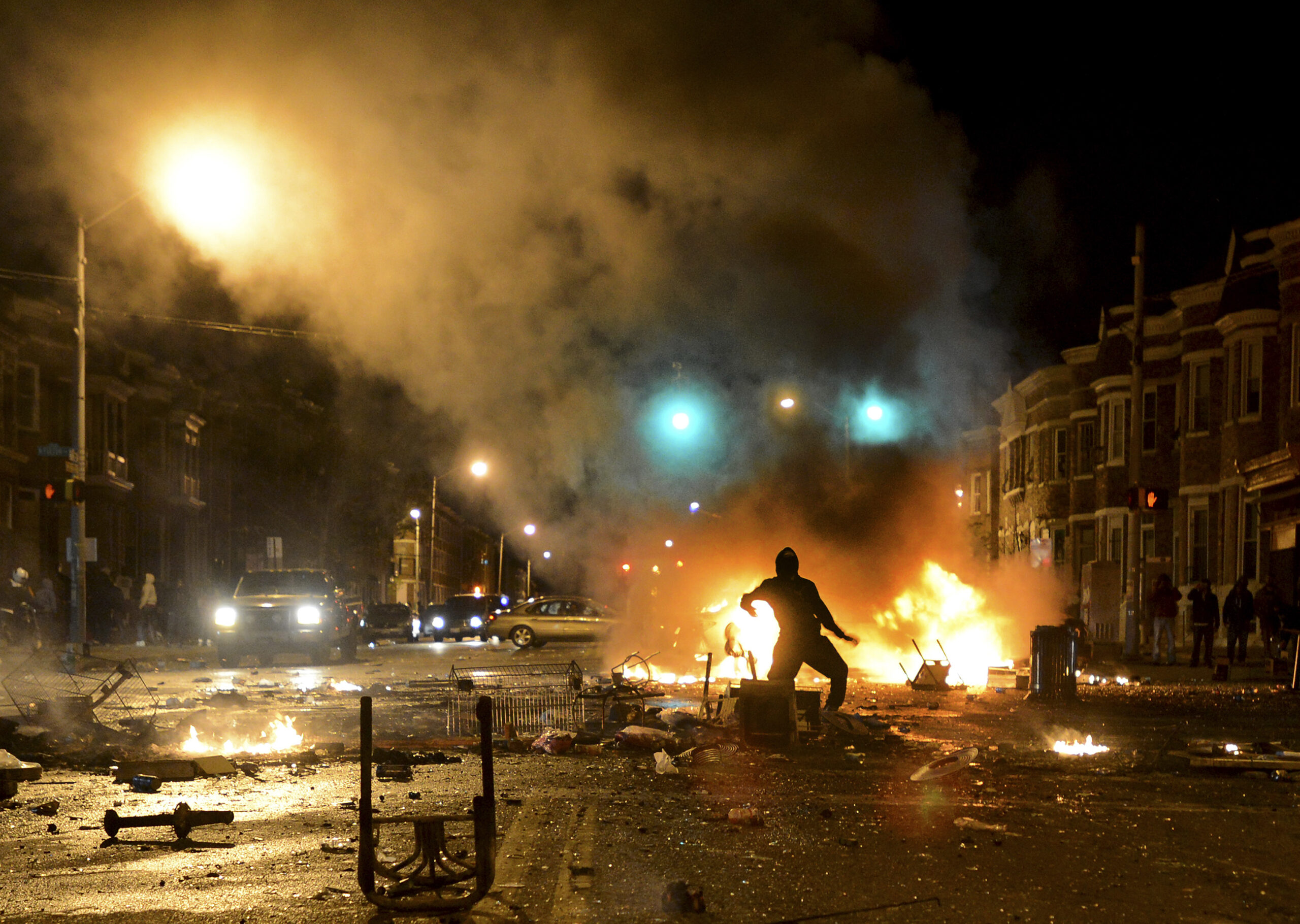


A good friend recently asked me a very thoughtful question. Reflecting upon our seeming inability to address the persistence of anti-ICE rioting, he noted that the Sixth Amendment guarantees the accused the right to a speedy trial and asked, “but what about society — don’t we also deserve a speedy trial?” It is, I think, a very good question.
In the criminal justice system, the victims include both the actual victim and society itself. However, in the now prevalent “bend over backward” approach to protecting the rights of the accused, we seem to have lost altogether the presumption of justice for victims and for society as a whole. This matters in ways that extend far beyond any narrow concern for “victims’ rights.”
What we’ve seen repeatedly over the last few years, from George Floyd to pro-Hamas, to anti-ICE, is the deliberate weaponization of protest.
Don’t get me wrong. I’m a firm proponent of victims’ rights, but by this I mean the rights of genuine victims, not the artificially inflated “rights” of the left’s favored classes. As I’ve argued repeatedly, our current justice system pays only lip service, at best, to the rights of genuine victims. This starts with “progressive” prosecutors who use “prosecutorial discretion” as a tool to protect their favored classes. It continues with progressive judges who either dismiss brutal crimes with inconsequential sentences, or who allow defense attorneys the freedom to spin out the delivery of justice while perpetrators remain on the street. We’ve seen how this works, too many times to catalog here.
But I firmly believe that there is a larger concern, and that is protecting the rights of society. When fear governs how ordinary citizens try going about their daily lives, then something is deeply wrong. At the most basic level, this is about control of our public spaces. Recently a 66 year-old grandmother was stabbed to death on a subway train in Atlanta. This can’t be spun as racial; both victim and perpetrator were black. This was but the most recent in an increasing number of violent crimes in the Atlanta subway system.
It’s not just Atlanta. Far from it. Some time ago I wrote with disgust about the brutal murder of Iryna Zarutska on a Charlotte transit system car. One could easily fill several pages with descriptions of similar horrors. Nor is it just about public transport. In recent years street crime has spiraled alarmingly across most of our major cities. For example, more people were killed in Chicago in March than military personnel were killed in the war with Iran. It’s no wonder that the iconic Chicago Bears NFL franchise is looking to relocate to suburban Indiana.
The prevalence of murder, obviously, represents an attack on the rights of society. It’s not just murder, or even the increasingly common brutal beatings. Other attacks on public order also corrode the rights of society. We can sympathize with the homeless, but homeless encampments frequently deprive ordinary citizens of safe passage along streets and through public parks.
When I was still taking commuter trains to and from downtown D.C. on a regular basis, I found myself accosted regularly — and often aggressively — by panhandlers. Women had it worse, often being treated to ugly sexual commentary if they didn’t come across with at least $5.00, which seemed to be the minimum these men — and they were almost always men — were willing to accept without turning overtly hostile.
Even behaviors routinely dismissed as “innocent” are deeply damaging to the social fabric. Take shoplifting. What was once done sneakily — in itself highly problematic — has now become a “in your face” proposition, done openly, defying, often aggressively, any response from store clerks or fellow shoppers.
We’ve recently been treated to the phenomenon of “teen takeovers,” crowds of teens gathering to dominate shopping streets or malls. This is often characterized as innocent youthful exuberance, but when it forces patrons to seek shelter from the jostling crowd or struggle to protect their small children from public sexual demonstration, then it’s hard to see it as anything other than a vicious abuse of the public commons. A “takeover,” by definition, is something inherently aggressive.
Which brings us to the original source of my friend’s question. Too often forgotten in the discussion of the rights of protestors, is that the rights guaranteed are those of “peaceful assembly.” What we’ve seen repeatedly over the last few years, from George Floyd to pro-Hamas, to anti-ICE, is the deliberate weaponization of protest. Streets and bridges blocked, rocks thrown, law enforcement officers and innocent bystanders physically attacked.
Yet we’re forced to accept that only the most egregiously criminal actions merit arrest, and that, even then, prosecutions are spun out endlessly and then dropped, while the perpetrators proceed, draping themselves in the mantel of “free speech.” Even when prosecutions lead to convictions, the leftist machine is quick to make martyrs of the convicted and offer all manner of psychic and practical rewards. Instead, it is the ICE agents or such individuals as Daniel Penny who are stigmatized and threatened.
The father of our own Ben Stein, the renowned public economist Herbert Stein, famously coined the axiom “Stein’s Law,” which states that “if something cannot go on forever, it will stop.” I would like to think that this applies to the deterioration of public order across the United States, particularly in our major cities. But when and how it will stop is another question, and here I’m much less sanguine.
The signs as of this morning are mixed. On the one hand, Iryna’s murderer has been ruled incompetent to stand trial “at this time.” We’re asked to ignore the fact that he was competent enough to navigate the streets of Charlotte and board a train, competent enough to identify and strike a defenseless victim. The “at this time” phrase is carrying a lot of weight. Perhaps with treatment — and he’s being held for treatment — he’ll someday be held competent and forced to account for his action. But all too often we’ve seen how this plays out.
We might take encouragement from the fact that, in spite of demonstrations both across the U.S. and outside the courtroom, a Texas jury yesterday found the courage to follow the overwhelming evidence and convict Karmelo Anthony of murder, sentencing him to 35 years in prison. Well-funded appeals will no doubt follow, and, again, a final resolution will likely be strung out. Still, in the current climate, this represents a step in the right direction for victim’s rights.
If one looks at the recent election of Zohran Mamdani in New York City, or Katie Wilson in Seattle, or a now likely runoff between Karen Bass and the even more egregious Nithya Raman in Los Angeles, it looks as if the race to the bottom has a few more years to run. The decks are stacked against sane alternatives, as illustrated by Chicago’s Brandon Johnson, the candidate of the Chicago teachers’ union. Whether through naked political power, as was the case in Chicago, or the outright fraud that appears to be in play in Los Angeles, the forces aligned against public order remain on the march.
They will, however, overplay their hand — they always do. And people, a steadily increasing number of people, are becoming increasingly fed up. One hopes that this will translate to change at the ballot box, which, after all, is the way our country is supposed to work. Whether it’s individual acts of violence or well-funded and coordinated street terrorism against ICE, the answer to my friend’s question remains unclear. If, as the saying goes, “justice delayed is justice denied,” when will society once again enjoy the swift and certain justice it deserves.
Still, society’s demand for justice is becoming more insistent every day, and, one way or another, the time will come when society insists that justice is once again both sure and swift. This can’t come soon enough for those who love this country and wish to live safely in peace.
Because it can’t go on any other way.
READ MORE from James H. McGee:
Iran War: The End of the Beginning
James H. McGee is a retired nuclear security and counter-terrorism professional. His most recent novel, The Zebras from Minsk, was featured among National Review’s favorite books in 2025. You can find The Zebras from Minsk and his previous thriller, Letter of Reprisal in paperback and Kindle editions at Amazon.




















