


The Austrian neurologist Martin Pappenheim is said to have visited and briefly interviewed Gavrilo Princip in prison during the height of the First World War. The state of the Serbian gunman’s mind was naturally of some interest to the professional analyst, and one of Princip’s answers gives the amateur historian fodder for reflection: when asked if he felt any guilt for the outbreak of the war that would consume more than 15,000,000 lives by its end, Princip stated that he did not. While he regretted the terrible suffering the war had inflicted on his country, he felt no compunction for his own part in kindling the conflagration, which, as he saw it, “would not have failed to come” whether or not the Austrian Archduke’s chauffeur had taken a wrong turn down a certain street in Sarajevo.
Social and economic tendencies may account for many things, but not for beings like St. Joan.
A great number of the theorists of history would agree with him. After two World Wars especially, the old-fashioned habit of reading history as mainly a succession of great individual spirits molding the materials of their times to their intended purposes has been increasingly abandoned. The past has come instead to be visualized as a series of temporal forces and movements that make their entrances and exits without depending essentially on private human wills and personalities. History, it is supposed, would not have been immeasurably different if Augustus Caesar, Mohammed, Charlemagne, or Martin Luther had never lived and acted. There is something in this outlook that appears reasonable, and even flattering; it allows the great majority of us who are not Titans to feel that our own part on the world stage might not be restricted to staring up at the giants who overshadow us. Maybe all of us, from Napoleon to a nameless soldier freezing to death on the retreat from Moscow, are in an ultimate sense supernumeraries. No great character was necessary and every great event was inevitable. I suspect that everyone given to thinking about these things at all has felt this in a certain mood; such a mood, however, might not be quite worth exalting into a philosophy of the past.
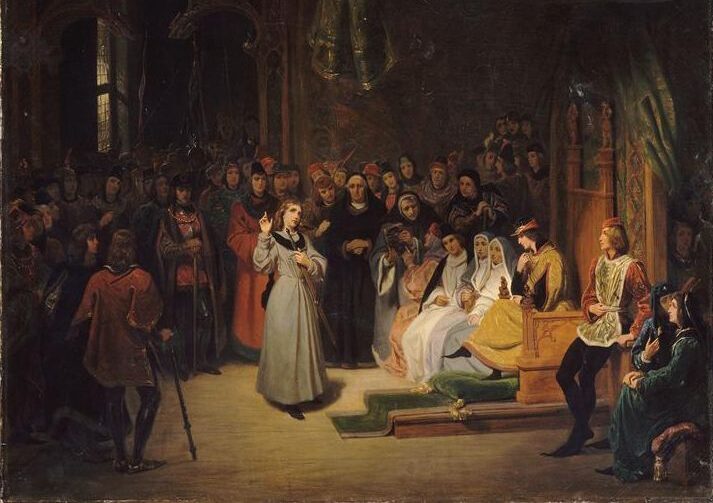
More than one reason makes me think this; to concentrate on one item of counterevidence, consider St. Joan of Arc, whose feast day has just passed by.
Only the slightest details of her life before she rose to sudden fame are known to us. It is not recorded that any of her family or circle of acquaintances during her childhood thought her to be obviously marked out as a creature of destiny. She was alertly pious, but so were many children in her day and since, and it would be mistaken to assume that the great part she would later play in her country’s salvation was foreshadowed from the cradle onwards. Heroes are not heroes from the crib, and saints are not born wearing halos, a fact sometimes forgotten by their biographers. She was not necessary to the cause of France until she proved herself so.
The proof was in her doing what more than one saint has done across the ages: a thing that was both practically needful and impossible to do. Joan rode out of her village in Les Vosges to see to the coronation of France’s still unrecognized king, and to expel from her country the triumphant English.
The full weight of these impossible tasks may be felt when we consider that the king in question was a despised man whom very few people, saints or otherwise, would wish to follow into battle. His very legitimacy and right to the throne were questioned by many. France was herself divided into the dueling camps of the Armagnacs and the Burgundians, so that the country was riven by civil war while lying simultaneously under the feet of foreign armies. Apart from Joan, most of those whose responsibility was the defense of France seem to have regarded their nation less as a great vessel to be guided out of the present tempest and more as a hopeless shipwreck from which they might scavenge a few spoils for their own advantage. That Joan was able to rally such an unpromising company for any patriotic object, especially one so bristling with challenges, is nearly as impressive as her success at Orleans — a victory which, if it did not signal the war’s end, was no less the victory that made France’s final triumph possible.
By any reasonable law of probabilities, she should have been able to carry out none of these things. By the same law of probabilities, her early successes might well have filled her with an inflated sense of her own importance. They appear to have done no such thing. After the French had carried the day at Orleans, she expressed the wish to return to the obscurity of Domremy, “to tend sheep with my brothers and sisters.” It may have been purely out of humility that she wished for this, or — equally plausible — that at the age of seventeen she had tasted enough already of events. Whatever its reason, her wish would not be granted. There would follow soon enough the Siege of Compiègne, her capture by the Burgundians and sale to the English; her trial at Rouen, the condemnation by the infamous magistrate Cauchon — and at last the fire, and the scattering of her ashes in the Seine.
Every saint is in some sense blessed to see and to fathom what to the rest of us is invisible or despised. Holiness is always mysterious, and in Joan even more so for making her both simpler and more sensible than the lords and courtiers and men-at-arms whom she served beside. In his History of the English Speaking Peoples Winston Churchill offered the following tribute: “Unconquerable courage, infinite compassion, the virtue of the simple, the wisdom of the just, shone forth in her. She glorifies as she frees the soil from which she sprang.”
It may be added to this that she contradicts the facile inclination of the historian to speak of the past as a chain of social, economic or other tendencies that leads down predictably and undramatically to the present. Social and economic tendencies may account for many things, but not for beings like St. Joan. Her story is at once too wonderful and too tragic for that. She lived swiftly and with an unbreakable assurance of her purpose. She was not yet twenty when she died, by which time she had reversed the course of an unwinnable war and shown to a defeated nation that its defeat need not be permanent. In these few years she did so much that was impossible, and was herself an impossibility.
READ MORE:
Pope Leo XIV on Immigration: Order, Dignity, and Misconception
Pope Leo: Rely on Your Brain Rather Than AI
Maximilian Kolbe’s Triumph at Auschwitz
Thomas Banks lives in North Carolina and teaches online at the House of Humane Letters. His writing has appeared in First Things, Quadrant, the European Conservative, the New Oxford Review, the North American Anglican, and elsewhere.




















