
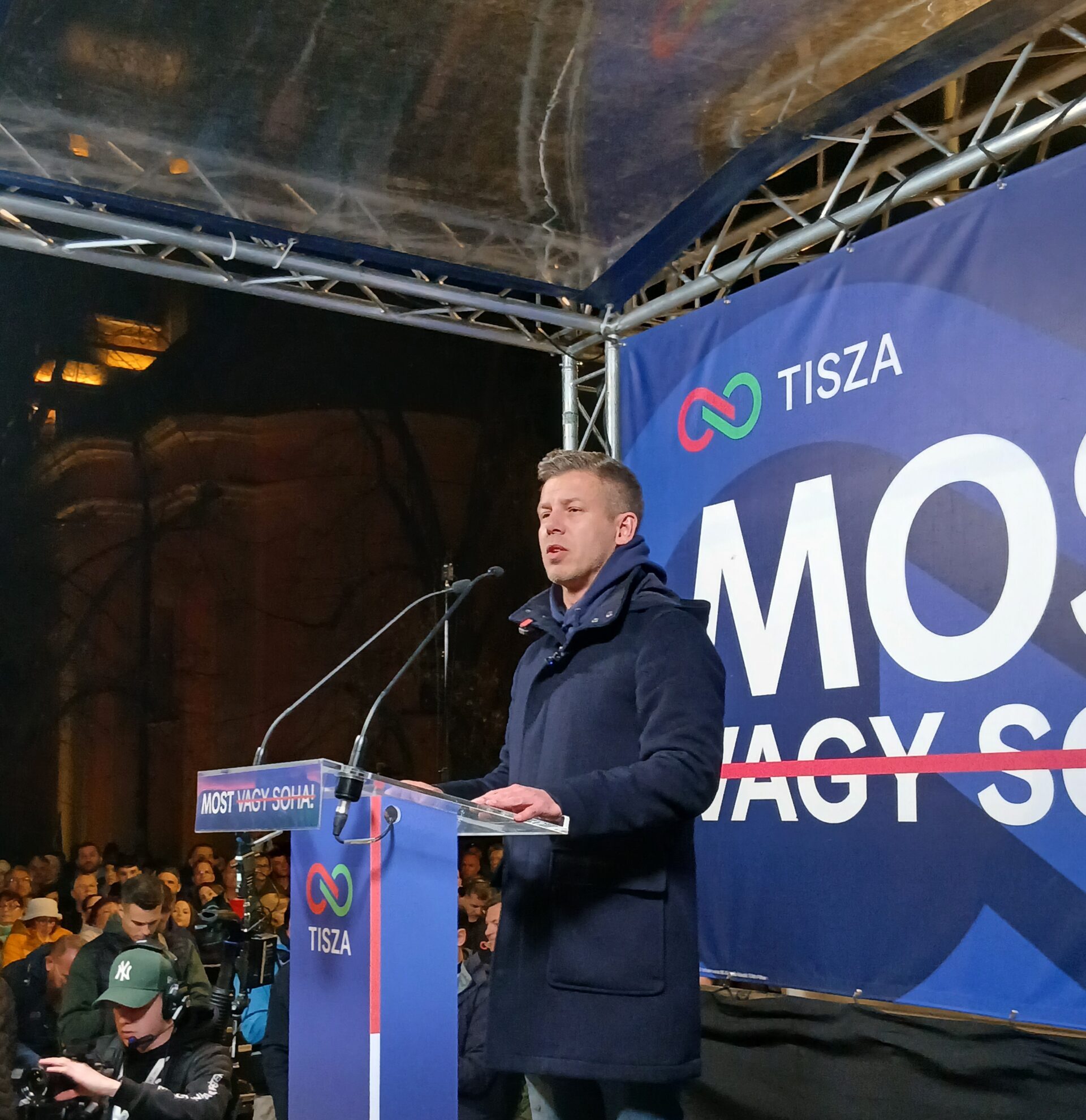


Péter Magyar’s landslide victory is neither the victory of the left nor the victory of the right. It was a victory of Hungarian democracy.
When 18–24-year-old young people traveled back to Hungary en masse, fearing that their votes might be stolen, they fanned out in teams of 20 across rural Fidesz strongholds. They convinced traditionally Orbán-supporting, war-fearing grandparents that the reason their grandchildren live hundreds of miles away with no intention of returning is the government’s conduct, corruption, and cronyism. If grandparents wanted to see their family again, they were told, they should vote for Tisza — because this was an internal correction, not ideological betrayal as they stand unapologetically for Hungary: anti-migration, anti-war, proudly Hungarian without supporting Orbán.
On election night, as I drove at nearly 150 mph toward Budapest to meet my son, the police stopped me. After I explained my speed, they let me go, waving a Hungarian flag and urging me onward with a grin: “Go — it’s a special night.”
Hungarians went to the polls and chose internal renewal on their own terms: accountable governance rooted in heritage, not imported ideologies.
That personal moment mirrored the national mood. In an election with nearly 80 percent turnout, the Tisza Party secured a two-thirds parliamentary majority, garnering support from across the political spectrum and ending Viktor Orbán’s 16-year rule.
The symbolism Magyar has embraced explains why his appeal transcends left-right binaries: he offers systemic reform without surrendering the nation’s soul.
At events commemorating the 1848 Revolution, Magyar appeared in the Bocskai suit — a formal, braided Hungarian national costume inspired by 17th-century Prince István Bocskai’s anti-Habsburg uprising. His version incorporates the Tisza Party’s infinity-loop logo, fusing folk heritage with modern branding. The choice signals unapologetic pride in Hungarian culture and resistance to external domination. It positions Magyar as a leader rooted in the countryside’s folk nobility rather than Budapest elites or progressive puppets of the international Left. It resonates like American conservatives’ embrace of flag pins, and songs that celebrate the homeland as it truly is.
Equally potent is his promise to open the new parliamentary session with the Hungarian national anthem followed by the Székely (Sekler) Anthem. A 1921 poem-turned-song is deeply tied to ethnic Hungarians in Transylvania, it speaks of suffering, resilience, and unity across borders. Its inclusion evokes the mystical, historical Hungary of the pre-Trianon era. This is no mere gesture; it asserts that a nation is people bound by shared history, values, and faith.
The theme deepens with the historic decision that all MPs, will swear an oath to the Holy Crown of Hungary. The thousand-year-old relic, symbolizes Christian statehood, legal continuity, and national sovereignty in Hungarian political theology. Magyar has publicly prayed before its display. Reviving the pre-communist monarchic-era oath rejects the purely secular in favor of Hungary’s deeper heritage. In a country where the Crown is revered as a sacred expression of sovereignty, this reassures Christian-conservative voters that breaking with Orbán is purification, not rejection, of traditional values — the kind of symbolic stand American traditionalists applaud when leaders reaffirm Judeo-Christian foundations by swearing oaths on the Bible.
Magyar’s speeches frequently quote Lajos Kossuth, the fiery 1848 revolutionary, and István Széchenyi, the “Greatest Hungarian” known for pragmatic modernization. By invoking both, he bridges revolutionary zeal with cautious reform. Most powerfully, he has framed the current moment as a “moment of grace” akin to 1848 and 1956 — the anti-Soviet uprising that remains a cornerstone of Hungarian identity. In 1956, Hungarians rose against totalitarian rule, demanding freedom and sovereignty. Their sacrifice, crushed by Soviet tanks, became a beacon of national dignity. Yet last year, on the 69th anniversary, the Orbán government’s commemoration was notably subdued and politicized, subordinating historical memory to contemporary foreign-policy messaging. Magyar’s rival events reclaimed the day with fuller patriotic fervor, reminding voters that 1956 stands for uncompromised national assertion, not selective silence.
His personal and strategic choices reinforce this continuity: Tisza vice-president Márk Radnai, son of the leader of the far right Mi Hazánk (Our Homeland), presents a broad patriotic front without endorsing extremism. This demonstrates a willingness to unite cultural assertiveness with anti-corruption reform.
These symbols translate into policy positions that defend Hungarian interests abroad, positions the left would immedately brand revisionist. On April 14, 2026, when Romanian authorities attempted to evict Premonstratensian Abbot Rudolf Anzelm Fejes from the historic church and monastery in Romania amid a communist-era property confiscation dispute, Magyar intervened as incoming prime minister, declaring firm opposition and diplomatic support for the Hungarian Catholic community. The move earned immediate praise from Our Homeland leader László Toroczkai: “The homeland and the Hungarian nation come first.”
In Slovakia, Magyar’s first call with Prime Minister Fico conditioned deeper cooperation on repealing current laws threatening imprisonment for questioning the post-WWII Beneš Decrees — measures that justified collective punishment and property seizures against ethnic Hungarians. In Ukraine, he insists normal “allied relations” require concrete restoration of Hungarian minority rights in Zakarpattia, while still supporting Ukraine’s sovereignty against Russian aggression.
In Hungarian political culture, where history, symbols, and ethnic memory carry immense weight, these elements show how Orban over 16 years has shifted the entire frame of public debate, affirming Hungary’s traditional, conservative tropes are just as important as any economic program. Magyar has positioned himself not merely as a change agent but as a guardian of the Hungarian soul — a timely reminder that conservatism thrives when it reaffirms national identity and defends what makes a people great.
Globalist cheers from Soros, Obama, Newsom, and others overlook this: they see only Orbán’s defeat and assume a march toward secular, borderless liberalism. The Bocskai suit, Székely Anthem, Holy Crown oath, 1956 invocations, and explicit minority-rights preconditions tell a different story. They promise leadership that strengthens, rather than erases, national continuity amid globalization.
Whether this symbolic conservatism will fully shape long-term policy remains to be seen. Early signals, however, suggest it is foundational to Magyar’s leadership. In 2026, when Donald Trump, Xi Jinping, and Putin all wanted to see another four year term of Orban, Hungarians went to the polls and chose internal renewal on their own terms: accountable governance rooted in heritage, not imported ideologies.
READ MORE from Mónika Palotai:
The Ukrainian Refugee Crisis: We Need Them Back
Is President Zelensky Still Legitimate?
Mónika Palotai is a Senior Fellow at the Religious Freedom Institute, Washington DC and Non-Resident Expert at the Warsaw Institute, Poland.




















