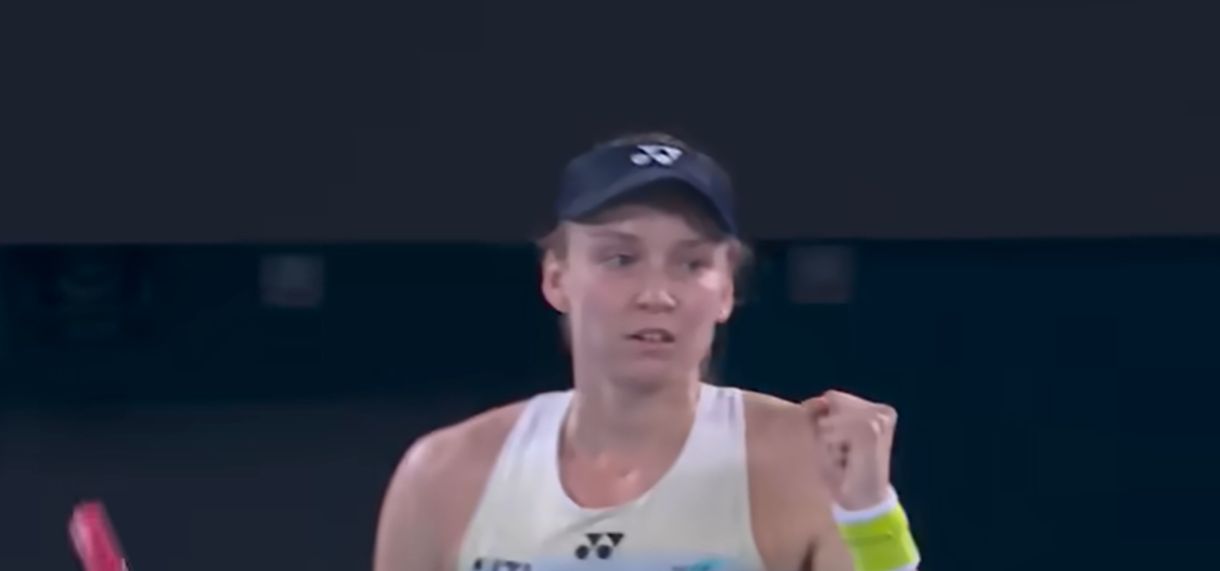


The news from Melbourne is that Elena Rybakina beat Aryna Sabalenka in the women’s final of the Australian Open, and Carlos Alcaraz beat Novak Djokovic in four sets in the men’s. It was commanding win for the 22-year-old Spaniard who with it achieves a career Grand Slam. It does not take anything away from the 10-time winner from Belgrade. Djokovic overcame Janik Sinner in five hard-fought sets in the semis; but Alcaraz, who also played a five-setter in the same round, against Alexander Zverev, had more in the tank and could not be intimidated.
One wishes the Ukrainians, Russians, Belorussians, and Kazaks could get along in political life with the same sportsmanship their lovely lasses show on the tennis courts.
Miss Ukraine tennis, who is also Mme Gaël Monfils and a happy mom, had a terrific run through the women’s singles draw, but she went down to past champion and top seed Aryna Sabalenka in the semis. It was not streamed — which, I will say, is definitely not the best way to watch sports. But we still should appreciate innovation in communications technology, so long as it is not abused and a detriment to literacy, which many think it is. Reports say that M. et Mme Monfils’s daughter Skai, who is three, made the trip to the southern hemisphere with them again this year, which, again, I mention not only because I heartily approve (les voyages font la jeunesse, as they say in French) but because it is right by my own parenting experience. Up to a point, of course. Sometimes you have to leave the child with the grandparents, or the aunts or the cousins.
But I am sure it helped Elina, who always has Ukraine’s suffering on her mind and is always speaking and making donations to the cause and visiting her home. Her great run gives her moral strength, as well as a boost to her compatriots. She refuses to shake hands at the end of play with Russians or Belorussians, but she is correct, polite.
Her husband supports her courage and comforts her sorrows, and the child is hope, life. Gael lost in the first round, but make no mistake, he is one of the greats and at 39, he is just a little older than Novak Djokovic. I hope he stays on the tour, not only because he — like his wife — is an inspiration, but also because he has one of the most artistic games in the sport.
Where was I? What the French say about the educational value of travel. As it happens, Mr. and Mrs. Monfils speak English, as she is still learning French and he is still learning Ukrainian. Love is its own language, however, so it does not matter what they speak, and little Skai benefits from growing up multilingual. Gaël Monfils speaks an excellent, rather austere English which is music to the ears when you have been listening to one too many young tennis players — or one too many anything — explaining that, like, I mean, it’s a thing, you know. What thing and what the listener is supposed to know get lost in a haze of whatever’s.
This is very bad, because it is a reflection of a broader breakdown of communication that exposes a failure to think clearly. Liberty is lost when language is hazy or corrupt. At the tournaments, it is customary for the winners, losers too, to spread a few thanks around following a match, their opponents, their coaches, the ballboys, the spectators, and sometimes — not often enough — the policemen and first responders. (Reportedly they were playing at temperatures over 100 degrees and there were quite a few injuries; Djokovic himself, who is the most fit athlete in the world, benefited from one and a half forfeited matches due to injury withdrawals.) Also they thank the spectators, who, I have noticed, are increasingly addressed collectively as “you guys,” applied to both genders. The player thanks “you guys” for all their support, even though one cannot avoid the fact that sports audiences are often terribly impolite, shouting during points and insulting players.
Sports etiquette varies from sport to sport. It is okay to scream and yell during a basketball game, but in tennis it is a serious faux-pas to let go even a mild burp during play, and the cheers and applause at the conclusion of a point should stop as soon as the server goes to the baseline to launch the next one. More and more often, you see breaches to this rule, to such a degree that players ask the umpire to remind people to show some manners.
Just so, but then you get these “you guys are great” lines in the mishmashed English that is the international sports language and while surely it is nice of the players to try to express themselves and to thank the fans, is it right for them to say “you guys” when what they means is “all you guys and girls”? I mean, like, guys are guys and girls are girls, aren’t they?
If the answer is not yes, we’ve got a serious problem. It would seem that, in fact, the threat of total and ubiquitous breakdown of norms and genders was well on its way to being blocked, averted, and we as a society were going to muddle through, once again, by the skin of our teeth. But the reality is that we are not out of the woods yet. We are surrounded on all sides by Bidenism, a word I just invented. This is the phenomenon of constant gaslighting, which itself is not new, but which has reached an unprecedented level of toxicity, due to advanced communication technology and the decline of public education. I am confident both of these issues are being addressed. But in the meantime, we must beware.
Which means we must be faithful to our own principles. You cannot, for example, say that people are lying to you about “undocumented migrants” when in fact they are law-breaking border-jumpers or illegal aliens. Ideas have consequences and words have meanings.
By the same token, you cannot call people “domestic terrorists” and “assassins” when they are alleged lawbreakers. Attacking law enforcement with spittle or vicious kicks is, I am fairly sure, at least a misdemeanor and possibly a felony in most states, including Minnesota. But if high officials make extremely serious charges against someone, such as accusing him, or her, of murderous intent or terrorism, then who is abusing the language?
Frankly, I am disappointed when so eminent a writer and journalist as George Will accuses a collective group of law enforcement officers of being “louts.” This is completely unfair and imprecise and coming from Mr. Will it surprises. Particularly as he has always been careful to expose problems and issues clearly and fairly. Agree or disagree with him, it is good that one of the essential conservative voices of our times should explain, as he has been doing for several years, why the Trump administrations, the first one and the present one, may be flouting the law and contributing to the undoing of the system of checks and balances by which we govern our republic.
Precisely because so many newspaper readers closely follow his editorial commentary, it is unnerving when he seems to lose his steady grip on facts. It is not out of school to write that some border police agents, on the evidence available, appear to have acted with insufficient discipline or inadequate training and under poor command; but saying that does not mean you can go and make unproven generalizations about a lawless “loutcracy,” as he calls it.
Particularly as it simply encourages the other side to misrepresent an appalling situation for which it bears considerable responsibility. When high officials — governor of Minnesota, mayor of Minneapolis — slander law enforcement with shocking references to Nazi Germany, they encourage people, under a false cover of engaging in free assembly and speech, to seek out unlawful confrontations which can only end in tragedy.
Far be it from me to suggest that calling an audience that includes many women and girls “you guys” leads to calling American cops louts, or to brand Americans terrorists and assassins before they have even been charged. Abuses of language come in degrees and the damage is not comparable. In fact, popular usages like “you guys” in informal contexts contribute to our language’s vitality. I call attention to it because it highlights the carelessness with which language is being used in contexts that demand the utmost accuracy and restraint.
Elina Svitolina played a great tournament and, for those who admire her tactical finesse, her run to the semifinal was a treat. It crashed against the strong groundstrokes of the tournament’s top seed and defending (2024, 2025) U.S. Open champion, Aryna Sabalenka, who also won at Oz in ’23 and ’24. In the final, Elena Rybakina played a tight match, for a set and a half, then Minsk’s favorite daughter took charge until 3-0 in the deciding set. Whereupon the Moscow-born Kazak who lives in Dubai rallied and held on to win, adding Oz to her 2022 Wimbledon trophy.
One wishes the Ukrainians, Russians, Belorussians, and Kazaks could get along in political life with the same sportsmanship their lovely lasses show on the tennis courts, but there you have it, which is also why, far from Australia, this column could not help but digress into our own unfortunate political divisions and quarrels.
However, it was nice to see an all-Anglosphere final in the men’s doubles, pitting Shreveport’s Christian Harrison and Liverpool’s Neal Skupski against Aussies Jason Kubler and Marc Polmans. The Anglo-American side took it in two sets. It was a reminder of 2017 in Paris, when Christian’s older brother Ryan won the doubles at the French Open, against American Donald Young and Santiago Gonzalez. Ryan teamed with his friend Michael Venus, a New Zealander who played at LSU and trained at the Harrison tennis school alongside Ryan and Christian under the guidance of their father Pat Harrison, himself a former tennis pro.
We really have to get over this and concentrate on winning at whatever we want, but fair and square and without calling one another awful names.
READ MORE from Roger Kaplan:
Poles Apart? Thoughts Sparked by the Australian Open
The Berber War Cry for Freedom