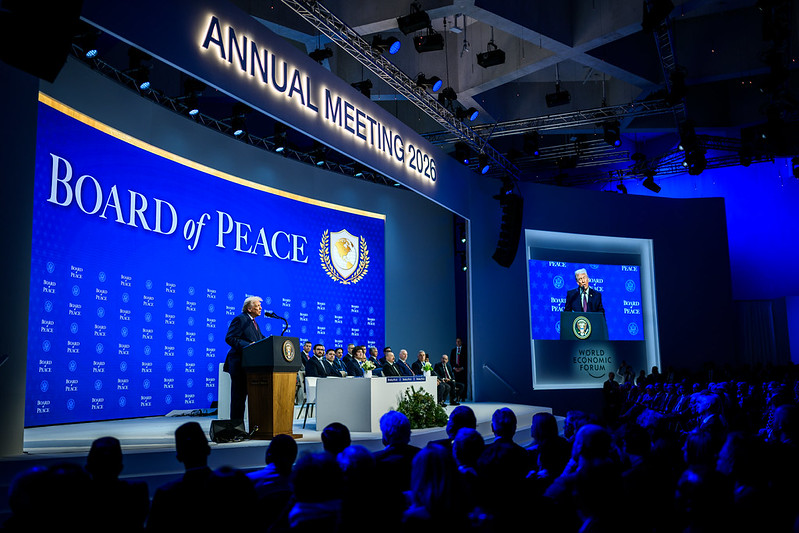


While the world holds its breath over a possible confrontation between the U.S. and Iran, President Donald Trump is meanwhile pushing forward, perhaps prematurely, with the next phase of the Gaza Peace Plan.
Last week, on Jan. 22, Trump appointed the 15 members who will make up the National Committee for the Administration of Gaza (NCAG), the Palestinian technocratic body appointed to govern the Gaza Strip. The only member publicly named was the committee’s leader, Dr. Ali Sha’ath, who will oversee urban reconstruction and civic development in the enclave. Reports indicate that the other unnamed members are Gaza natives affiliated with the Palestinian Authority (PA) and its Fatah political party. The committee will operate in Cairo until the “second phase” of Trump’s peace plan is officially inaugurated. (RELATED: The Trump Peace Plan: Promise, Pause, or Illusion)
The NCAG is just one sub-body under the supreme architecture of Trump’s “Board of Peace.” Trump announced the signing of the “Board of Peace” last Thursday while at the World Economic Forum in Davos, Switzerland, declaring that the war in Gaza is “really coming to an end.” The 19 signatory nations span from Latin America, across the Middle East, and Southeast Asia.
The “Board of Peace” will oversee two executive boards. The “Founding Executive Board” will focus on high-level diplomacy and economic investment. Among its seven members are U.S. Secretary of State Marco Rubio, special U.S. envoys to the Middle East Jared Kushner and Steve Witkoff, president of the World Bank, Ajay Banga, and former U.K. prime minister Sir Tony Blair. (RELATED: Give (Eternal?) Peace a Chance?)
The second board is the so-called “Gaza Executive Board,” supervising on-the-ground economic and political reconstruction in Gaza, under which Dr. Sha’ath’s NCAG is situated. This board consists of senior political figures and diplomats from, among other nations, Turkey, Qatar, and the UAE, and is headed by former Bulgarian politician Mickolay Mladenov, who holds the title “High Representative for Gaza.”
The invitees who abstained from signing on to Trump’s “Board of Peace” in Davos, or rejected the president’s invitation, are also worth noting, among them representatives from Canada, the U.K., France, Germany, Italy, and Russia.
There are rising concerns among European nations that Trump is planning to extend his board beyond Gaza to play an international role in monitoring global conflicts, thus undermining the U.N.
There are rising concerns among European nations that Trump is planning to extend his board beyond Gaza to play an international role in monitoring global conflicts, thus undermining the U.N. U.K. Foreign Secretary Yvette Cooper described the body as “a legal treaty that raises much broader issues” than the charter’s initial focus on ending the war in Gaza. Cooper abstained from the signing ceremony and cited grave concerns over Russian Prime Minister Vladimir Putin’s invitation, especially in light of Russia’s war with Ukraine and its alliance with Iran.
Kremlin Spokesman Dmitry Peskov said that Putin was “studying all the details of this proposal,” but no Russian representative was present at the Davos signing.
Although Israeli Prime Minister Benjamin Netanyahu later accepted Trump’s invitation to join the board, the absence of Israeli representatives at the Davos signing was a reflection of Israel’s criticism of Trump’s appointees and the caution with which Jerusalem is proceeding with the implementation of the peace process in Gaza.
In Jerusalem’s eyes, the appointments to the NCAG committee, including Dr. Sha’ath, are perceived as a reinstitution of the PA in Gaza — a political body currently riddled with terrorist motives. Witkoff and Kushner, in their mediations, have been urging the PA to undergo significant “reforms” to eliminate corruption from within their ranks and terrorism against Israel from their modus operandi in the hopes of presenting the group as a legitimate body to govern Gaza and a new Palestinian State.
Israel is also critical of Trump’s inclusion of Turkey (a vocal enemy of Israel) and Qatar (a nation harboring and supporting Hamas leaders) as key actors in the Gaza Executive Board. According to the Israeli Channel 12 news, Marco Rubio informed Netanyahu that Turkey and Qatar were irrevocable to the peace process. The Trump administration views these countries as critical to getting Hamas on board to agree to the current ceasefire, and predicts that they will be necessary for convincing Hamas to eventually disarm.
In addition to these concerns, Israel considers the formation of governing bodies and committees in Gaza as a reckless march forward into the “second phase” of Trump’s peace process when the stipulations of the “first phase” have not been upheld, and the enclave is still engulfed in armed conflict.
Since December, Witkoff and Kushner have been urging Jerusalem to move forward into the second phase, which calls for the complete withdrawal of the Israeli Defense Force (IDF) from the Gaza Strip, leaving the governance and security of the enclave in the hands of Trump’s appointed committees, which contain many vocal enemies of Israel.
Jerusalem has maintained that the stipulations of the first phase must be upheld before Trump’s Peace Plan can move forward. This includes the return of all Israeli hostages in Hamas custody and ensuring Israel’s future safety by removing Hamas from political and military power and dismantling its military infrastructure, tunnel networks, and weapons production facilities.
Only on the morning of Jan. 26 did the IDF recover the body of Ran Gvili, the last remaining hostage in Gaza. With all Israeli hostages and bodies of fallen hostages back in Israel, Netanyahu told the Knesset in Jerusalem, “We are at the threshold of the next stage: dismantling Hamas’ weapons and demilitarizing Gaza. This stage is not about reconstruction, and we have an interest in advancing it without delay.”
While Hamas has agreed to cede power to the NCAG, they stand firm against disarming.
In addition, Hamas and other Palestinian terrorist groups in Gaza have continually breached the terms of the “Yellow Line” delineating areas in Gaza under IDF control. Armed clashes broke out between terrorist militants and the IDF positioned within the Yellow Line within days after Trump’s brokered ceasefire last October. Since then, the IDF has had to reinforce its positions to counter daily violations from Hamas and other terrorist assaults. According to IDF officials, the safety parameters and guarantees are not securely in place for the IDF to withdraw under the next phase.
Against this context, Trump’s urgency to move forward with the second phase puts Israel in a precarious security position and makes allowances for Hamas’ belligerence. Jerusalem has vowed not to withdraw its forces until the job of disarming Hamas and demilitarizing the Gaza Strip is complete. With Hamas’s allies appointed to various bodies of Trump’s “Board of Peace,” it’s unlikely that Jerusalem will trust these executive bodies to get the job done.
READ MORE from Bennett Tucker: