


What constitutes a “national emergency”? It’s a question at the heart of the Supreme Court’s upcoming decision on tariffs and the president’s authority to unilaterally impose them under the International Emergency Economic Powers Act of 1977. Now, anticipation surrounding the court’s opinion in Learning Resources, Inc. v. Trump has only grown following the events of the weekend.
In response to the Trump administration’s continued insistence that Denmark relinquish sovereignty over Greenland, several European countries, including France, Germany, the U.K., Norway, Sweden, and the Netherlands, sent troops to “establish a more permanent military presence with a larger Danish contribution.”
This maneuver by the Danish and their European allies drew the ire of President Donald Trump.
On Saturday, he announced new 15 percent tariffs on goods from Denmark, Norway, Sweden, France, Germany, the U.K., the Netherlands, and Finland, which would take effect on Feb. 1.
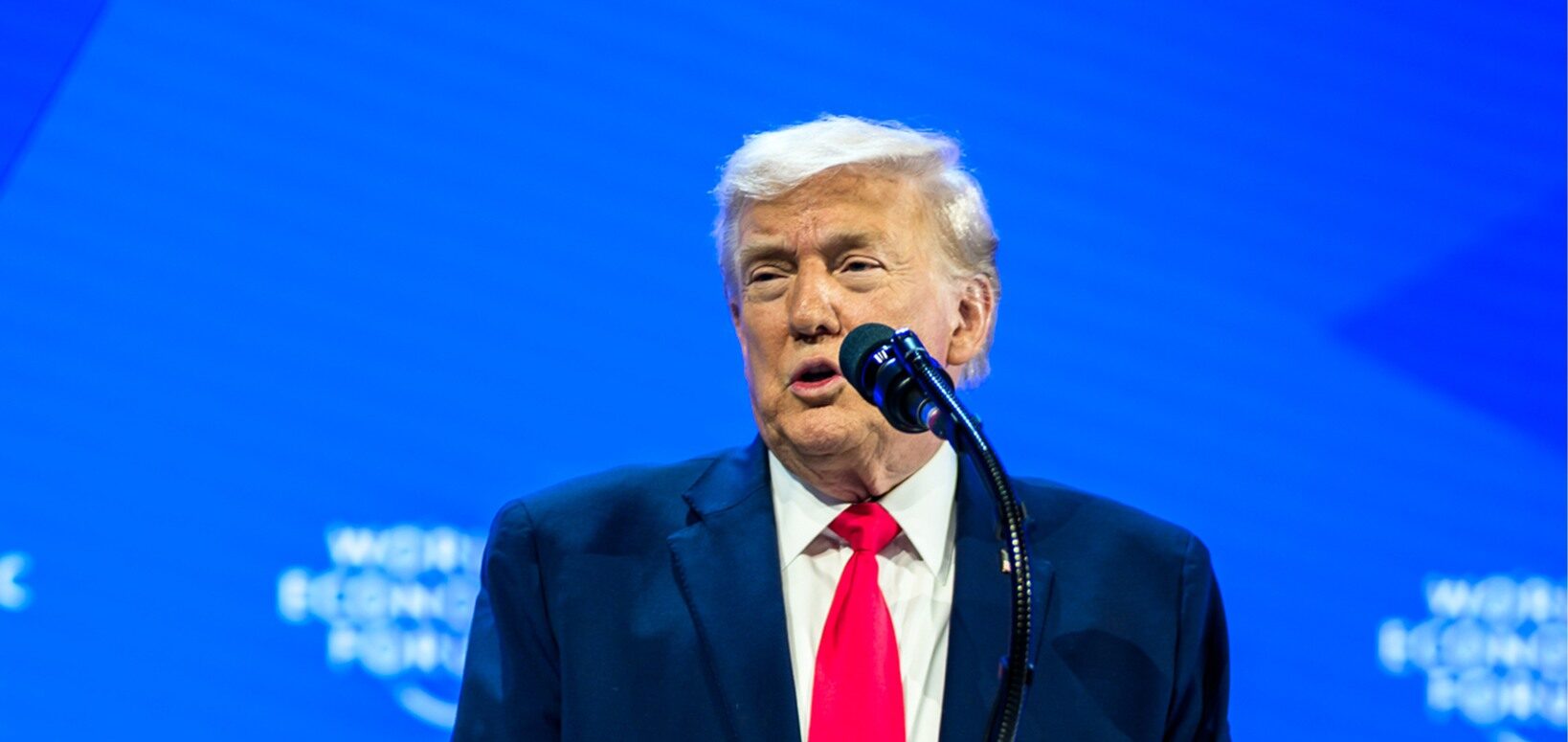
On Wednesday in Davos, the president struck a different tone following his speech at the World Economic Forum.
Following a “very productive meeting” with NATO Secretary-General Mark Rutte, President Trump declared on Truth Social that he would “not be imposing the Tariffs that were scheduled to go into effect on February 1st,” citing ongoing talks on the “Golden Dome as it pertains to Greenland.” Details are scarce, but one takeaway remains apparent.
While President Trump’s assertion that the acquisition of Greenland is “imperative” to “protect Global Peace and Security” is debatable, the use of tariffs as a political cudgel to browbeat foreign opposition to his policies is both unconstitutional and untenable.
However, declaring new economic policies on a whim has become the de facto operating procedure.
Even as the Supreme Court deliberates, the legislature has done little to check President Trump’s worst impulses. He has employed tariffs and the threat of tariffs as a cure-all for a range of issues, from trade deficits to retaliation for international decisions with which he disagrees.
In this regard, lawmakers should find Treasury Secretary Scott Bessent’s rationale that “the national emergency is avoiding a national emergency” woefully inadequate.
The International Emergency Economic Powers Act only grants the president authority to deal with “any unusual and extraordinary threat,” so long as a national emergency has been declared “with respect to such threat.” However, the law also requires any “new declaration of national emergency” be made “with respect to such threat,” placing a limit on the executive’s authority.
Under Article II, the president’s authority to act must come from an act of Congress or the Constitution, but, through the National Emergencies Act of 1976 (NEA), Congress has granted the executive branch extensive powers to act during crises.
While Congress enacted the NEA to curtail presidential power, the law essentially gives the president the authority to declare national emergencies in perpetuity, until Congress passes a joint resolution terminating the emergency. The act requires the president to specify the emergency authority being invoked. It directs Congress to meet every six months to consider such a joint resolution, although Congress has never done so.
In October, the Senate voted 51–47 to approve a joint resolution terminating the “national emergency” justification the president used to impose tariffs. However, a procedural vote by House Republicans on the Rules Committee blocked any efforts to end the national emergencies until March 31.
While the threat of new tariffs hung in the air, the early signs of backlash appeared on the stock market, reflecting the inherent volatility of a one-man-driven tariff policy.
The Dow Jones Industrial Average dropped 876 points on Tuesday, with European companies in the automotive, pharmaceutical, and luxury goods industries already bracing for another year of uncertainty.
Bessent’s statement to CNBC that President Trump’s goal was to “pre-empt the problem before it starts” gives the game away. If there is no problem, then there is no national emergency.
Deft diplomacy could have achieved the same outcome. Instead, the president relied on threats and coercion.
According to the Brennan Center for Justice, there are currently 150 statutory powers available to the president when a national emergency is declared, 58 of which lawmakers enacted “more than half a century ago.”
Steadily accumulating over time, some of these powers, like IEEPA, are used almost annually, transforming what should be an extraordinary measure into a routine policy tool — fundamentally contradicting the concept of an emergency.




















