

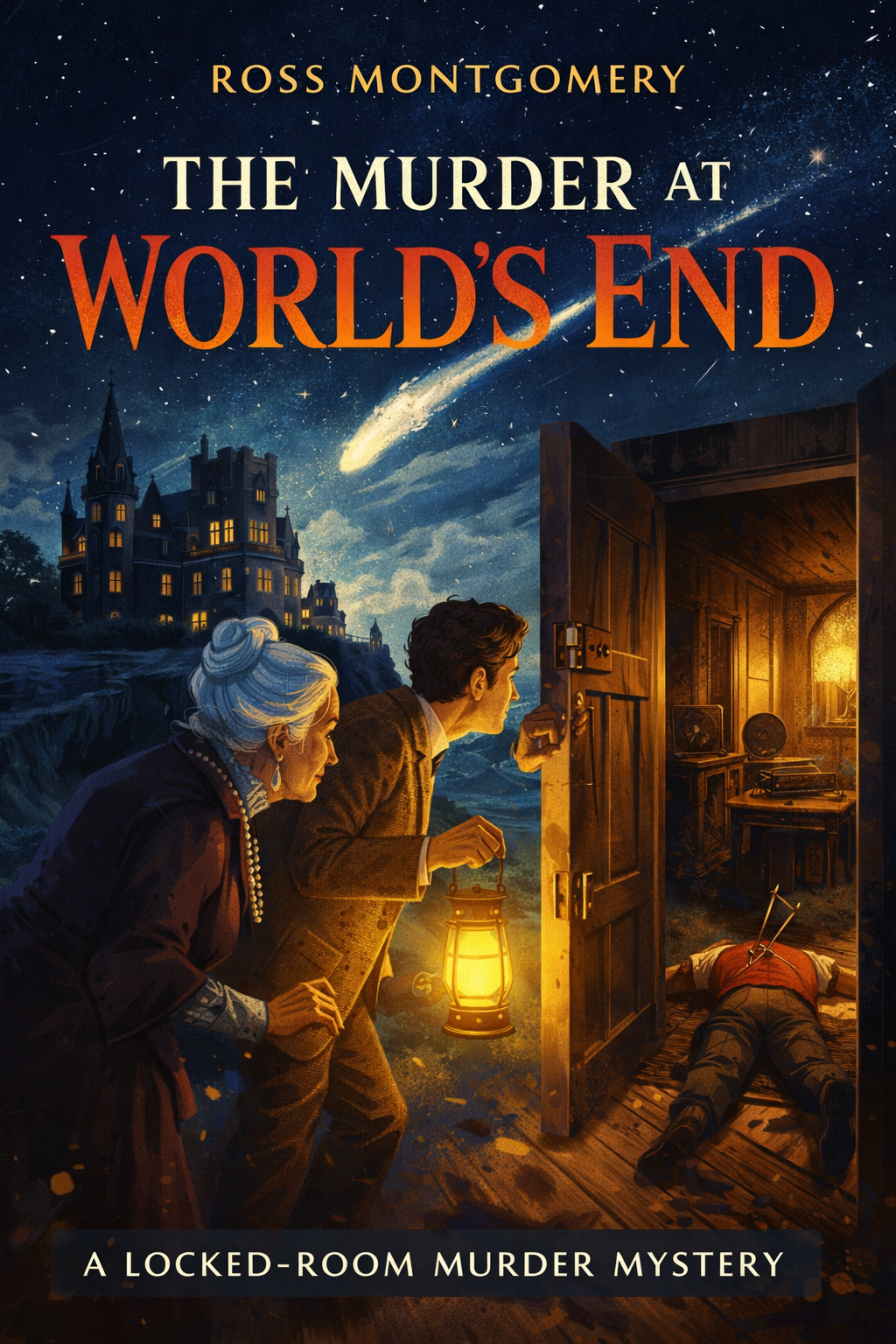


The Murder at World’s End
By Ross Montgomery
(William Morrow, 323 pages, $31)
British writer Ross Montgomery has several successful children’s books to his credit. On the evidence of The Murder at World’s End, his first book for grownups, he needn’t return to the children’s table unless he wishes to.
This story is in the English tradition of the cozy, thanks to its remote location, its small and isolated cast and the fact that … Montgomery does not linger over the corpse..
World’s End is the most absorbing and satisfying whodunit I’ve read in many a moon. It’s an intelligently rendered, tense, and suspenseful locked-room murder mystery with enough twists and turns to give a snake a backache. The story develops quickly, moves forward relentlessly, giving both characters and readers little time to breathe. Happily, the story is leavened by frequent humor.
World’s End is a period piece, taking place at a remote manor house in coastal Cornwall not long after the death of Edward VII in 1910. The master of the house, a self-appointed viscount and soon to be the dearly departed, treats his staff and just about everyone else badly. Tithe Hall ain’t Downton Abbey.
Two amateur detectives, less alike than Felix and Oscar but just as entertaining, finally crack the case. But only after exposing themselves to considerable personal danger while being considered suspects themselves by a caricature Scotland Yard inspector. Our amateurs are obliged to sort a procession of suspects, all with means, motive, and opportunity to have done the deed. When I learned who was responsible for the murder most foul, my reaction was: “How did I miss the clues!?” On a second reading, I found the clues are there. Subtle, but they’re there. Montgomery plays fair with readers. But he pulls off a literary sleight of hand most illusionists would applaud and many readers will fall for.
The set up: It’s the spring of 1910 just before the arrival of Halley’s Comet, which is generating fear among various Calamity Janes who, on the basis of no evidence whatever, fear that the comet, which has passed Earth harmlessly countless times, will do much damage to the planet this time. Breathless newspaper stories blame various bad weather events, even the death of King Edward, on the approaching comet. (Does this remind you of the excitables who believe the Earth will burn to a crisp if we don’t abandon fossil fuels? Yeah — me too.)
Lord Stockingham-Welt, master of Tithe Hall, who fancies himself a scientist but in fact couldn’t tell the difference between a hypothesis and a meat pie, is in the most extreme wing of the comet calamity crowd. He believes this comet’s passing will bathe the planet in a deadly gas. “This time it will be the end of the world,” he claimed. So he had the household and all of its inhabitants, including himself, sealed, air-tight, into their rooms as the comet passes. When the gas dissipates the following morning, the world, he imagined, would continue with the Tithe Hall survivors. Hardly an impressive gene pool with which to start a planet.
Of course the sealed up night is not the end of the world, but it was the end of the viscount, who is found dead in the office the following morning, slain by a bolt from his own crossbow. How could this be as he was in a sealed room by himself all night? But was he?
It quickly becomes evident that the Scotland Yard detective assigned to the case would be challenged by attempting to find his own butt with two hands. So our two unlikely detectives assign themselves to finding the murderer.
The book’s narrator and one of the detectives is Stephen Pike, not yet 20 and just out of prison for a crime he didn’t commit, and hired just the day before Tithe Hall is sealed against the comet’s imaginary poison gas. He’s an intelligent lad but naïve in some matters. The other unofficial detective is the viscount’s 80 year-old great aunt, Decima Stockingham. Highly intelligent, but imperious and sharp-tongued, she doesn’t suffer fools gladly. And as Tithe Hall, especially among the Viscount’s family, is chock full of fools, all hands steer clear of her. But is one of these a murderer as well as a fool?
This story is in the English tradition of the cozy, thanks to its remote location, its small and isolated cast, and the fact that while there is murder, Montgomery does not linger over the corpse. No gore. Only Decima’s potty-mouth keeps the story from a G-rating. Ex-con Stephen remarks: “I’d never heard language like it … and I’d just spent the last month sharing a bunk with a man called Filthy Mick.” (Decima’s conversational style reminds me of my Navy days. I worked for a chief petty officer who could and often did use the f-word in the noun, verb, adjective, and gerund form all in the same sentence. Crude, but impressive.) Decima makes Downton’s Violet Crawley seem like Miss Congeniality by comparison.
World’s End is an enjoyable romp from end to end. A cozy — save for Decima’s blue streaks — but more intelligently done than most cozies. More meat and potatoes for readers than stories from the body in the library tradition, or, God forbid, stories in which a cat is the detective. And in the end there are hints there will be future Stockingham & Pike mysteries. Something for savvy detective fiction readers to look forward to.
READ MORE from Larry Thornberry:
Reports of Woke’s Death Are Greatly Exaggerated
Democrat Policies Are Crazy, but Crazy Still Sells (See NYC)




















