
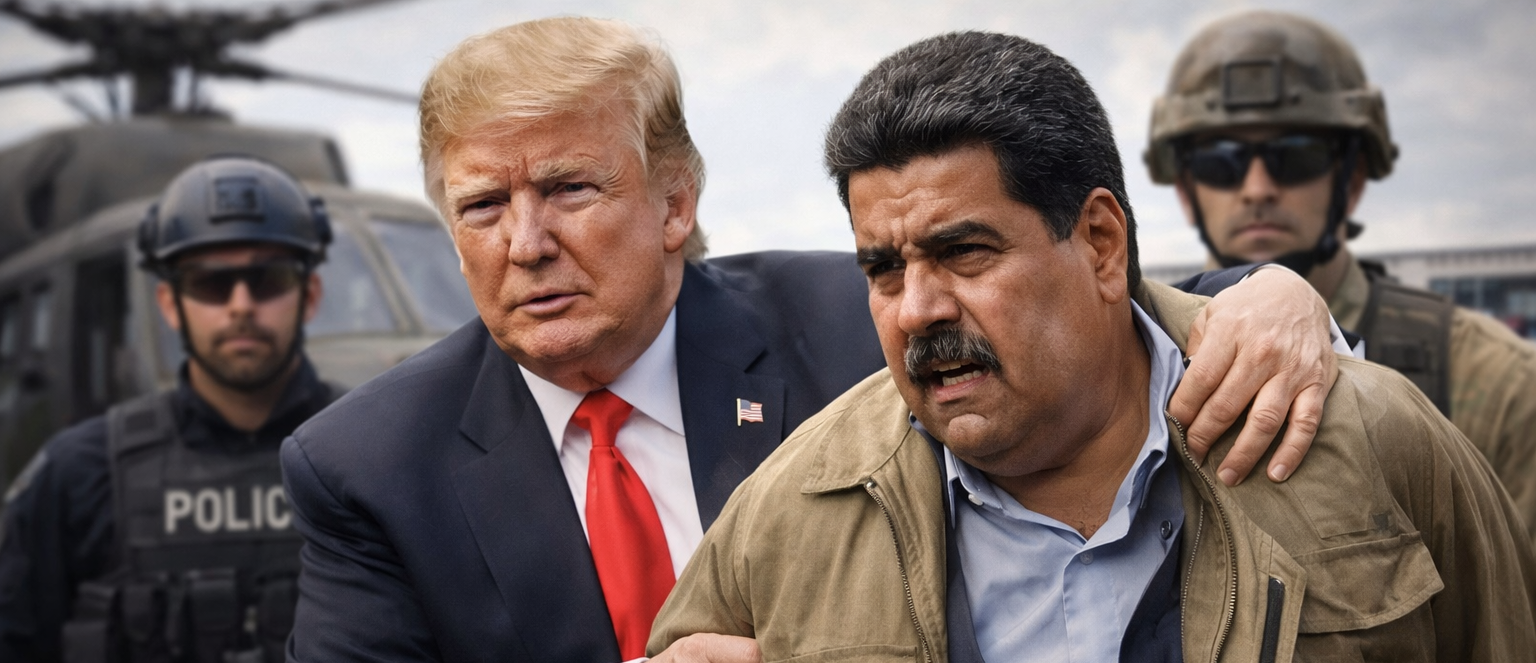


The United States of America has successfully carried out a large scale strike against Venezuela and its leader, President Nicolas Maduro, who has been, along with his wife, captured and flown out of the Country. This operation was done in conjunction with U.S. Law Enforcement. Details to follow. There will be a News Conference today at 11 A.M., at Mar-a-Lago. Thank you for your attention to this matter! President DONALD J. TRUMP
— Social media post from President Donald Trump at about 4:30 AM ET/2:30 AM MT on Saturday, January 3, 2026
Victor Maduro is a Venezuelan high-school dropout, former bus driver and union activist and leader who “studied” socialism/communism in Cuba, became a loyal foot-soldier to dictator Hugo Chavez, who made Maduro foreign minister and then vice-president. When Chavez died in 2013, Maduro became president after a narrow (and probably fraudulent) election victory and has stolen every election since then to remain in power. There have been a few attempts by opposition leaders to defeat Maduro at the ballot box but they’ve all failed, even as the world typically recognizes the challenger as the actual winner of the election.
In any case, good riddance to the ignorant communist bus driver who has done such harm to the people and the economy of Venezuela.
In fact, his challenger in the 2024 election, María Corina Machado, led a movement that is widely believed to have won more support than Maduro, but Maduro disqualified her. Having the thugs, the guns, and the jails, Maduro remained in power, as dictators so often do. Machado was awarded the Nobel Peace Prize for her efforts to democratize Venezuela.
Maduro has been a disaster for the Venezuelan people, tanking the economy though incompetence and corruption, as one would expect from such a person. It’s a country that should be wealthy due to the amount of oil it possesses but (much like Iran) they spend too much money buying the passivity and votes of citizens and not enough maintaining the infrastructure or expertise needed to maintain oil production.
Much of the Venezuelan oil industry had been nationalized from the late 1970s through 1990 but Chavez further nationalized it, leaving only Chevron among U.S. oil producers with any important involvement. And if you were an American company operating in a place like that, how much would you risk that an ignorant corrupt communist like Maduro wouldn’t just steal what you’ve built?
Although small as a percentage of China’s total oil imports, China is the biggest buyer of Venezuelan oil. That seems odd, given Venezuela’s proximity to the United States. This fact likely played into Trump’s actions; they double as additional pressure on China without ever needing to say so.
Near the end of the first Trump administration (in early 2020), Maduro was indicted for “narco-terrorism” in the United States. A year ago, at the end of the Biden administration, the bounty placed on Maduro was increased from $15 million to $25 million.
For months now, President Trump has been waging an aggressive war of words, and then of actions, against Maduro’s key sources of revenue: oil and drugs. (I’m not going to spend time today on the issue of whether Trump’s actions were legal. It’s questionable, but, at least for now and probably forever, doesn’t matter.) Trump famously started bombing claimed drug boats, most of which probably were that, and, more recently, seizing oil tankers carrying sanctioned Venezuelan oil (some of those tankers were also likely involved with illegal trade in Iranian oil).
So, back to today’s news:
New York Times reporter Tyler Pager posted this note early Saturday:
President Trump sounded tired.
It was just after 4:30 a.m. Saturday morning and 10 minutes after he announced on social media that the United States had captured Nicolás Maduro, the leader of Venezuela. I had called the president to try to better understand what happened and what comes next. He picked up after three rings and answered a few questions.
Mr. Trump first celebrated the mission’s success.
“A lot of good planning and lot of great, great troops and great people,” he told me. “It was a brilliant operation, actually.”
I then asked if he had sought congressional authority before the U.S. military, along with law enforcement personnel, engaged in a “large scale strike,” as he put in on social media.
“We’ll discuss that,” he said. “We’re going to have a news conference.”
In his social media announcement, Mr. Trump said he would speak at 11 a.m. from Mar-a-Lago, his private club and residence where he has spent the past two weeks.
I tried to ask what he envisions next for Venezuela and why the high-risk mission was worth it.
“You’re going to hear all about it 11 o’clock,” he said before hanging up.
The call had lasted 50 seconds.
In an interview on Fox News on Saturday morning, President Trump disclosed that Maduro and his wife are being taken to New York, presumably to face trial for indictments announced this morning for “narco-terrorism conspiracy” and other drugs and weapons crimes.
There are some key implications of today’s news, domestically and internationally:
First, as my friend Don Boudreaux has taught me about economics and that I think applies to many other circumstances, “the most important question is ‘compared to what?’”
In other words, Maduro is objectively terrible but when someone argues that removing him is obviously the right move, we should ask ourselves what the range of potential replacement regimes might be and which of those outcomes are better for the United States and for the Venezuelan people (whose interests should significantly overlap ours right now) … and which won’t.
Will Maduro’s corrupt lackeys take over? Will the military take over and, if so, will they try to stay in power or facilitate elections? If the latter, will the elections be fair or stolen? Will a pro-U.S. or at least pro-true democracy reformer end up in power? At this point, the most likely successor in that lane would be María Corina Machado, the recent recipient of the Nobel Prize for Peace.
Overall, it’s easy to see a situation that is roughly as bad as the current situation but also fairly easy to see a better situation, and somewhat difficult to see a worse situation (from the perspective of American interests), so by this test I don’t think removing Maduro is a high-risk proposition for the U.S.
Second, sticking with foreign policy, this sends a message to other U.S. competitors/enemies that Trump is willing to act against a foreign nation, including directly against its leader. That said, nobody believes Trump would try to eliminate or capture Vladimir Putin, so I’m not sure it’s a message that is very important beyond reminding people that if Trump says he’s serious about something in foreign policy these days, he should generally be believed and should be considered likely to act, even if short of physically capturing a nation’s illegitimate dictator. (In that sense, the actions against Venezuelan drugs and tankers is more important than the capture of Maduro, though the latter is more likely to frighten other weak-country dictators who find themselves on Trump’s radar.)
Third, there are the U.S. domestic politics. Donald Trump’s favorability ratings are slightly off their worst levels registered in November but he’s still significantly underwater. National “right track, wrong track” polling has been getting slightly but steadily worse since shortly after Trump’s inauguration. And in election after election recently, Republicans have been getting trounced, generally by wider margins than polling had suggested.
Trump’s lack of popularity outside his base and particularly the perception that he’s not doing enough (or doing anything, really) to address voters’ primary concern over the cost of living may well have Trump operating effectively as a “lame duck” quite soon. Especially if/when it becomes clear that Democrats will win a majority in the House of Representatives in the elections later this year. In such situations, it is common for presidents to turn to foreign policy, where there’s much they can do without Congress (though Trump has done a heck of a lot via executive order in policy areas that should involve Congress, but which a supine Republican Congress has been content to allow, eroding the separation of powers that’s so important to our nation’s form of government).
Trump has turned to foreign policy early and aggressively in this term, involving himself in trying — and sometimes succeeding — to settle conflicts around the world (perhaps in pursuit of a Nobel Peace Prize, for which he deserves very strong consideration though I suspect much will depend on what happens in the Russia/Ukraine war). He has a never-ending parade of White House meetings with foreign leaders, from Mark Carney (Canada) to Volodymyr Zelenskyy (Ukraine) to Zohran Mamdani (New York/Uganda).
It’s an interesting approach for a president who ran on a near-isolationist platform — or at least championing less involvement with the rest of the world in almost every aspect — and whose base is more isolationist than he is. MAGA is probably at somewhat of a loss here. They want to cheer their guy for doing something audacious and aggressive (and probably good) but they also think — and are right — that he’s not spending enough time on issues (again, primarily cost of living) that American voters, not just MAGA, care about most. In terms of U.S. politics, this is a small win at best for Trump and more likely doesn’t move the needle at all.
One wonders whether Trump, who will certainly see this as a huge success and talk about it that way for the rest of his presidency, will now focus even more on trying to impose his vision of the world on other nations. I suspect he will, especially due to the lame-duck status discussed above. Given his arguments regarding going after Venezuela because of drug trafficking, you’d think that Trump would focus on the real source not just of drugs but of violence in service of protecting drug profits, which is Mexico.
Of course, Mexico and Venezuela are quite different. Mexico is one of our most important trading partners, shares a border with us, is a major tourist destination for Americans, and has a leader whom Trump seems to get along with. That said, I wouldn’t be surprised to see a couple of American missile/drone strikes on cartel targets in Mexico. Those, too, will not help Republicans in upcoming elections or Trump’s slowly but steadily declining influence in American politics.
Another potential target for Trump would be the regime in Cuba, long an irritant to the United States with its alliances with Russia and communist-revolutionary regimes in our own hemisphere, and another place where a government that believes the same things Zohran Mamdani believes has impoverished its people. That said, the current level of direct antagonism against the U.S. from Cuba is not the same as it has been from Venezuela, and the upside for the U.S. of regime change in Cuba is, in the short term, less than the potential benefit of removing Maduro.
In any case, good riddance to the ignorant communist bus driver who has done such harm to the people and the economy of Venezuela.
READ MORE from Ross Kaminsky:
Trump’s Federal Spending Freeze Should Be a Massive Wake-Up Call




















