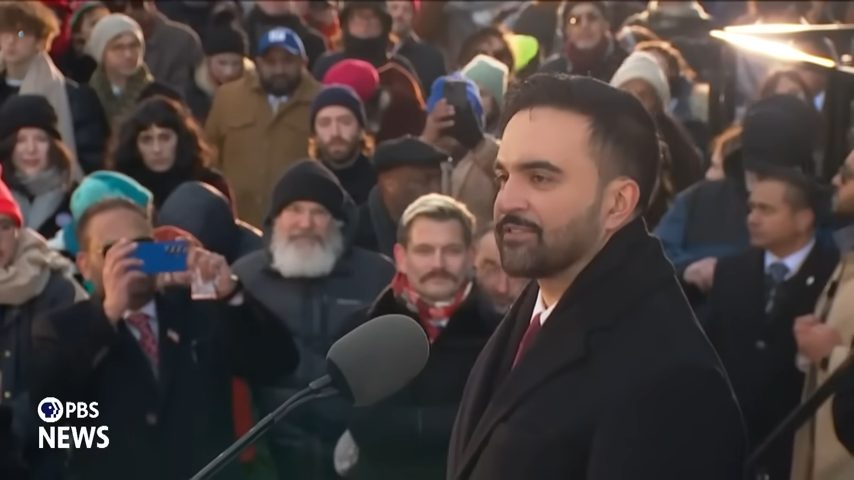


On New Year’s Day, as New Yorkers gathered for what should have been a unifying inaugural address, New York City’s new mayor, Zohran Mamdani, placed his hand on the Koran for his oath and then used the moment to unveil a collectivist vision that should concern anyone who values individual freedom. Promising to “replace the frigidity of rugged individualism with the warmth of collectivism,” he signaled a governing philosophy that elevates state‑defined unity over personal freedom.
In his opening words, Mamdani’s speech seemed at first glance to be crafted to soothe and reassure. But then it took an abrupt turn as the Mayor pledged to govern as a “Democratic Socialist,” who would lead “without shame and insecurity.” Promising to change the culture of City Hall, Mamdani told those gathered that he would refuse to abandon his principles “for fear of being deemed radical,” and concluded by invoking a quote on the value of being radical from Vermont’s Socialist Senator Bernie Sanders: “What’s radical is a system which gives so much to so few and denies so many people the basic necessities of life.” (RELATED: Mamdani’s Rent Control Plans Will Make the Rental Market Worse for Working People)
Socialism always arrives steeped in the language of compassion, but its first real act is to strip individuals of the freedom that makes genuine community possible.
Taken together, these declarations reveal the deeper project embedded in his inaugural address. Socialism always arrives steeped in the language of compassion, but its first real act is to strip individuals of the freedom that makes genuine community possible. That danger is no longer theoretical in New York City. In celebrating a government that will “draw this city closer together” and “foster solidarity,” he signals a statist model of unity enforced from above — one that risks silencing those who refuse to fall in line, narrowing autonomy, and weakening the very pluralism that has been the city’s defining strength. (RELATED: Gooder and Harder, New York)
Refusing to temper expectations like most inaugural addresses, Mamdani expanded on his campaign promises to “govern expansively and audaciously.” Adding that “To those who insist that the era of big government is over, hear me when I say this — no longer will City Hall hesitate to use its power to improve New Yorkers’ lives,” Mamdani provided a long list of the ways in which he will use government power to reign in “greedy corporations,” recalcitrant landlords, and unaffordable childcare. Promising to “freeze the rent,” and “deliver universal childcare for the many by taxing the wealthiest few,” the mayor also promised to make the City’s buses “fast and free.”
For many New Yorkers, Mamdani’s sweeping promises evoke an earlier era when City Hall’s grand visions outpaced its ability to govern effectively. Critics of past administrations — most notably during the Dinkins years, and the de Blasio years — argued that expansive rhetoric about unity and social uplift often masked an inability to manage the city’s basic functions, from public safety to fiscal discipline. By echoing the same faith in government-driven transformation, Mamdani risks repeating the pattern in which ideology collides with the reality of running a complex city. The concern is not merely ideological; rather, it is historical, rooted in our memories of what happened when a mayor’s ambitions grew faster than the city could sustain.
Older New Yorkers will recall what heavy‑handed housing policies of the past led to during the 1970s, when strict rent controls and a collapsing regulatory system helped create the conditions for the “Bronx is burning” era, as landlords — unable to cover basic costs — abandoned buildings, let them decay, or even set them on fire for the insurance money. Entire neighborhoods were hollowed out as government policy distorted incentives and accelerated decline. In the mid-1970s, the Bronx had up to 130,000 fires per year, or an average of 30 fires every 2 hours. More than half of the housing in the Bronx was destroyed. When Mamdani now promises to “freeze the rent” as a centerpiece of his agenda, he may not realize that “protecting tenants” at the expense of well-intentioned landlords may end up destroying the very communities they claim to save.
Mamdani’s inaugural address was a declaration of a governing philosophy that places all of his faith in centralized power. His promises may sound benevolent, but they rest on the assumption that freedom is a barrier to progress and that the state should decide what solidarity looks like. New Yorkers have long thrived on the friction, independence, and diversity of thought that define the city’s character. As this new administration moves from rhetoric to policy, the question is no longer whether collectivism will reshape New York, but how much individual autonomy its residents are prepared to surrender in the process.
READ MORE from Anne Hendershott:
Spite Repaid with Spite: The Metaphysical Roots of the Academic Massacre at Brown and MIT
Unproven but Unfolding Whistleblower Claims of Somali Medicaid Fraud in Ohio
No, Mayor-Elect Mamdani, the Homeless Are Not an Apartment Away From a Good Life