
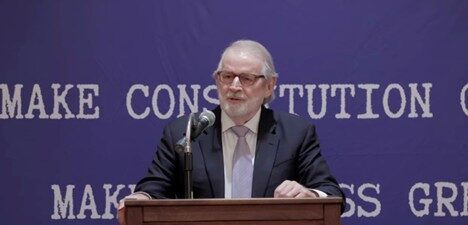


President Reagan’s Director of the Office of Management and Budget (OMB) David Stockman was the featured speaker at a special event on the federal debt on November 13, 2025 hosted by the Committee for the Republic in Washington, D.C. During his speech, Mr. Stockman put America’s federal government debt into historical context:
[P]rior to the 1913 creation of a central bank [the Federal Reserve] with a printing press capable of monetizing the public debt, America’s fiscal record was nothing short of remarkable by present day standards.
after decades of budget surpluses during the second half of the 19th century — along with no income tax, no Welfare State and no peacetime military that amounted to anything much — the public debt had been reduced to just $1.2 billion by 1914.
Today’s dollar is worth just 3.1% of its 1914 value — so the 1914 public debt amounted to $36 billion in 2025 dollars of purchasing power. On an apples-to-apples constant dollar basis, that’s $365 per capita of public debt back then versus $113,000 per capita today.
Stated differently, in constant dollars the public debt has soared from $36 billion with a “B” in 1914 to $38 trillion with a “T” today. In real terms per capita, it’s up by 310X!
These words are only a small excerpt from the in-depth, sobering speech given by Stockman on America’s ever-growing federal government debt. Stockman, who is now a writer and commentator on economic issues, has extensive practical knowledge on economic policy beyond his years as Reagan’s OMB director from 1981 to 1985. After his government service, Stockman held top positions at two prominent Wall Street firms, Salomon Brothers (1985-1988) and Blackstone Group (1988-1999). He ran his own private equity group from 1999 to 2005.
[T]he political establishment in Washington must reject calls for increasing federal tax revenue as this would only harm American economic activity and prosperity.
Stockman highlighted the explosive growth in America’s welfare state, primarily driven by its two largest components — Social Security and Medicare. He said that federal spending on America’s welfare state has quintupled in constant 2025 dollars from just under $500 billion in 1980 to almost $2.5 trillion in 2024. The growth in spending on the welfare state will continue into the foreseeable future due to the incessant increase in the number of benefit recipients. Stockman said that number will increase to about 100 million by the year 2050. (Currently, about 70 million Americans receive both Social Security and Medicare benefits.)
Stockman did not even mention other costly welfare state programs, such as Medicaid, the Children’s Health Insurance Program (CHIP), Obamacare (Affordable Care Act) subsidies, Veterans’ disability and retirement benefits, the Supplemental Nutrition Assistance Program (SNAP), subsidized housing, and other welfare state programs and subsidies. In 2025 alone, Medicaid and CHIP are estimated to cost about $660 billion, Obamacare subsidies about $213 billion, Veterans’ benefits about $270 billion, and the SNAP program about $110 billion.
Corroborating Stockman’s Dire Outlook
Stockman’s main point was that the United States is headed towards an economic crisis of historic proportions by the middle of the current century unless the political establishment in Washington executes a radical change in fiscal policy with dramatic reductions in spending across the board.
A report issued by the House Budget Committee on March 5, 2025 corroborates Stockman’s concerns. Excerpts from the report:
Perhaps the greatest threat we face from our debt is the one we don’t see: a fiscal crisis. According to CBO, a fiscal crisis is “a situation in which investors lose confidence in the value of the U.S. government’s debt…. such a crisis would cause interest rates to rise abruptly and other disruptions to occur” ….
Given the interdependent nature of the world’s financial markets and the U.S. dollar’s role as the global reserve currency, such a crisis would almost certainly have irrevocable international repercussions. For instance, if international investors and foreign governments lose confidence in the U.S. government’s ability to pay its debts, this assumption could jeopardize the dollar’s reserve status, making it yet more difficult for the federal government to borrow and perform its vital duties on behalf of the American public.
The report goes on to cite the Penn Wharton Budget Model, which estimates there is only about 20 years for the government to right its fiscal ship, after which no level of tax hikes or austerity could prevent a government default.
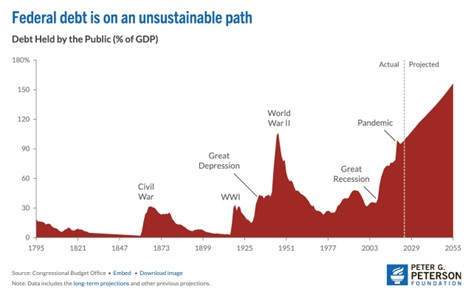
The Budget Committee report also cites data from the Peter G. Peterson Foundation, a non-partisan think tank dedicated to increasing public awareness about the U.S. government’s fiscal challenges. The graph from the Foundation below illustrates the historical trends in federal government debt held by the public as a percentage of GDP from 1795 to 2025 and projected forward to 2055. The forecast to the year 2055 indicates that federal government debt held by the public will rise to an all-time high of 156 percent of GDP:
One Point of Disagreement with Stockman – Tax Cuts are Not the Problem
During his speech, Stockman was critical of Reagan’s tax cuts during the 1980s as a cause of the budget deficits during that decade and beyond. The data does not support Stockman’s criticism. The data shows that federal tax revenue actually increased every year from 1983 through 1990 by at least 4.1 percent (1989 to 1990) and by as much as 11.1 percent (1986 to 1987).
U.S. Fiscal Problem Is Entirely on the Spending Side
Federal government revenue in FY2025 (Oct 2024 to Sep 2025) was $5.23 trillion, which is 17.1 percent of 2025 U.S. GDP of approximately $30.5 trillion. This percentage is generally consistent with the historic trend since the end of World War II. Federal spending in FY2025 was $7.0 trillion, which is 23.0 percent of 2025 U.S. GDP. Thus, the federal government has a spending problem, not a revenue problem.
Going forward, the political establishment in Washington must reject calls for increasing federal tax revenue as this would only harm American economic activity and prosperity. As Stockman discussed, the Washington political establishment needs to find the courage to take on powerful special interests to stop the federal government’s unsustainable deficit spending.
READ MORE from Steve Dewey:
US Foreign Assistance as a Means of Soft Power
A Flat Income Tax Removes the Need for the IRS
Overhaul the Financial Regulatory System
Steve Dewey is a fellow at the Ben Franklin Fellowship, founder of GeoFinancial Trends, LLC (www.geofinancialtrends.org) and writes on Substack (stevedewey.substack.com). He can be reached at [email protected]




















