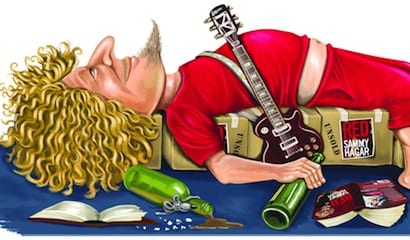


Sammy Hagar has numbers on the brain. Or rather he had numbers on the brain. One night in Fontana, California, in 1968 or ’69, he dreamed that he saw a spaceship manned by “two intelligent creatures.” Before jolting off back into the Milky Way, the creatures “fired off a numerical code, but it was not of our numerical system.” For Hagar, this late-night vision set in motion a numerical, or rather numerological, “quest” that led him to explore his dreams, his backyard, the stars in search of answers about the future. One day he discovered an ancient henhouse just beyond the edge of his driveway: “Inside there was nothing, except for a dirty, f—ed-up trunk.” In the trunk he found a pseudo-mathematical tome, which he soon began reading. Almost immediately Hagar (“I’ve always been a bit of a mathematician”) was hooked: “It tripped me out that if you add numbers up, you always come down to one number.”
Unsatisfied after a while with the results of his amateur arithmancy, Hagar decided to see a professional. In nearby Yucaipa he found a fortune teller to whom he gave his last 50 cents. In return, she offered him an assortment of advice: Get rid of your beard but keep the long hair, stay away from drugs and cigarettes, feed your wife a mixture of raw egg whites, honey, and lemon, move to Santa Barbara and then to San Francisco. If he did these things, she assured him, his name would be “in lights all over the world.”
Despite further occult or quasi-occult interludes, including some fairly low-grade color mysticism (“I just started doing red, red, red”), Hagar, of “I Can’t Drive 55” and Van Halen fame, does not return to this incident later in the first edition of Red: My Uncensored Life in Rock, the memoir he published in 2011. (Like so many autobiographies published these days, Red was written in “collaboration,” an arrangement the logistical details of which are usually shrouded in mystery. In Hagar’s case, it was with Joel Selvin, a popular music columnist for the San Francisco Chronicle.) But the 2012 paperback version contains an afterword in which he once again mentions the soothsayer, an Italian woman with the odd name of Kellerman, who apparently also told him, “‘Later on in life, you’re going to get a big break as a writer.’” (Oddly, Hagar claims here to have visited Kellerman when he was 20 years old, two or so years before his earlier account suggests.)
One wonders whether Hagar would have been so forthcoming about Madame Kellerman’s other prediction had the hardcover edition of Red, a number-one New York Times best seller, not fared so well with the American bookbuying public. After all, Hagar’s book has had the good fortune of arriving in stores amid a rash of what I shall call, for lack of a better term, rock memoirs.
Surely you’ve seen these books at Barnes & Noble: rows and rows of ostentatious hardcovers with names like Waging Heavy Peace, Does the Noise in My Head Bother You?, Makeup to Breakup, and Rod: The Autobiography. Rock memoirs have done very well in the last few years, and I don’t just mean sales-wise, though it’s true that Keith Richards’ Life, for example, has sold over
1 million copies. I’m thinking of the glowing write-ups that at least some of the rock memoirs (from here on “RMs”) have received in the review sections of major newspapers and magazines. “Terrific”; “oddly beautiful”; “brilliant”; “soul-searching”; “rich and moving”; “compelling, endearing, insightful”; “intensely intimate”; “unusually frank”; “entertaining, revealing, captivating”; “generous and well-written”; “warm, roguish”: the adjectives and adverbs, as you can see, have really piled up.
Lucky, as I said, for Hagar that he caught American readers when he did. He and the other rockers in the RM classes of late 2011 and 2012 were not the first to slap their bleared reminiscences between hard covers. Take poor Ronnie Wood (the Rolling Stones), who sat down with a co-author two or so years before the recent boom. Ronnie wound up heavily remaindered, along with almost two dozen others, including books by Chuck Negron (Three Dog Night), Slash (Guns n’ Roses), Tommy Lee (Mötley Crüe), Ozzy Osbourne (Black Sabbath), Levon Helm (The Band), Ginger Baker (Cream), Ace Frehley (KISS), Brian Johnson (AC/DC), Dee Snider (Twisted Sister), and Sting (the Police).
TIBOR FISCHER ONCE WROTE that Martin Amis’ Yellow Dog “isn’t bad as in not very good or slightly disappointing. It’s not-knowing-where-to-look bad. I was reading my copy on the Tube and I was terrified someone would look over my shoulder.” After a month spent reading eight RMs—on the D.C. Metro, in dive bars and public libraries—I think I understand what Fischer meant. I have also come to accept that it’s better for me not to think about what I might have read instead: more than half the published fictional output of Henry James, say, or the first three volumes of the Pléiade Voltaire. In just short of 3,000 pages, I’ve come across the word “f—” and its many variants roughly 9,000 times, an average of about three f—s per page. Sex in print, for which I’ve never had much patience, seems to me now ludicrously banal. There are only so many blow jobs—in bathrooms, airplanes, and bathrooms on airplanes—you can read about before deciding that any attempt to depict sex acts in literature is doomed. As far as drugs are concerned, the big H (heroin), the small h (hash), marijuana, cocaine, speed, sunshine tabs and microdots of LSD, tonics, elixirs, injections, pills—all of them are pretty much old hat at this point. (Anti-drug and pro-abstinence crusaders would do well to assign these books to school-aged children, who might get a sense of how yawn-inducingly dull hedonism eventually becomes.)
Besides, in much the same way that, after making his way through The Tower Treasure and The House on the Cliff, a reasonably clever seven-year-old knows that the Hardy Boys are indeed going to find The Missing Chums or solve The Shore Road Mystery, after reading one or two of these books, the overall narrative thrust of the RM genre becomes pretty clear, and you find yourself wondering whether you really need to pick up the next one (or three or four). “All happy families,” Tolstoy wrote in 1873, “resemble one another,” an observation with which many have since disagreed. It may or may not be true of happy families, but rock lives—all of them—resemble one another, to an almost painful degree. Lower/solid/upper-middle-class kid with one (never two) musical parent discovers music for himself in late teen years; joins or founds band which “makes it” due to brilliant manager/promoter/producer; hits follow hits; much sex is had and now-famous rocker develops drug habit (or drug habit, if already formed, worsens); band breaks up, in some cases at the height of its success, in others after making a string of lousy (i.e., poorly selling) records; time passes; rehab; later band’s fortunes are revived due to high-grossing reunion tour/critically well-received comeback album/admittance to Rock Hall of Fame/overall late ’90s post-grunge mood of classic rock nostalgia (none of the above are mutually exclusive); rocker, now elder rock statesman, arrives, wealthy, at boomer stasis, which is enjoyed alongside pets, grown children, and second/third/fourth/de facto wife. Throw in Peter Criss’ aborted suicide, substitute bourbon whiskey for drugs in the case of Gregg Allman, allow for Neil Young’s farming and model train collecting, and the above outline might well serve as the RM equivalent of Joseph Campbell’s influental work of comparative mythology, Hero with a Thousand Faces.
 Speaking of Campbell, I find it worth noting that hard materialism is not a metaphysical stance that many rockers seem willing to endorse. In fact, none of those whose memoirs I read claim to be atheists or agnostics. Peter “Catman” Criss, the original drummer of KISS, is, for example, a communicant member of the Roman Catholic Church. In fact, Criss’ memoir Makeup to Breakup is, somewhat astonishingly given that it is about a founding member of a band whose name is (unofficially, according to bandmate Gene Simmons, whose own memoir I was forced to consult) an acronym for “Knights in Satan’s Service,” full of references to his religion. Early on in the book, we learn that Criss’ grandfather abandoned his faith because “one day he went to church and caught a priest screwing a nun.” He claims to have witnessed a Marian apparition while a teenager, and even at the apex of KISS fame in the late 1970s, we find him praying the Angelic Salutation with “two or three chicks next to me in bed.” Predictably, however, Criss cannot simply say the Creed, genuflect, and get on with it, and so we are also treated to his fulminations (in a kind of sub–Maureen Dowd register) about things in the Church he doesn’t like: the sacrament of penance, for example, the theology behind which he apparently finds confusing.
Criss is, so far as I can tell, the only RM author who is a practicing Christian. All the others fall somewhere along the sinuous continuum of the “spiritual but not religious,” drawing sustenance from what amounts to a fruit smoothie blend of moralistic therapeutic deism, the prosperity gospel, and Eastern-style mysticism of dubious authenticity. Gregg Allman (of the Allman Brothers Band, founded in 1969 with his late brother, Duane) claims to believe in God, but the only consequence of this seems to be that his co-writer, Alan Light, has allowed him the occasional folksy “by God” in My Cross to Bear. Keith Richards doesn’t mind “what Christ said,” but, following Huck Finn, has “never found heaven a particularly interesting place to go to.” Pete Townshend is still big on gurus. Or rather a particular guru, one Meher Baba, a Sufi cum Vedanta who claimed during the 1950s to be Vishnu’s avatar. Rod Stewart, on the other hand is not: “Surely if God had meant us to do yoga, he would have put our heads behind our knees.” For Neil Young, a pantheist of sorts, “scenery is God.” Sammy Hagar, of course, believes in God in addition to “UFOs and aliens.”
HOW MUCH SHOULD WE MAKE of the fact that most of the RMs have been written collaboratively? Not much, I think, if only because it’s been a long time since the majority of public figures—politicians, businessmen, athletes—have been willing to write (or perhaps I should say capable of writing) their own memoirs. If we don’t begrudge John McCain his co-author, or for that matter, Barry Goldwater his ghostwriter, can we really blame Peter Criss for enlisting the aid of Larry “Ratso” Sloman (he of Private Parts and Miss America fame)?
Neil Young, Pete Townshend, and Rod Stewart have all written their own RMs. This is, I suppose, admirable, though, at least in Young’s case, perhaps not altogether advisable. Throughout Waging Heavy Peace, his 500-page account of a nearly half-century-long musical career (in Buffalo Springfield, Crosby, Stills, Nash & Young, Crazy Horse, and as a solo artist), Young simply cannot keep his timeline straight. Much of the book reads like a series of diary entries written over the course of five or six decades, but presented in more or less random order.
Young also lacks all sense of narrative proportion: the exact number of pounds his wife’s dog weighs or arcane details about the conditions under which obscure album tracks were recorded are given as much space as, say, his earliest musical influences. Some of his chapters go absolutely nowhere, while others wheeze for breath after being forced to cover too much ground. “So when he died and left that note, it struck a deep chord inside of me”: Never have the hazards of cliché been more apparent than in this sentence, which, when first read, seems to suggest that, contrary to what I had always assumed, Kurt Cobain’s suicide note consisted not of words but of a musical stave with a lonely G marked on it.
Pete Townshend’s Who I Am, an account of his life as lead guitarist and chief songwriter for The Who from 1964 to the present, has apparently been a decade and a half in the making, in contrast to Young’s clearly somewhat hastily written book. Certainly Townshend, who is probably the only RM author who can claim to have once been an acquisitions editor for the venerable London publishing house Faber and Faber (a position held by T.S. Eliot), gives one the impression that he had read an English sentence or two before he sat down to compose several thousand of them. Here is one, taken at random from near the beginning of Who I Am, that could easily have appeared in one of Dominic Sandbrook’s excellent popular histories: “In 1945 popular music had a serious purpose: to defy post-war depression and revitalise the romantic and hopeful aspirations of an exhausted people.” Townshend also has some understanding of how books are structured, such that, like a 19th-century English novel, his memoir is divided into three volumes, or rather “Acts,” of roughly equal length.
As befits the first composer of a “rock opera,” Townshend for the most part takes himself and his work very seriously. There are exceptions to this, of course: His wry anecdotes of The Who’s early touring show us that he also knows how comic timing works in print. My favorite, too long to recount in full here, involved a cake, a hotel swimming pool, a Lincoln Continental, and a lamp (don’t ask; it was Keith Moon’s birthday), and ended with The Who being permanently banned from Holiday Inn hotels.
The last of the RM authors to go it alone, Roderick David Stewart, CBE, seemed to me at times refreshingly staid in comparison with both Young (flighty) and Townshend (angst-ridden)—indeed occasionally almost dapper in an oleaginous sort of way. Also surprising was the news that the former Faces frontman and composer of “Da Ya Think I’m a Sexy?” was once a devoted reader of the Daily Worker (later the Morning Star), that former flagship of the Central Committee of the Communist Party of Great Britain. On the whole, Rod: The Autobiography was far less sleazy than one might have expected: I underlined the word “sweat” (after seeing it on the first page) a mere six times, two fewer times than I found Rod writing about “breasts.” Admirable restraint on both counts.
THERE IS PROBABLY ONLY ONE ITEM OF INTEREST to be found in Steven Tyler’s Does the Noise in My Head Bother You?, a book otherwise full of infantile puns (“cum to find out”; “Ladies and Genitals”) and poorly deployed Tom Wolfe-style CAPS! Aerosmith was visiting the White House to play a private show for the president the day Slick Willie was impeached. After reading this, I had an RM epiphany. In 1998 Toni Morrison declared Bill Clinton “the first black president.” I’ve never been sure what she meant by this, and anyway she seems to have retracted her earlier statement during the 2008 election. So whether or not he is the first black president I can’t say. But I’ve come to think that Clinton, a loose fish who has grown rich blowing bubbles at his eager co-generationalists, may be the first—and so far the only: Bush is too earnest, Obama too staid and fussy—rock president.
That makes Clinton’s memoir, My Life—co-authored, simultaneously pseudo-confessional and evasive, overlong, superlatively reviewed and widely purchased but (one suspects) probably little if ever actually read—in some sense the archetypal, even if not the first, RM. Publishers should recognize this and follow Knopf’s lead by releasing deluxe, autographed, numbered, slipcased versions of future RMs; copies of the limited edition of My Life, with gold ribbons and fine purple cloth, still manage to fetch $700 on Amazon.
One more thing about Does the Noise in My Head Bother You?. Having seen Tyler’s title question repeated across the top of nearly 200 right-hand pages, I feel entitled to answer:
Dear Steven:
Yes, the noise in your head does bother me—almost as much as the words on the pages of your awfully written, self-aggrandizing, self-exculpatory, self-indulgent, graceless, tasteless, morally callow (one could go on) memoir.
Best,
MW
PS: Rock and roll is noise pollution.
THE BEST OF THE RM LOT turned out to be Keith Richards’ Life (co-written with James Fox, a correspondent for the London Times), incidentally the most highly praised and widely purchased of them all. One certainly sees why the book was received with such enthusiasm in the London Spectator: The prose is very good in a rakish, Jeffrey Bernard sort of fashion, and Life is full of memorable phrases in Richards’ peerless, Jacobean cutpurse cum P.G. Wodehouse’s Ukridge register: “The Bible Belt was a lot tighter in those days”; “There were a lot of Pre-Raphaelites running around in velvet with scarves tied to their knees, like the Ormsby-Gores, looking for the Holy Grail, the Lost Court of King Arthur, UFOs and ley lines”; “I’ve been through more cold turkeys than there are freezers.” His great rolling lists of illegal drugs purchased and consumed remind me of the glorious catalogues of nouns in Robert Burton’s Anatomy of Melancholy.
 About Richards there isn’t much I can add to what has been written in the scores of positive reviews that have appeared elsewhere. For once I agree with my fellow correspondents: Life was a thoroughly enjoyable read. Its author (or subject: What does one call a person who tells his life story to someone else who writes it down for him?) is a mystery to me. Richards’ antinomianism is not of a fundamentally different order from that of, say, Criss or Tyler; but somehow his across-the-tracks anti-glamour managed to win me over.
If Richards comes in at the top of his class in the School of Rock, then down at the bottom of the list, far and away the worst of the RM authors, is Hagar. In fact, if one agrees with St. Augustine that evil is really just a privatio boni or privation of the good, and comes up with a list of what, book-wise, constitutes “the good,” then there is, I think, a pretty decent case to be made that Red is an evil book. Badly written, badly edited (more on this later), it is an account of a life badly lived. It even has a bad cover: Out from under a cheap-looking red-and-white all-caps stencil font, doubtless meant to scream the title and subtitle at passersby, looks “Red” himself, his hair dyed “rock” blond, enormous “rock” sunglasses sitting just above his mental patient’s grin, wearing a solid black “rock” T-shirt, faded “rock” jeans, and a “rock” (read: peace sign) necklace.
Throughout Red, Hagar manages to elevate raunch and affront to the level of Platonic ideals. Of a disabled friend: “he was really f—ed up looking from spending life in a wheelchair.” Of the same friend’s mother: “She would wipe his a— for him and everything.” Of former band mates: “They f—ing arrested the f— out of Larry and Dave.” Of himself: “I was probably the best guy in the world for about two years.” Ditto: “I’m a sexual person.” Of a studio secretary: “She came around from behind her desk, undid my pants, and started blowing me, right there in the lobby, about two in the morning. She wanted to take me in the Jacuzzi, but I didn’t go for that. I wasn’t that promiscuous then, but when a chick unzips your pants and starts going down on you, it’s really hard to say no.” Of chivalry: “When I found out Betsy was pregnant, I kind of decided to end my affair, or at least started slowing down.” Also, I doubt he impresses any of his readers when he admits to collecting unemployment after buying a $5,000 Porsche with a $5,100 royalty check—this appearing in his book not long after he has described writing a song meant as “a little political commentary on consumer society.”
Hagar also struggles to keep his facts and opinions straight. About this someone—his co-author, his editor, an intern at HarperCollins—should have done something, because the results make for a very embarrassing 252 pages. Compare: “Everybody in the family hated my dad”; “I loved my dad, but he was crazy.” “He never beat us kids, but he would thump my mom around”; “Because my dad hit so hard, I learned how not to get hit”; “My dad never laid a hand on one of his kids, ever, except one time with my brother.” “Me? I never worked another day in my life”; “I worked all that summer.” He was an avid fan of the Rolling Stones well before their first American Top 20 hit, has a Twiggy lookalike girlfriend prior to Twiggy’s American debut, and even covers The Who’s “Won’t Get Fooled Again” in 1969, two years before Pete Townshend wrote the song.
THERE IS A COMMON IDEOLOGICAL UNDERCURRENT running through all these books, a kind of necessary corollary to the generic RM narrative that I outlined earlier: Rock, Hagar et al. would like us to believe, is a tough game, a Chinese meritocracy that admits only the most adept mandarins into the upper echelons of its scholar-gentry. In the words of AC/DC’s Angus Young (himself conspicuously absent from the list of RM authors), “It’s a long way to the top if you want to rock and roll.” Except as a kind of auto-justification for rock excess (lurid accounts of which are both the chief matter and doubtless the main selling point of these books), this is very hard to take seriously. For one thing, when one takes a long view of the matter, it becomes difficult to judge rock talent in any meaningful way. Between the 4/4 tempo and snare-driven beat (not rhythm) fleshed out by simple instrumentation and throwaway lyrics (“Yeah, she’s straight / Just won’t wait”) of the “first” rock song, “Rocket 88,” and the abrupt time signature shifts, Mellotron noodling, and pseudo-mysticism (“Nothing is real”) of the “best” rock song, “Strawberry Fields Forever,” there is far less musical progress on display than between two successive symphonies by a minor 19th-century composer. To say that rock itself, considered in light of the Western classical tradition, is a fundamentally unsophisticated musical form is like saying that Boucher’s portrait of Marie-Louise O’Murphy is slightly better than a stick figure drawing of a naked woman. A course in rock theory will (one hopes anyway) never be offered at Juilliard, not because conservatories are bastions of cultural atavism but because it would be over after a week of lectures.
Of course, the RM authors (many of whom rarely discuss music with much depth in their autobiographies) know all of this, at least at some level. The Angus Young thesis is contradicted by their own testimony, which they have given without realizing that, by admitting they owe their success mainly to chance, expert marketing, or the black arts rather than to their own talent or industry, they are pulling the magic carpet out from under their own autobiographical enterprise. After all, if it’s not so much a long way to the top as it is an instantaneous rise attributable to either the whims of record company executives or the passing fancies of a credulous rock-consuming public, what boots it?
Here is the great joke of the RMs, and, in an extended sense, the great joke of rock itself: A bunch of people who got rich paying lip service to a set of disingenuous values are now getting even richer writing about how they were indeed mostly just paying lip service to those values, all the while earning adulatory reviews from our increasingly obsequious Baby Boomer media. “Won’t Get Fooled Again” indeed! As if rock’s total victory over our airwaves, turntables, car stereos, ethernet cables, and iPods were not enough, it has now successfully insinuated itself into deckle-edged pages as well.
I’m not trying to be a snob. An honest list of the records sitting on my shelf right now would include dozens of rock albums, including more than a handful of items by some of the idols whose memoirs I’ve just panned. But I put on albums like Some Girls on what I think are suitable occasions: while playing poker or peeling garlic cloves or polishing glasses. When I sit down to listen—really listen, while doing nothing apart from maybe smoking or drinking a cup of coffee—it’s Purcell or Stravinsky I want to hear. To attempt to pound out a book review or execute a lane change while listening to Dido and Aeneas is ridiculous the same way that putting a Matisse in one’s bathroom is ridiculous. One brings John Le Carré rather than Jane Austen to the airport. So by all means listen to rock music: with your X1’s Bose system, with your smartphone and earbuds on your walk or jog to work, feel free to let the Led out, roll with the Stones, or get all the Kinks out of your system. The rest doesn’t have to be silence. But please don’t take any of it seriously, and, whatever you do, for heaven’s sake, don’t buy any of these books—expect maybe Keith Richards’.