
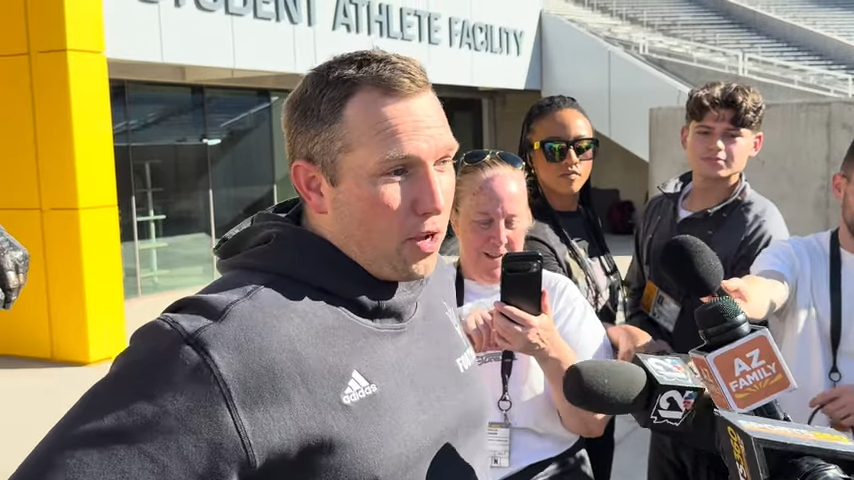


Kenny Dillingham said the quiet part out loud last Saturday.
We need to find one of these really rich people in this city to step up and stroke a check. … We live in Phoenix, Arizona. You’re telling me there’s not one person who could stroke a $20 million check right now? There is somebody out here who can.
Who is Kenny Dillingham, and what is he talking about? Dillingham is the youthful (35), vibrant, innovative head football coach at Arizona State University (ASU). What he’s talking about is a “plan” to make ASU’s football program elite.
Give him $20 million, and he could “recruit” enough talent to elevate his Sun Devils to an even higher level than their lofty status — 8–4 this past season, but 11–3 and a botched targeting call away from beating Texas in a double-overtime playoff game last year. It might even be enough to keep his current quarterback, Sam Leavitt (currently making $2.1 million), from jumping into the transfer portal. (RELATED: Fourth and Funded: College Football’s Fiscal Fumble)
And it might put ASU in the same financial ballpark as fellow Big 12 foe Texas Tech. The Red Raiders ponied up $28 mil for their football roster, thanks to big-money boosters. They got their quarterback cheap (only $1 million), which freed up funds for an elite edge rusher ($1.2 million) and an offensive tackle ($5.1 million for three years).
Through name, image, and likeness (NIL) deals, Tech also decided to become a softball power. They inveigled a pitcher from Stanford to Lubbock for $1 million; the new talent took them to within a game of a championship this past year. As it’s a yearly deal, they renewed the contract — she’ll get a million this year too. (RELATED: Figures Flip the Field)
But Tech is only one among many. A Michigan booster anteed up $3 million a year for a quarterback — $12 mil if he stays four years. BYU “landed” a basketball prospect for $4.1 million. The going rate for “average” quarterbacks is $1–2 million per year. Basketball programs routinely pop a mil or two on transfer players; some work out, but some count their millions while sitting on the bench.
This is where “amateur” sports is these days.
It’s been five years since the Supreme Court ruled that the NCAA was not exempt from antitrust regulations, leading ultimately to the NCAA allowing student-athletes to make money off their name, image, and likeness. Also in 2021, the rule that athletes in the major sports (football, men’s and women’s basketball, hockey, and baseball) had to sit out a year of competition if they transferred to another major school was dropped. In June 2025, the House v. NCAA case was settled, which opened the door to major colleges paying athletes directly — to the tune of $20.5 million per annum.
The net effect of all this? Major college sports have become professional.
The net effect of all this? Major college sports have become professional. Players receive direct payments from the universities but can also engage in side deals through NIL. They can move from school to school anytime they want, without restriction or penalty, which is tantamount to free agency. The only thing still “college” about big-time sports is that jocks still have to show up for class at their 101 courses once in a while — at least theoretically.
Tradition has been forfeited to the almighty dollar. One tradition most imperiled is the idea of the student-athlete. The idea behind college sports has always been that these athletes were not professionals; that they participated in the college experience like everybody else. They attended class, took notes, studied for tests, and had to get a passing grade.
It may be romantic — Pollyannish, in fact — to retain the idea of the student-athlete, but it’s the thing that keeps fans on board, loyal to the college. Richard Vedder, a professor emeritus at Ohio University, told William McGurn of the Wall Street Journal: “College and universities are all invested in the idea that the guys on the field are students because they are afraid that the bottom would drop out of all the millions they are taking in if alumni and fans had to acknowledge the reality that the athletes really aren’t students but professional athletes paid for their services.” (RELATED: College Football Is About to Change Forever)
Loyalty to a school is also a thing of the past. Time was that a fan could build an attachment to a player and sustain it for years. It was always a thrill to see a promising young player and remark, “And he’s only a freshman. We have him for three more years.”
Not anymore. With unrestricted free agency — called the transfer portal — players are here one year, gone the next. Some of them spend their four years of eligibility at four different schools. Some teams flip a roster significantly — some almost entirely — every year.
A good player on a lower-tier team is snapped up by an upper-level team — who offers hundreds of thousands of dollars, or more — while unproductive players from upper-level teams seek playing time at lower-tier schools.
The athletes care so little for the name on the front of their uniforms and so entirely for the name on the back. If the players care so little about their school, how long until the fans follow suit?
One wonders how long donors will accept poor returns on investments when a player they are paying big bucks via NIL doesn’t live up to his promise. Will they keep ponying up the $2 mil NIL deal to the quarterback who throws interceptions and fails to win games, to the projected hoops star who averages 2.7 points per game and spends most of his time watching the action?
The system is broken. The question then is: Can it be fixed?
Requiring athletes to sign and adhere to contracts would be a start. If they’re going to be pros, they should be treated as pros. An NIL “salary cap” would also go far to bring order to the chaos, put a limit on how much each school can dole out in NIL money. And third, regulate the transfer portal somehow, for example, by limiting “free” transfers to one per athlete.
Absent the imposition of such sanity, however, Kenny Dillingham has the right idea. His only problem is, he’s lowballing the amount.
Twenty million is not enough.
READ MORE from Tom Raabe:
The Altogether Predictable Sports Gambling Scandal



















