


Marines got some recognition on their 250th birthday from PBS and Netflix. On November 10th, they both aired programs about the Marine Corps. Each was of a different era, but both largely told their stories through the voices of the young marines involved. As I mentioned in a recent piece, PBS aired a documentary titled The Last 600 Meters describing the battles of Najaf and Fallujah two decades ago. Netflix began streaming Marines, a description of today’s Marines preparing for a deployment of the 31st Marine Expeditionary Unit (MEU) and their sister Navy Amphibious Ready Group for a recent deployment in the Western Pacific.
I’m not sure I would be quite so confident if I had to make that call today with the MEU assets now available.
In both cases the language used is authentic and largely uncut. Neither is recommended for church ladies, but both do a good job of capturing what marines do best in war and peace.
I’ll concentrate here on the Netflix offering, Marines because it captures both the strengths and challenges of today’s Marine Corps. In the best of times there are three Marine Expeditionary Units (MEUs) deployed in the world’s most likely trouble spots. Each MEU has a reinforced infantry battalion Ground Combat Element (GCE), a squadron of fixed winged jump jets, attack and transport helicopters (ACE) and a Logistics Support Element (LSE).
This is the smallest standing Marine Air Ground Task Force (MAGTF). Most MEUs deploy with very similar organizations because they have to be ready to do a variety of special operations missions that cannot be anticipated when they sail. These can range from disaster relief, hostage rescue raids, and evacuations of civilians to ship take-downs on the high seas.
Marines concentrate on the 31st MEU’s work-up for the deployment and the final exercise which will certify them as capable of accomplishing any of the missions described above. It is called a CERTEX. It is a high stakes practical examination for the marines involved and their Navy partners.
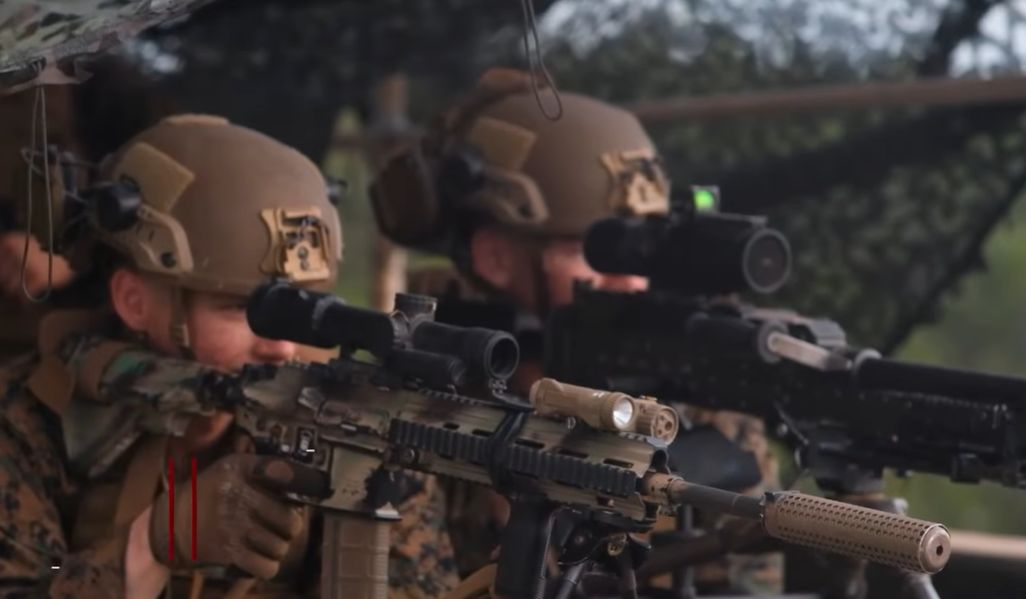
The series shows the best of today’s Marine Corps, but it also reveals some of its challenges. I don’t think the filmmakers realize the depth of those challenges, but sometimes they come from the mouths of the Marines themselves. The MEU’s Scout-Sniper Platoon is on its last deployment. The Marine Corps is eliminating such units and has closed its legendary Sniper School. The platoon’s marines are vocally unhappy and morale has plummeted.
The situation is exacerbated when the Commandant of the Marine Corps visits the MEU. He tries to explain why the elimination of some legacy capabilities is needed to afford a new strategy initiated by his predecessor called Force Design. This modernization effort calls for the Marine Corps to acquire anti-ship missiles and advanced radars to fire at Chinese warships in the event of a conflict. The elimination of the scout-snipers is one of the things needed to support this effort. Two things are obvious in the documentary. First, the marines aren’t buying what he is selling; second, they don’t understand what Force Design is and why it is so necessary. In that, they join most retired and former marines.
What the troops do know is that the discipline and accuracy of precision rifle fire is critical to several of the MEU’s missions. These include assisting in hostage rescue, amphibious raids, and ship take-downs at sea. The way the snipers are integrated into such missions is graphically illustrated as the CERTEX continues. The scout-sniper program was an incredibly small part of the Marine Corps’ budget.
Another challenge facing today’s MEU which Marines notes is the lack of tanks. The Marine Corps also did away with its tanks to afford Force Design. This is an area where I have considerable experience. In 1990, the Republic of the Philippines was experiencing a crisis when a number of senior Philippine military officers were reportedly planning a coup against the democratically elected government of Corizon Aquino. The Bush administration was determined to support the Aquino government.
The 31st MEU would normally be in Philippine waters to back up administration policy, but it had numerous other commitments in the Western Pacific that year. Accordingly, it was decided to create an Okinawa-based MEU-like Contingency MAGTF formed around my light armored battalion which would be deployed to the Philippines. These ad hoc organizations are now called Special Purpose MAGTFs designed for specific missions.
Due to the nature of the potential mission sets, the Contingency MAGTF was slightly larger and heavier than the 31st MEU. It consisted of a GCE of two light armored companies, an infantry company, a tank platoon, an amphibious vehicle unit, and a battery of artillery. The ACE consisted of a section of Harrier jump jets, attack helicopters, and transport helicopters. The logistic Support Element was smaller than that of the usual MEU because much of the support needed was already resident at Subic Bay. Because we were land-based at Subic Bay and its adjacent Cubi Point Naval Air Station, we generally had a detachment of FA/18 fighter-bombers available to ensure air superiority and provide what would later become known as “shock and awe” against any potential coup participants.
We had two primary missions. The first was to deter a coup or support the loyalists if one occurred. The second was to assist in the evacuation of the sea-side embassy and other American citizens in the case that order in Manila broke down. My planning in both cases involved the tanks. In the event of a coup, we contemplated a road march from Subic Bay to Manila to assist the loyalists. This required meticulous planning. My staff spent countless hours in ensuring that the bridges along the route could handle our M-60 tanks. In the event that the bridges were blown, they reconned potential fords.
The evacuation plan was more complex. We were going to use the tanks as rolling pillboxes to protect the evacuation beach. The best option was to do it by sea, but there was one problem; no Navy ships to land the tanks or do the evacuation were immediately available. The 31st MEU had most Western Pacific ships, and the remainder were in reserve in Okinawa and were days away if we needed them quickly. We solved this by partnering with the resident Army logistics unit to use some of their auxiliary supply ships some of which could carry and land the tanks. All of the options were war gamed and we rehearsed continuously.
One disturbing factor was that intelligence reports indicated that senior Philippine Marine Corps commanders were among the coup planners. Once settled at Subic Bay, one of my first orders of business was to invite the commander of their First Marine Regiment, which was located nearby, to dinner at the Cubi Point Officers’ Club. We had been classmates at Quantico, Virginia when we were captains.
The club overlooks the runway at Cubi Point. Over cocktails I had ordered a capability demonstration of our combat power. The Ground Combat Element paraded over the runway while the helicopters and jets did a fly-by at eye level from our perspective. I had our combat camera crew film the event on VHS. Over dinner, he told me that he was opposed to any coup and was particularly impressed with the tanks and jets. I presented him with the video cassette when he left and suggested that he share it with his seniors. There was no coup and my MAGTF was eventually replaced by a larger one commanded by a brigadier general.
I’m not sure I would be quite so confident if I had to make that call today with the MEU assets now available. You can’t prove the negative, but I believe we played a meaningful role in averting a crisis. The current commandant insists that today’s MEU remains as capable as ever. I hope he’s right — but hope alone is not a strategy.
READ MORE from Gary Anderson:
The Drug Boat Incident, a Decision-Making Simulation
The Marine Corps Could Not Fight Fallujah Today
The Best Birthday Present for the Marine Corps
Gary Anderson retired as the Chief of Staff of the Marine Corps Warfighting Lab, and later served as a civilian advisor to the Deputy Secretary of Defense.



















