
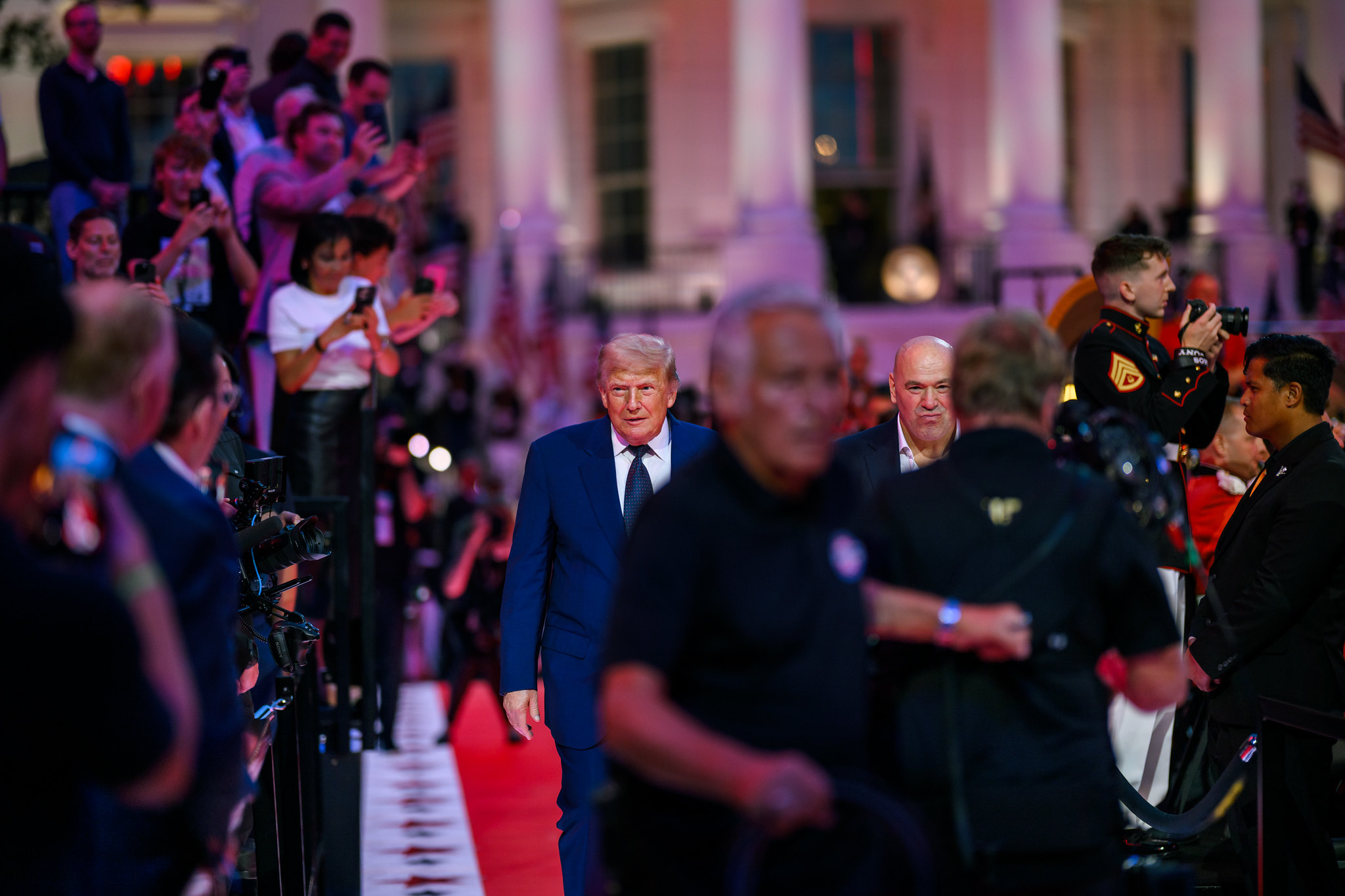


It is altogether natural and fitting that Donald J. Trump turns 80 as the United States approaches its 250th year. That the man most hated by our administrative class should stand at the helm during the Semiquincentennial would have struck the Founders as the mark of Providence: of “the hand of God,” of “the smiles of Heaven.” They understood, better than we, that republics are lost by internal decay and not by foreign invasion, and that sometimes a single, obstinate statesman can arrest it.
We have been instructed for decades that history has ended, that liberal democracy is now a matter of administration, that politics is to be turned over to experts, foundations, and bipartisan commissions whose great virtue is that no one can remember what, if anything, they believe. These are called “norms.” It is also called decline. Not the dramatic, noble kind that furnished themes to tragic poets, but the soft descent into comfort, cowardice, and mental flabbiness: the bipartisan managed decline of a civilization that has grown ashamed of itself but still expects the fruits of its former greatness.
What most outrages his critics is not his vulgarity, his tweets … It is his refusal to accept America’s decline as either necessary or noble.
Enter Donald J. Trump. What most outrages his critics is not his vulgarity, his tweets, his Queens accent, or even his obstinate refusal to speak the language of the credentialed classes. It is his refusal to accept America’s decline as either necessary or noble. He does not merely disagree with the genteel funeral directors of the West; he exposes them. Worse, he enjoys doing it.
Our enemies understand this far better than many of our fellow citizens. Beijing’s tyrants, Tehran’s theocrats, the polite despots of Davos and Brussels: these men and women know a threat when they see one. They recognize in Trump something that many Americans cannot quite admit: he is an obstacle. Not to “progress,” that euphemism for managed decay, but to the West’s transformation from freedom into despotism of a new, smiling kind.
Trump, by contrast, is the one figure who has thrown his body, reputation, and peace of mind onto the gears of this new machine. He breaks every taboo the soft tyrants laboriously construct. He shatters their careful euphemisms by calling things names that sound more like the locker room than the faculty lounge. That is precisely why they fear him. The West’s enemies abroad hate him because he asserts Western strength. Its enemies at home hate him because he reminds them that this civilization once believed in something: and might yet again.
Consider his foreign policy, which polite opinion told us was a buffoonish improvisation and now studies as it compares it to the refined incompetence that preceded and followed it. Trump did something that the post-Cold War consensus refused to even contemplate: he named China as the central strategic threat to the West. Not as a “partner,” not as a “stakeholder,” not as a new market, but as a rival power whose ambition must be checked if the free world is to remain free. University faculties, awash in Confucius Institute money and abstract theories of globalization, could not manage this feat. A builder from Queens did. (RELATED: Broadly Speaking, the Iran War Is About China)
In the Middle East, where generations of statesmen and scholars assured us that nothing could move but in the direction of catastrophe, Trump presided over the Abraham Accords: peace agreements that bypassed their tired formulas. The math was simple but decisive: treat friends as friends, enemies as enemies, and reality as something more than a subject for graduate seminars. Iran, the theocratic heart of the world’s terrorism, found itself for once genuinely constrained and not indulged. Venezuela began groping toward a post-tyrannical future. Even Cuba suddenly looks less immortal. (RELATED: The Foreign Policy Establishment Plans for a Post-Trump World)
Is Trump solely responsible for all this? Statesmanship is never solitary in fact, but it can be solitary in principle. The clarity to name enemies, the courage to defy the permanent foreign policy establishment, the refusal to sign the ritual documents of surrender disguised as “frameworks” and “roadmaps”: these traits were his. In an age that worships process and despises decision, Trump insisted that one actually govern.
Trump loves this nation with an untheorized, visceral passion, much closer to the Founders’ spirited attachment than to the bloodless abstractions of late liberalism.
But the heart of Trump’s significance lies at home, in his relation to America herself. He is, in the classical sense, a patriotic man: almost embarrassingly so in an era when patriotism is regarded as vulgar at best and fascist at worst. Trump loves this nation with an untheorized, visceral passion, much closer to the Founders’ spirited attachment than to the bloodless abstractions of late liberalism. He does not admire America because it is a “project” or “experiment” in need of permanent revision by committees. He loves it as something precious, noble, and irreplaceable.
Any hostility against America he experiences as a personal wound. One can see it in the way he reacts to flag burning, to Olympians kneeling, to professors who sneer at the Founders. The refined soul will say he is thin-skinned, narcissistic, unable to distinguish himself from the nation. But that is precisely the point. His fate and the nation’s are, in his mind, intertwined. The blows aimed at America’s honor strike him. A leader who identifies his destiny with his nation’s, who ties his own glory to its greatness rather than to cosmopolitan applause, is a dangerous figure for those who seek to dissolve it.
This is the real controversy. Trump does not want America to become a post-national, post-historical entity managed by global committees. He wants it to be America: loud, competitive, proud, and, above all, free. His Renaissance, then, is simultaneously spiritual and philosophic rather than merely geopolitical or economic. It is the sudden intuition, felt by millions who had been told to shut up and obey, that they remain citizens in a republic and not the slaves of a despotism. The so-called “populism” that horrifies editorial boards is merely the recollection that sovereignty rightfully belongs to the people.
Lincoln would have understood this. Lincoln knew that the danger to the American regime would come from an internal loss of faith and not its external enemies: from the corrosion of the belief that “all men are created equal” is a serious proposition and not a rhetorical flourish. He spent his public life trying to rebind the nation to its first principles. He understood that, in a liberal democracy, the people must be argued with, persuaded, and rallied. He would have recognized in Trump something familiar: a man who refuses to accept the fatalism of elites who have grown tired of their own principles.
To call Trump the perfect American hero will strike many as a joke. He is not Cincinnatus returning modestly to his plow, nor is he a philosopher-king descending from the clouds. He is noisy, combative, and comfortable with the vulgarity of the people. Precisely. America’s heroes have never been carved in marble before they lived. They have been frontiersmen, generals, rail-splitters, and yes, businessmen. What makes Trump heroic is his willingness to stand, alone if necessary, against the bipartisan consensus of retreat.
His legacy will outlive him because he has reawakened the central question of the American regime: shall we live as free citizens who govern ourselves or as managed subjects in an empire of experts? By forcing this choice, by refusing to let the great questions be buried under progressive jargon, Trump has restored to American politics something of its old grandeur and danger. He has brought back the possibility of real decision: of renaissance or ruin.
On his 80th birthday, therefore, we find the stage oddly set: an aging nation, tempted by exhaustion, approached by predators abroad and missionaries of despotism at home; and a man who obstinately refuses to concede that the story is over. That this man is in a position to oversee the 250th anniversary of the Republic is no accident. It is precisely the sort of irony in which Providence delights.
The Founders believed that republics survive only if they can still produce men who love them more than comfort, career, or praise. In Donald J. Trump, they would have recognized such a man, and seen in his embattled figure a sign that America’s capacity for renewal is not yet spent.
READ MORE from Dimpee Brar:




















