

When they decided to form a country, the Founding Fathers foremost preoccupation was that it was not, and would not become, despotic. At first, they created The Articles of Confederation and Perpetual Union, but that experiment fizzled; in their intense dislike of abuse of power, they had created a government with no power.
The Dutch Republic, the Amphictyonic League and the Swiss confederacy also had a similar confederacy, with mixed outcomes.
So, they tried again. But what to create? In studying historical precedents, there were four types of government: monarchy, oligarchy, dictatorship, democracy, republic. The first three were anathema. A democracy was impractical considering the size of the nation. That left a republic. But republics had historically evolved into dictatorships. So how to prevent that outcome? The answer was a separation of powers: the executive, the legislature, and the judiciary; on top of that, the legislature (for other reasons) was further split up into the Senate and the House of Representatives (logically, the legislature setup should not work, but it does), each protective of its turf. The result is the present Constitution — which is essentially a manual on how to run a country.
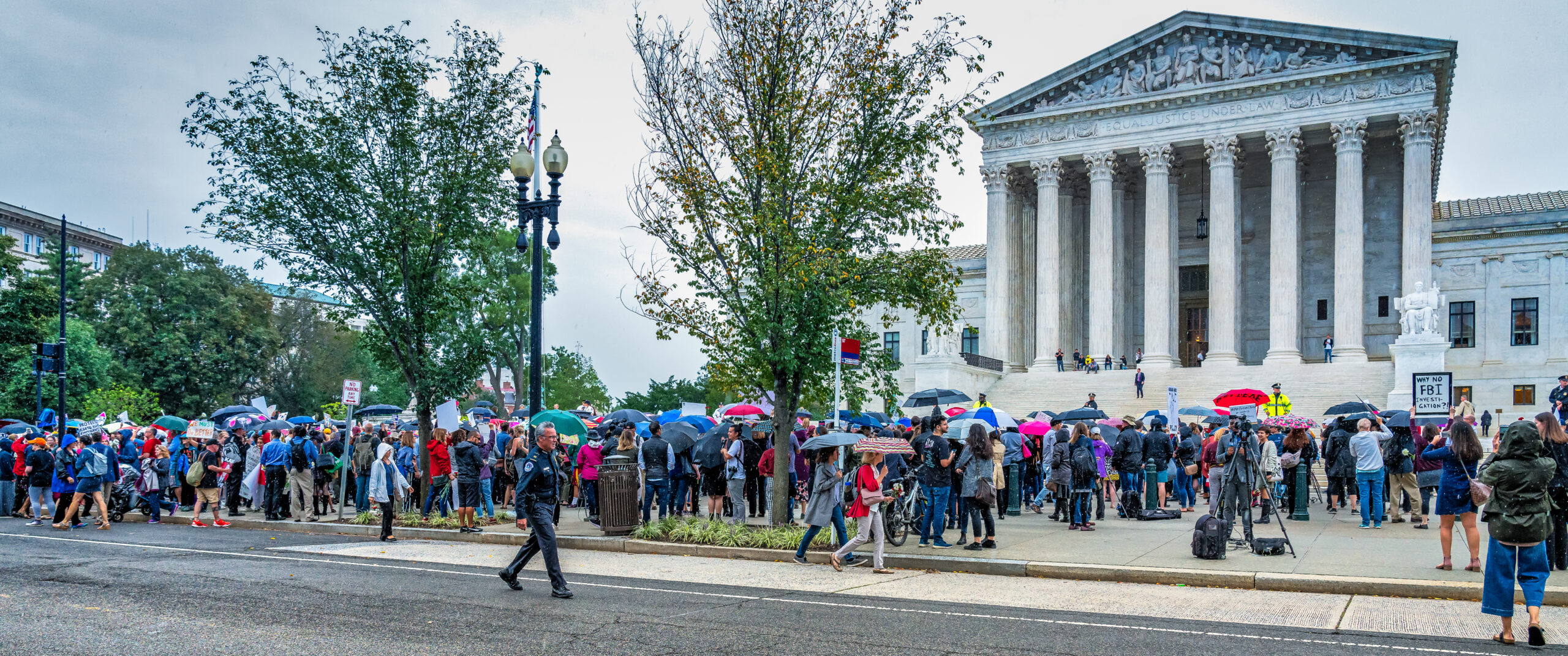
On numerous occasions, Democrats have practically salivated over legislating additional seats to a presumed defenseless Court.
They were further aided by the fact that each colony, and later each state, considers itself a country. Some individuals were of the opinion that there was no point in continuing the Union now that the War ofr Independence was over. Like many others, James Madison considered Virginia his country; he also considered America his country. For many decades, citizens simultaneously considered themselves to be both, for example, Georgians and Americans.
Recently, in social media, several Brits have remarked that each state is practically a country, with different concerns, laws, traditions, dialects, cuisine, radically different geography, many American states being bigger than European countries. After all, America spans half a continent.
Partly because of comity, and partly because of planning, the decentralization of political power became set in stone. This was one of the things that has made the American Constitution truly unique. The other was the Bill of Rights, which is a protection against government overreach. The Supreme Court has rigidly upheld the Bill of Rights and the principle of comity in legal matters not pertaining to the U.S. Constitution (such as how many persons can be in a jury). The Constitution was engineered to protect the public from people like Democrats.
Incidentally, many Europeans were certain that the United States would follow precedent and either become a dictatorship, dissolve, or plunge into civil war; in 1860, they were proven right.
This multimodal center of power was a stumbling block for the leftists who seek concentrated power. This became clear in 2020 after a shady election brought them to power. Although most states were cowed into submission, Texas, Arizona, and Florida eventually fought back when hordes of illegal aliens were brought into the country by the Biden Politburo. The numerous attempts at censorship in state universities were also thwarted by a handful of scholars and students who still had backbones. Numerous conservatives were judicially attacked, as well as individuals who defended themselves from crimes. Appeals away from leftist judges saved the victims.
Donald Trump was particularly targeted with a barrage of bogus lawfare indictments, such as being prosecuted for borrowing money from a bank and paying it back with interest. They failed because he has a huge war chest and a titanium backbone.
Democrats’ hatred of the Supreme Court (and the U.S. Constitution) is well documented. Although they have placed leftist judges in courtrooms and even some State Supreme Courts, their primary target remains the U.S. Supreme Court. On numerous occasions they’ve floated the idea of packing the Supreme Court with leftist judges who will nullify the Bill of Rights and sanction lawfare.
Recently, the Democrat Virginia legislature tried to nullify the state constitution regarding representation. Virginia’s Supreme Court (SCOVA) nixed it, whereupon Democrats appealed to the U.S. Supreme Court where they failed — again. And, as usual, they responded with hysterics, with one Democrat urging that the Virginia constitution be trashed. Others threatened SCOVA with “reform,” proposing the legislature retire the judges at SCOVA. That idea was soon abandoned.
The US Supreme Court Is Immune From Attack
On numerous occasions, Democrats have practically salivated over legislating additional seats to a presumed defenseless Court (“packing”). But that would be congressional overreach. Just like Congress can decide on its own rules, and the executive can decide on how it can act, SCOTUS can rule that law to be congressional overreach and, therefore, unconstitutional and, therefore, illegal. Likewise, just as Congress can expel a member, so could Justices conceivably expel an unworthy member. Perhaps like Kitanji Brown.
READ MORE from Armando Simón:
Uncovered: The Power of the Citizen Journalist
The Nobel Peace Prize Hits Rock Bottom
Armando Simón is a native of Cuba, a retired psychologist and historian, author of When Evolution Stops, and The Transgender Cult: Psychology, Politics, Religion and the Media.