
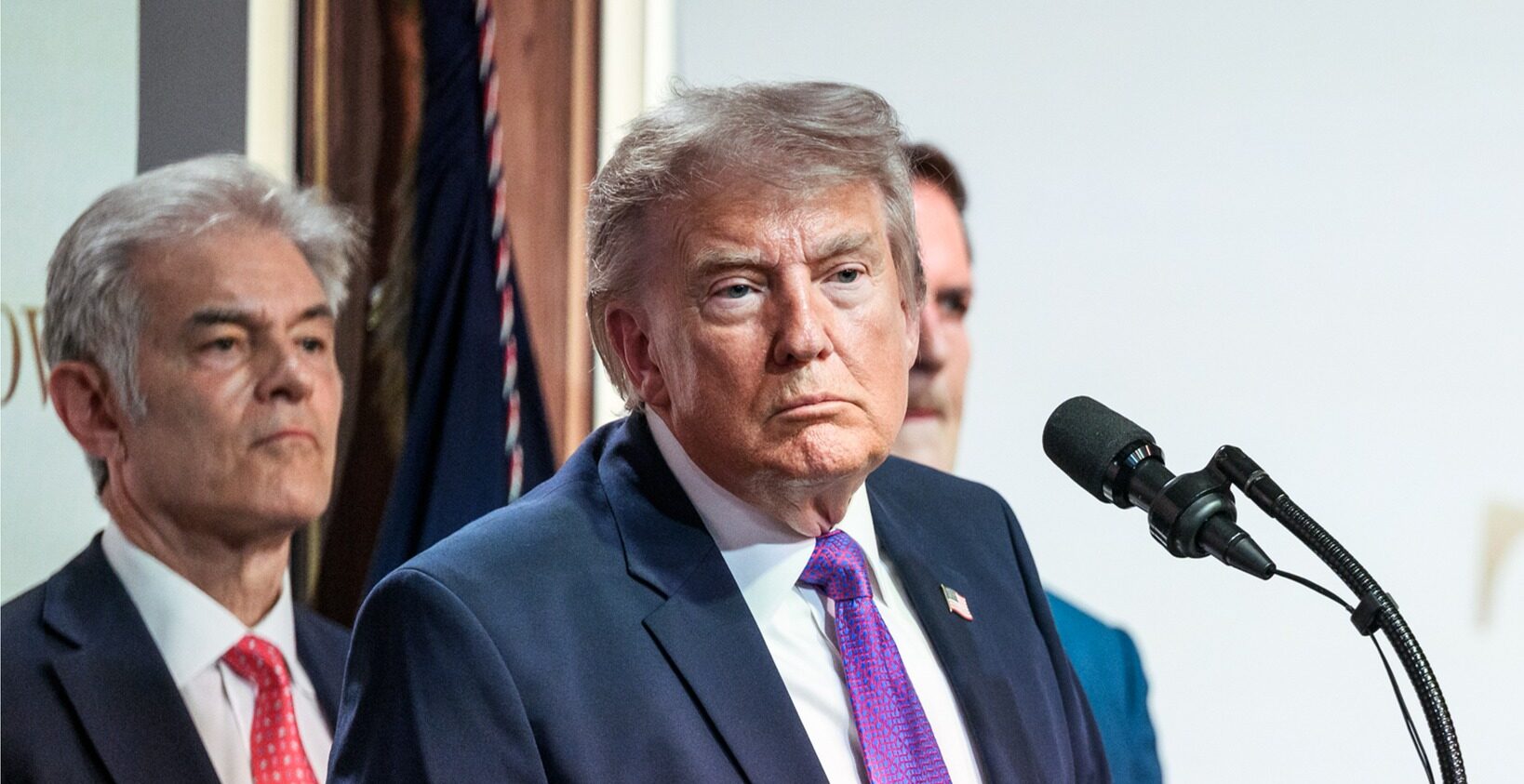


Donald Trump killed the Tea Party Movement on Tuesday.
The Trump-orchestrated defenestration of Rep. Thomas Massie from Congress confirms the metamorphosis of the Republicans into the party of big government. Unfortunately, for voters interested in restrained government, the Democrats also offer them this same “choice.”
Where should voters who believe in restrained government turn? Increasingly, Donald Trump — better described by all words in Webster’s Dictionary than by “restrained” — points us elsewhere.
Ed Gallrein, who switched his registration from Republican to independent when Donald Trump captured the GOP presidential nomination in 2016, defeated Massie 55 to 45 percent in the primary for Kentucky’s 4th District on Tuesday. Given the president’s will, even a mannequin — and Gallrein occasionally resembled one in his passive campaigning — might have won with Trump’s backing on Tuesday. To Massie’s credit, he made it competitive.
Trump encouraged the primary challenge, and declared Massie, an inventor who boasts two engineering degrees from MIT, a “moron,” the “Worst Congressman in the History of our Country,” and an all-caps “LOSER.” Trump, ironically, also questioned the widowed Massie’s remarriage.
In 2024, the president knocked Rep. Bob Good of Virginia, similarly a constitutionalist conservative, out of the U.S. House of Representatives. Last year, Marjorie Taylor Greene, once the president’s fiercest acolyte in Congress, announced her resignation after Trump repeatedly called her a “traitor.” Earlier this year, he wrote that Republicans should never reelect Sens. Josh Hawley and Rand Paul when they asserted, rather meekly and through a vote, that Congress possesses a constitutionally recognized war powers role.
As the Reason headline explains, “Thomas Massie Loses, Proving That Deficit Hawks and Foreign Policy Doves Aren’t Welcome in Trump’s GOP.” This shrinks the party when Republicans should look to shrink the federal leviathan.
The president imagines he can broaden his coalition through subtraction and division. He cannot. He can, however, hold greater sway over a smaller Republican Party in his war on conservative Republicans. Like the progressives who chased away Tulsi Gabbard and Robert F. Kennedy Jr., Trump’s fealty purity tests ensure a more conformist, obedient, albeit smaller, party. While a president better suited as an underdog challenging power than wielding it through governance may find such a situation more comfortable, most conservatives loathe the idea of Hakeem Jeffries and Chuck Schumer running the U.S. Congress. We head quickly in that direction because of the president’s second-term blunders.
Why does the president spend so much of his time, and his party’s finite supply of money, attacking conservative Republicans? Spoiler alert: the answer is because the president is a big-government Republican who cares little for the principles that have traditionally animated the American Right (or even the issues that animated him in his first term).
Thomas Massie forced transparency upon a recalcitrant president regarding the so-called Epstein Files, spoke out against the War Against $3 Gasoline (aka, the Iran War), and dared to vote against the One Big Beautiful Bill (what kind of conservative regards any “big” bill as a “beautiful” one?).
“Although there were some conservative wins in the budget reconciliation bill (OBBBA),” Massie conceded on the One Big Beautiful Bill last year, “I voted No on final passage because it will significantly increase U.S. budget deficits in the near term, negatively impacting all Americans through sustained inflation and high interest rates.”
Is there any doubt whether the president’s political fortunes, and the country’s economy, would be better off if he had listened to Massie on these issues rather than the advice that fast transforms his second term into a Jimmy Carter-like disaster?
Fifty-seven percent of Americans regard their country as heading on the wrong track, just 22 percent rate economic conditions as “excellent” or “good,” just 37 percent approve of the president’s job performance, and 65 percent disapprove of the war in Iran while 31 percent approve, according to the recent New York Times/Siena College poll. Surveys taken by other outlets mesh with these findings.
Why do Americans feel so down about Donald Trump and his policies? He presides over a weak economy that grows at about a 2 percent annual clip, pushes fiscal, monetary, and war policies that nudge prices higher (3.8 percent consumer price index in most recent report), and pressures conservatives to support spending bills that push the country further into debt and the federal government into a position of greater control over our lives. The terrifying epiphany: the federal government floods the economy with $2 trillion of borrowed money merely to nudge it just above recessionary levels.
The president launched the War Against $3 Gas without congressional approval just months after issuing the claim that he had “obliterated” Iran’s nuclear program. Like a modern-day William Jennings Bryan, he keeps pressuring the Federal Reserve to push its interest rate to unnaturally low levels even as the free market just pushed the cost of federal borrowing to a 19-year high in 30-year Treasury yields. The Republican in the White House and the Republicans in Congress (not named Thomas Massie) will spend $7 trillion this fiscal year, nearly $2 trillion of which they will have borrowed to do so and more than $1 trillion of which will pay interest on the existing $39 trillion debt to which they gleefully add.
Donald Trump fixated in Ahab-like fashion on the political destruction of the one representative standing athwart the spending bacchanalia that inevitably results in our nation’s destruction if continued. If only he would channel the energy and resources he mustered against Massie against progressives, then he might not find himself in such a mess.
READ MORE by Daniel J. Flynn:
How Did Trump Go from ‘Build a Wall’ to Grant Them Statehood?
Why So Many Political Pyromaniacs, Assassins, and Other Scary Types?




















