
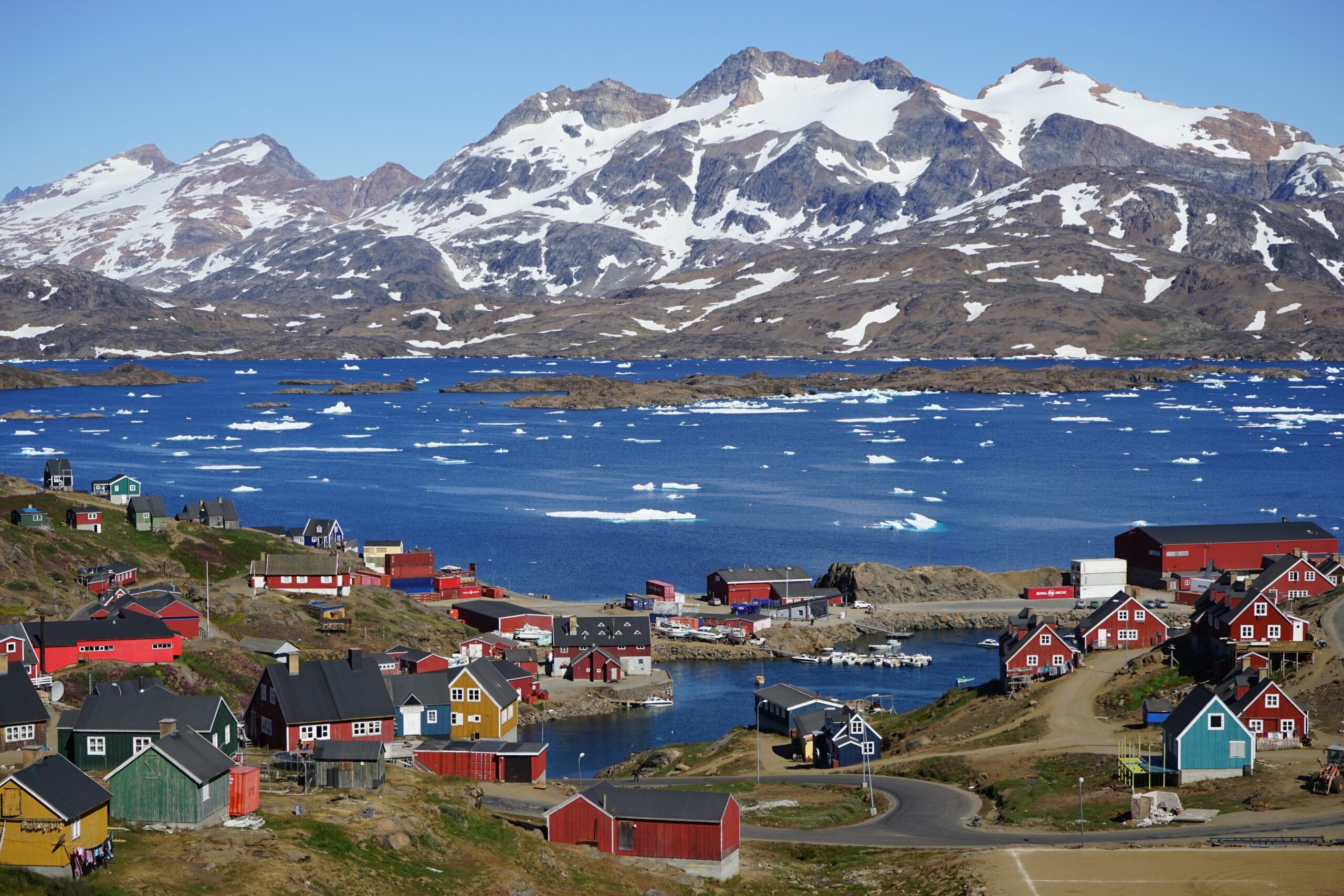


“One way or another” — that was the way Donald Trump spoke of his intention to acquire Greenland as he addressed a joint session of Congress last March. In recent days, Trump, fresh from overseeing a U.S. military operation that removed Venezuelan President Nicolás Maduro from power, has repeated that he wants to gain control of Greenland from NATO ally Denmark. The White House said he’s discussing his options, including potential use of the U.S. military.
Helping Greenland — financially and politically — acquire its independence from the Danes effectively puts America on the side … of self-determination and freedom.
The route of least resistance is to support their independence from the Danes and do a lease. I wrote about this for the Hill last February.
Trump’s critics are decrying imperialism, and the King of Demark once more thinks “there is something rotten” about the U.S. entrenching itself in the Atlantic colony of the Danes.
But, let’s be clear-headed here, America (a NATO ally of Denmark), is not going to invade Greenland. And annexing or buying Greenland is probably the wrong approach for multiple reasons. America doesn’t need sovereignty over roughly one and a quarter million square miles of basically — ice and rock.
What it does need is dictated by America’s national security interests— long-term access to the Arctic: military and space bases, infrastructure, and a durable agreement for harvesting strategic minerals.
Greenland sits astride the Arctic approaches that connect the Atlantic and the far North, for military purposes. Pituffik Space Base (formerly known as the Thule Air Base) already provides critical missile-warning and space-tracking capabilities.
Beneath Greenland’s permafrost are significant mineral deposits, including rare-earths — elements that are the heart of everything from consumer electronics to advanced defense systems. China is currently dominant in these scarce strategic resources.
Political costs
Yet, there are reasons why an outright acquisition — either by conquest or purchase — is a suboptimal way to secure access to the strategic and economic interests in Greenland.
Greenland’s people have to consent to any arrangement between America and the Danes. A deal that treats Greenland as an object rather than a participant is reminiscent of the treatment of the Czechs before WWII — “about me but without me.”
Ceding territory precipitates nationalist backlash and disrupts alliances.
A purchase would drag America into a constitutional and political firestorm. If the U.S. “owns” Greenland, the pressure to clarify political status begins immediately.
The U.S. doesn’t need to govern Greenlandic domestic or even foreign affairs. It needs long-duration basing and infrastructure rights, a stable legal framework for strategic minerals, and the ability to monitor and secure the Arctic approaches. Those aims are achievable without the baggage of sovereignty.
Financial Costs
“Something in the trillions looks about right,” said Douglas Holtz-Eakin, president of the American Action Forum, a center-right think tank, in an interview.
The value of Greenland’s known critical mineral and energy resources alone totaled more than $4.4 trillion, according to a study published in January 2025.
That figure falls to $2.7 trillion when excluding oil and natural gas, which Greenland stopped issuing exploration licenses for in 2021, citing environmental concerns.
But as of today’s technology, only a small fraction can currently be extracted economically. An estimate based on that fraction is $186 billion.
On the other hand, considering its strategic geographic location, this lifts the value to $2.76 trillion.
A better approach is to focus on “needs-based rights” — rather than a “deed of trust.”
Support Greenland’s Independence From Denmark
“It’s not a question of whether we should be Danish citizens or American citizens,” said Aaja Chemnitz, one of two Greenlandic lawmakers who represents the 836,000-square-mile island’s 57,000 inhabitants in Denmark’s Folketing, its Parliament. “It’s a question of how can we be Greenlanders and have a good Greenlandic future.”
Polls over the past few decades have consistently shown the majority of Greenlanders want independence from Denmark for reasons connected to its dark colonial past and persistent discrimination, though there is division over the timing of it and concern over what it could mean for living conditions.
Greenland’s “history and current conditions,” he said “have shown that our cooperation with the Kingdom of Denmark has not succeeded in creating full equality. It is now time for our country to take the next step.”
The Next Step
Given Greenland’s preference for independence from the Danes, America should forego any efforts at acquisition and negotiate a long-term lease guarantee with Greenland predicated upon their independence from Denmark. A century-long lease offers the simplest way to secure Arctic access without the political liabilities of ownership. A lease upon independence offers sovereignty to Greenland, while transferring defined rights for a defined term. Denmark gets political cover, Greenland receives permanent internal self-government, and the U.S. secures the access and capabilities that matter in the Arctic theater.
Moreover, a lease is much less costly for the U.S. — financially and politically. Here is one financing scenario based on realistic assumptions.
Greenland currently receives significant financial support from Denmark, amounting to approximately $623.5 million annually through a block grant, along with an additional $145 million for judiciary and defense expenses, bringing total annual support to around $768.5 million. This accounts for about 60 percent of Greenland’s government budget.
The present value of how much Denmark will save by no longer having to subsidize Greenland over the next century can be determined by using (as the discount rate) the coupon rate on Denmark’s 10-year government bond (2.8 percent) — essentially Denmark’s price for acquiring long-term money.
Denmark’s roughly $768.5 million annual support, discounted over 100 years at 2.8 percent, has a present value of about $25 billion. That’s the present value of the fiscal burden Denmark no longer assumes — in effect — compensation. Negotiations will determine any additional compensation accruing to the interest of Denmark.
The lease arrangement with Greenland could begin with negotiating how the payment comparable to Denmark’s present-value discount over 100 years ($25 billion) is to be made, followed by additional annual payments to cover the durable rights accorded the U.S. for the financing of any future real estate development, the implementation of military infrastructure changes (ports, docks, airports, etc.), drilling and mining rights and percentage participation in revenues generated from these efforts.
Compared with the political and financial “price tag” of an outright purchase, a 100-year lease with Greenland upon their independence delivers the same strategic ends at far lower costs — and without the sovereignty complications that make acquisition politically untenable.
Helping Greenland — financially and politically — acquire its independence from the Danes effectively puts America on the side of people wanting the right to self-determination and freedom. It would put Denmark in the awkward position of having to argue against that.
READ MORE from F. Andrew Wolf Jr.:
Trump’s First 12 Months: The Economy, Venezuela, and the American Electorate
Britain’s New Economic Policy: Get Used to Being Worse Off
Trump’s Economy Grows 4.3 Percent, Dashing Economists’ Lower Expectations




















