

On certain Sunday mornings in America, you can still hear a church bell toll across an otherwise silent neighborhood. The sound is familiar, but the congregation it once summoned has vanished. Pews sit undisturbed, hymnals gather dust, and sanctuaries once filled with life now echo only with the footsteps of estate agents measuring out a future that will no longer be Christian. In much of the West, the bell remains — but its audience has gone.
Nowhere is that shift clearer than in Buffalo, New York, where the Diocese sold the former St. Ann’s Church and Shrine — a Gothic landmark completed in 1886 — to Buffalo Crescent Holdings, a company associated with the Downtown Islamic Center. The purchase price was $250,000, far below the tens of millions required for structural repairs. There was no scandal — only a quiet transfer of a building one faith could no longer sustain to a community that could. Renovation has begun, with plans to establish the site as an Islamic center. (RELATED: Trivializing Religion Left Us Unprepared for Political Islam)
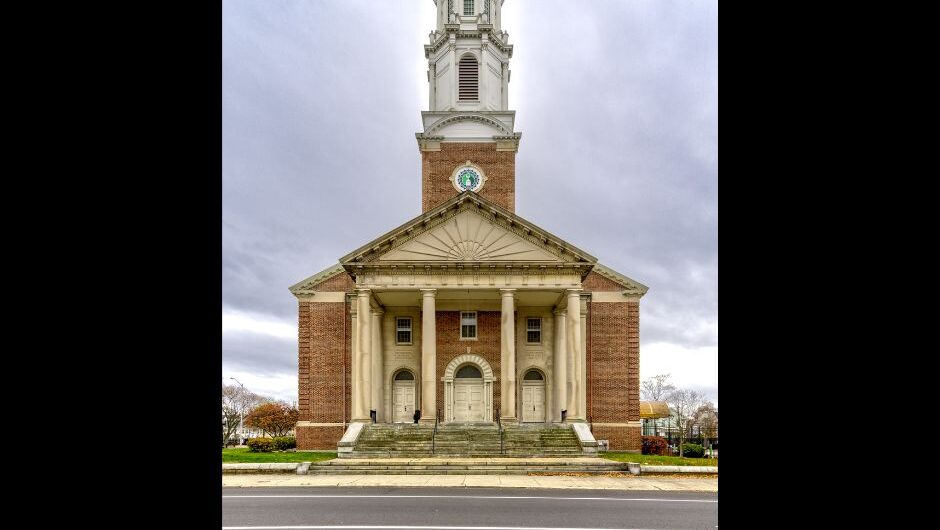
Across the United States, similar stories now surface with increasing frequency. In Bridgeport, Connecticut, the historic United Congregational Church — founded in the 17th century — sold its sanctuary to the Bridgeport Islamic Community Center, which reopened the building as a mosque and community hub.
When a mosque rises where a church once stood, it signals the retreat of one identity and the advance of another…
In South Milwaukee, Wisconsin, the former St. Adalbert’s Catholic Church and school was purchased by Masjid Al-Huda and now operates as an active mosque.
In Bristol Township, Pennsylvania, the closed Immaculate Conception B.V.M. Catholic Church was acquired by the United American Muslim Society and is being redeveloped as Mevlana Camii.
These examples sit atop an undeniable demographic reality: a nationally recognized Lifeway Research study found that 4,500 U.S. churches closed in 2019, while only 3,000 opened. Some analysts warn of a far steeper decline, with one widely cited estimate suggesting as many as 100,000 churches could close in the coming years.
This trend is not limited to former churches. In Stamford, Connecticut, a century-old decommissioned firehouse — once a Greek social hall — is being converted into a mosque by the Rahmatul-Lil Alameen Foundation. In Rolling Meadows, Illinois, a 47,000-square-foot warehouse was transformed into a large Islamic prayer center. And on Long Island, Masjid Al-Baqi occupies what was once a Pizza Hut and Japanese restaurant.
Across Western Europe, a parallel — and in some countries more accelerated — transformation is underway. In the Netherlands, reporting in Trouw found that at least 25 former churches have already been converted into mosques, as Christian congregations contract. In Friesland, roughly 250 of 720 churches have either closed or been repurposed, many into Islamic centres, while Amsterdam’s Fatih Camii occupies the former St. Ignatius Church, and a former synagogue in The Hague now serves as Al Aqsa Mosque.
In Germany, the conversion of a former Lutheran church in Hamburg into a mosque provoked intense debate about integration, symbolism, and cultural continuity.
In France, where hundreds of churches are underused or closing, a prominent Muslim leader publicly suggested converting empty parishes into mosques — a proposal that underscored both Christian decline and the organizational confidence of rising Muslim communities.
Meanwhile, purpose-built mosques are flourishing. In the United States, the number of mosques has more than doubled since 2000 — rising from 1,209 in 2000 to 2,769 in 2020, according to the U.S. Mosque Study conducted by ISPU and the Hartford Institute for Religion Research.
The United Kingdom recorded 1,825 mosques in a landmark 2017 assessment, a number that continues to rise.
Canada, too, has gone from only a handful of mosques in the mid-20th century to hundreds today.
These are well-established, well-funded communities with no shortage of purpose-built prayer spaces. Acquiring churches is not about scarcity. It is about symbolism. When a mosque rises where a church once stood, it signals the retreat of one identity and the advance of another — not by persuasion, but by presence.
This symbolism has deep historical precedent. Hagia Sophia in Istanbul began as a cathedral before being converted into a mosque following the Ottoman conquest. In Córdoba, the great mosque rose atop an earlier Christian basilica. These transformations expressed not practical necessity but civilizational triumph — architecture as declaration.
Canada reflects the same trajectory. In Ottawa, the former St. Margaret Mary Church — closed in 2019 —was purchased by a Sufi-led group and is being redeveloped into the Ottawa South Mosque. In Chatham, Ontario, the declining St. James Presbyterian Church was sold and reopened in 2021 as the Chatham Islamic Centre.
Canada’s National Trust estimates that 9,000 faith buildings — most of them churches — may close by 2030.
Many will become cafés or condominiums, but an increasing share will become mosques, Islamic schools, and cultural hubs for communities that are rising rather than receding.
The deeper question is no longer about real estate. It is about assimilation — or the limits of it. Earlier waves of immigrants adapted to the institutions of their host cultures. Today, a more assertive current seeks not to integrate but to replace. A mosque built where a church once stood is not merely a practical choice; it is a statement about which civilization is declining — and which one is advancing.
From Buffalo to Ottawa, from Bridgeport to South Milwaukee, from Amsterdam to Hamburg, the pattern is clear. When sanctuaries change hands, civilizations speak. The transformation is architectural, but the message is cultural: a record of what one society has abandoned — and what another is willing to claim.
The question is no longer what is being lost, but how long we will pretend not to see it.
READ MORE from Kevin Cohen:
When Honor Walks Into a Liberal Democracy
In Minnesota, Echoes of Failed Somali Experiment in Europe
How Sweden’s Demographic Winter Turned It Into Europe’s Rape Capital