
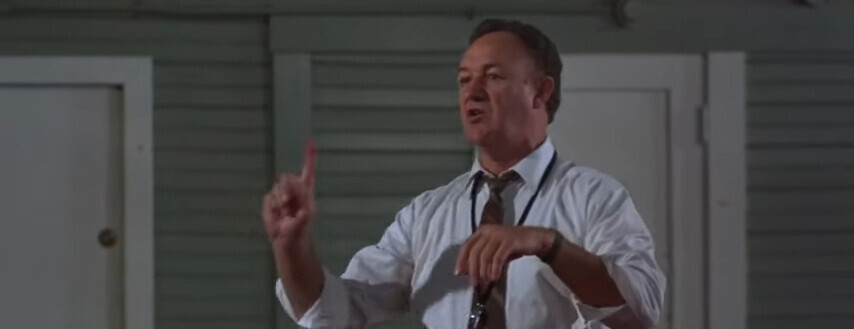


Of the recently departed Gene Hackman’s greatest hits — take your pick among The French Connection, Unforgiven, and The Royal Tenenbaums, among others — the most loved, at least for those seeking a fairytale David versus Goliath sports redemption story, is without question Hoosiers.
No movie in Hackman’s oeuvre — possibly in all of sports moviedom — pulls as many heartstrings and checks as many emotional boxes as the tale of the underdog high school basketball team from a tiny town playing its way to a state championship against much larger schools in hoop-crazy Indiana.
Hoosiers has everything. The “inspired by a true story” monicker — specifically, Milan High School’s 1954 state championship season. The down-and-out coach resuscitating his career in an improbable way. The plucky group of boys who overcomes significant adversity to achieve success. The pure, unsullied nature of a righteous pursuit. The great locker-room speech, realistic and time-sensitive game action, an unlikely hero making a game-winning free throw, and a likely hero making a championship-game-winning shot.
There’s a reason the Associated Press voted it the top sports movie of all time. It’s emotional; it’s uplifting; it’s inspiring; it’s nostalgic. It harkens back to a day when sports were as pure as an Indiana snowstorm in a state that made the now-almost-extinct single-class state tournament famous. (Only Kentucky, of all the states, still has one.) It tells a tale of unalloyed pursuit of a worthwhile goal undertaken under insurmountable odds. Of the 700-plus high schools participating in the tournament, the little one out in the boonies wins it all.
And Hackman’s character makes it all happen. He plays a coach — Norman Dale — booted out of college basketball in New York for punching a player but given a second chance by an old buddy (Cletus) who happens to be principal at a little, rural high school in Hickory, Indiana. He’s an old-schooler who wears a shirt and tie to practice and likes drills that don’t involve shooting the basketball. But the deck is stacked against him from the get-go: 64 kids in the whole school; nine show up for the first practice, of whom he throws out two for giving him lip; and the best player in town refuses to play on the team.
The Hickory Huskers start losing; townspeople start grumbling. The coach makes a controversial move — he hires the town drunk (Dennis Hopper) as an assistant coach. The discontent reaches panic level at a meeting where the whole town votes to can Norman Dale as the Huskers coach. But wait! Right after the vote, the star who won’t play — Jimmy Chitwood — walks into the meeting hall to declare that he’s decided to play ball after all. With one proviso — “I play, coach stays. He goes, I go.”
There’s a quick revote, and Coach Dale fares more favorably on this one. A town father announces the tally: “Coach stays.”
With Jimmy on board, the Hickory Huskers are a different animal. Jimmy’s can’t-miss shooting and the grit and hustle from the others propel Hickory through the remainder of the season and into the state tourney, through the sectionals and the regionals and into the final four. Coach Dale calms his wide-eyed troops by sending one onto the Butler Field House floor with a tape measure to chart the height of the basket and its distance from the free-throw line — “I think you’ll find these exact same measurements as our gym back in Hickory.” And with that, the boys go out and plow through their semifinal opponent and finally take down much larger South Bend Central, 42–40, in the championship game.
There is obsession about the movie — sports pundits have watched it endlessly and even charted shots and possessions of the fictional final game. One sports pundit claims to have watched the movie 250 times and has tracked Jimmy’s shooting percentage and output and has him going 14 for 18 from the field in the big game (the Huskers went 19 for 36).
It doesn’t matter that Coach Dale, for all his merits, seems like a suspect bench coach. He draws up a final play in the title game that treats Jimmy, who has made practically every shot he has taken up that point, as a decoy.
And it certainly doesn’t matter that the movie deviates in some important ways from the history that inspired it. The schools’ names are different; their nicknames are different (Milan Indians; Hickory Huskers). The real coach, Marvin Woods, was 26; Norman Dale was middle age (Hackman was 55 at the time). Milan had no drunk assistant coach sitting on the bench. No star player joined the team at mid-season.
True, Milan High School, like Hickory, is in southern Indiana. But it had 161 students; Hickory had 64. Milan was small, but it was a powerhouse, having made the state semifinals the year before. Bobby Plump, the real-life Jimmy Chitwood, made a shot at the buzzer from approximately the same spot on the floor Jimmy made his, but he held the ball at the top of the key for over a minute before, after a timeout, he made his three-dribble move to take the shot, whereas Hickory stole the ball with 18 seconds to go to set up Jimmy’s game-winning hoop. Muncie Central was Milan’s final-game opponent, not South Bend Central, and the final score was 32–30, not 42–40.
Plump once said only the winning basket of the championship game was true to life. “The final 18 seconds were the only thing factual in the movie about the Milan-Central game,” Plump said. “From the time the ball was in bounds after the final timeout, the movie was accurate.”
But these are quibbles. Hue strictly to the facts of the case, and you have a documentary, not a great sports movie. And of inspirational sports movies, of big underdogs toppling giants — of which there are legion — Hoosiers has few peers. It makes a relatively simple story with a predictable ending work.
And it works because of Gene Hackman. He’s the tough coach with unbending principles that nonetheless loves his players and believes in them, pushing them to their best selves while demanding respect. It’s a complicated role Hackman imbues with nuance and feeling.
Hackman may have considered Hoosiers one of his lesser works, but sports fans everywhere love his portrayal of Coach Norman Dale and the lessons he taught about leadership, perseverance, and the value of second chances.
READ MORE from Tom Raabe:
The Great Bob Uecker: Remembering ‘Mr. Baseball’
Christian Churches Mark 1,700th Anniversary of the Nicene Creed




















