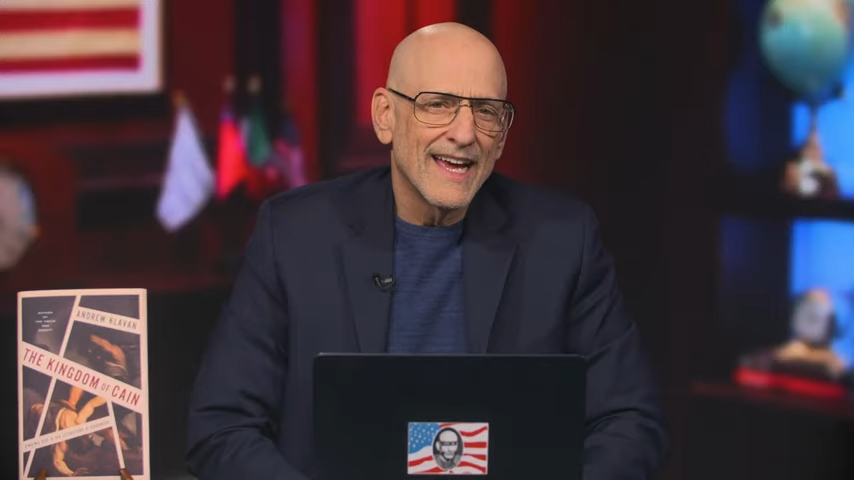


The Kingdom of Cain: Finding God in the Literature of Darkness
By Andrew Klavan
(Zondervan, 272 Pages, $29.99)
As last week stumbled to a close, I read the news story of Congressman Jared Huffman (D–Calif.), who was on his merry way to the National Prayer Breakfast, not to participate as a supporter but as a protester. Huffman has taken a proactive approach to stripping churches of their tax-exempt status. He was irked that the event was being held in Statuary Hall in the Capitol Building. He describes himself as a humanist. Huffman believes God has no place in government. As a humanist, Huffman may believe that God has no place at all.
Nietzsche’s old man declared that God was dead and that new lamps should be lit. The West has spent over a century struggling to find God’s replacement. In recent decades, many have opted for humanism over God. While there is a case to be made for the abuse by religions, be it economic, political, sexual, or otherwise, the stark fact is that the abuses have been from the machinations of men, not God. Likewise, the horrors of abortion, slavery, perversion and its chief method of distribution, pornography, war, and other demons that were once the occupants of Pandora’s Box are also the acts of humans, not the Deity. We owe our legacy of misery to men like Stalin, Hitler, Mao, their compatriots, and to a degree, ourselves, not to the creator of the universe. Humanism, despite the claims of humanists, is not quite what it is cracked up to be. Left to our own devices, we can be generous, kind, and empathetic. But as the headlines have shown us, we would be fools to continue to believe that man is the measure of all things. Humanity, by its very nature, is selfish, hedonistic, and narcissistic. Time and again, we have proved ourselves to be the very antithesis of the Godhead that we reject in our ongoing age of enlightenment.
In his introduction to the 1962 edition of 20,000 Leagues Under the Sea, Ray Bradbury draws our attention to the contrasting personas of Captain Ahab and Captain Nemo. Ahab, Bradbury rightly observes, is at war with nature and perhaps God himself. Ahab shakes his fist at heaven in his pursuit of the Leviathan. Indeed, Ahab rails, “That inscrutable thing is chiefly what I hate; and be the white whale agent, or be the white whale principal, I will wreak that hate upon him. Talk to me not of blasphemy, man; I’d smite the sun if it insulted me.” Bradbury asserts that Nemo, on the other hand, is in love with the natural world but also dedicated to the proposition that men should strive to be greater than the sum of their parts. Nature may be red in tooth and claw, but men need not be. Much of what Bradbury says makes sense, and his introduction is a wonderful read. But it should be noted that Nemo is driven by revenge, so much so that he resorts to wholesale murder to establish justice. He wields his Nautilus like a spear, again and again, sending men to watery graves until his conscience can no longer bear it.
Murder is the starting point for Andrew Klavan’s latest non-fiction offering, The Kingdom of Cain: Finding God in the Literature of Darkness. It is an odd place from which to begin. Why murder? Perhaps because murder is the ultimate self-indulgence. We murder for passion, self-preservation, revenge, to set right what has been wronged, or even as an expression of unbridled outrage. Sometimes, we murder for reasons we cannot even fully quantify, motivated by forces that have been afflicting us for years. Whatever the motivation, in the moment in which a murder is committed, we can tell ourselves that our act is justified. We can commit murder because, at the moment, we have taken the place of the rejected God. Murder is the ultimate act of hubris. It is not just taking a bite of the fruit of the Tree of Knowledge of Good and Evil; it is consuming as much as we can from the tree and scouring the ground for anything that has fallen from its branches.
Klavan focuses on three murders but does not unduly linger on them. Rather, he spends time explaining how they have echoed down from the past and fixed themselves in our culture, including literature, stage productions, films, and even philosophy. In doing so, they have become a part of our collective conscience. The murders he highlights are jumping-off points that have helped pave the way to the darkness that has characterized the 19th through 21st centuries.
Klavan begins with Pierre Francois Larcenaire, a man who murdered an acquaintance and his mother for a pittance. Larcenaire became a media sensation in his day, and of his sociopathy, he remarked, “I never strove for personal gain but for revenge. I wanted my revenge to be as huge as my hatred … Do you think the blood of ten or twenty would have sufficed me? Never. It was the social structure I wanted to strike at, in its foundations, in its rich folk. Its harsh, egotistical rich folk.” If those words sound familiar, they should. We have heard similar sentiments over the years from Black Lives Matter and Antifa. Klavan notes that Larcenaire’s crime inspired Dostoevsky’s Crime and Punishment, in which the protagonist, beset with debt, murders a woman and her developmentally disabled daughter, only to realize that he has slaughtered himself.
Following the same trail, Klavan recounts the story of Nathan Leopold and Richard Loeb. Leopold and Loeb were two well-heeled young men who suffered abuse as children. Because they considered themselves to be Übermensch, as they interpreted Nietzsche, they murdered a child, ostensibly because “they could.” Leopold and Loeb’s story fascinated the nation as an example not only of perversion but as an example to some as “living one’s truth.” The story would be retold multiple times, including as a stage play, a film, and even a musical titled “Thrill Me.” Leopold and Loeb buried God without a funeral, declared themselves overmen, and became the arbiters of life and death.
Klavan even delves into the story of Wisconsin’s Ed Gein, whose horrific exploits, too terrible to describe in detail, would inspire Psycho, The Texas Chainsaw Massacre, the Halloween series, and The Silence of the Lambs. Like Norman Bates’s character, Gein wrestled with an overbearing, manipulative mother, and the results were not confined to the silver screen; Gein’s crimes were not merely the musings of a writer’s overactive imagination; they were very real and were nightmare fuel. Gein and his onscreen avatar Norman Bates, and for that matter Leopold and Loeb, sought solace not in the transcendent or wrestling with their demons but by taking it upon themselves to inflict unspeakable horrors on others. Gein was not seeking revenge but, as terrible as it was, redemption. It was a twisted redemption, as is the case when redemption is sought beyond the Cross.
To that end, Klavan touches on Freud in several instances. I once heard a comedian remark that a Freudian slip is when you say one thing but mean your mother. While Gein and his fictional counterpart Norman Bates suffered at the hands of unbelievably dysfunctional mothers, Freud has been invoked by society, not just in the case of Leopold and Loeb, and to some extent, Gein, but to anyone who has transgressed societal norms under the banner of “Do what thou wilt shall be the whole of the law.” Klavan explains that Freudian theory gave way to the idea that guilt and shame are the problems. Ergo, as he put it, “All sexual behavior is not just permitted but required for self-actualization.” Such an idea can be applied to anything, be it setting a city alight in the name of equity, killing a baby days or even hours before its birth (in some cases, post-partum), or subjecting children to surgery and puberty blockers before they have a sense of themselves.
For this writer, the most damning part of Klavan’s book came as he explored the story of the titular Cain murdering his brother. Klavan plumbs various aspects of the story, but what was most striking was his examination of Lord Byron’s book, Cain: A Mystery. While few would consider Byron to be a theologian, and his reasons for penning the book may be up for debate, Cain: A Mystery chronicles Lucifer’s hypothetical response to Cain’s complaint that the world is an unfair place and that, among other things, he is unjustly denied access to the Garden of Eden over sins that he did not commit. Lucifer affirms Cain’s suspicions that God may not just be detached but possessed of a mean streak. Again, nature is red in tooth and claw, and God is unjust, and cares little for the sufferings of the innocent or those who hold themselves to be so. So, all bets are off, and do what thou wilt.
Byron’s story echoes, as Klavan notes, Ivan Karamazov’s angst over the concept that no matter what succor or justice God may provide in the world to come, it will not alleviate the suffering or injustice in the present one. And many Christians, whether they care to admit it or not, have, at some point in their spiritual walk, demanded to know why an all-loving, omniscient, and omnipotent God can remain so aloof and completely indifferent to the pain and chaos of the world. For the believer who has been, as playwrights Jerome Lawrence and Robert Edwin Lee put it, “cursed with the ability to think,” such a conundrum can be unbearable. One may be tempted to put the world to rights on one’s own when one should recognize that God is not the creator of misery but the response to it. That is not an easy pill to swallow. I confess to moments in prayer during which I have said to the Almighty, “Enough is enough, already!”
The common theme through all of the topics is that although we reject God, we still try to replace Him or reconcile our losses and dysfunction through our own devices. We seek our own answers, our own excuses, and our own forms of justice in an effort to restore not only what we have lost but to set right what is wrong in us or others. Rich people are evil; someone wronged us, and a bad thing happened. Therefore, we are given license to wrestle with that through wronging or perverting others. Murder, as it turns out, is the supreme example of the effort to set things right, turned inside out, and set aflame. We are beset with problems and struggles that we, lacking a connection to the transcendent, are in no position to solve by ourselves. Any attempt to exorcise our demons on our own will likely only summon more.
Finishing Klavan’s book, I was reminded of Plato’s Cave. Men are chained to the floor of a cave and perceive the world behind them through shadows of the goings-on outside cast by a fire. They do not fully understand reality, only the shapes of it. We take it a step further in our attempts to force those shapes to make sense, often to our detriment. Fittingly, Klavan ends the book with a call not just to slip off the chains but to crawl past the fire and into the sunlight to confront and eventually embrace the ultimate reality.
Klavan’s works are generally fast and easy reads, even his non-fiction. Although he references works that, by and large, are not taught anymore in academia or likely eschewed for the latest YA vampire novel, beach read, or the latest progressive screed assigned a place of prominence on the New York Times bestseller list, the tacit invitation is there to wade into the company of Dostoevsky and Milton.
The Kingdom of Cain seems like the natural next step to Klavan’s last Cameron Winter outing, A Woman Underground. In that novel, the hero copes with the idea of, in Nietzsche’s words, his horizons being wiped away and is faced with the task of lighting new lamps. While Winter’s fate will be decided in future volumes, we have the opportunity now to look beyond ourselves.
READ MORE from Lincoln Brown:
A Review of Robert Spencer’s Muhammad: A Critical Biography