
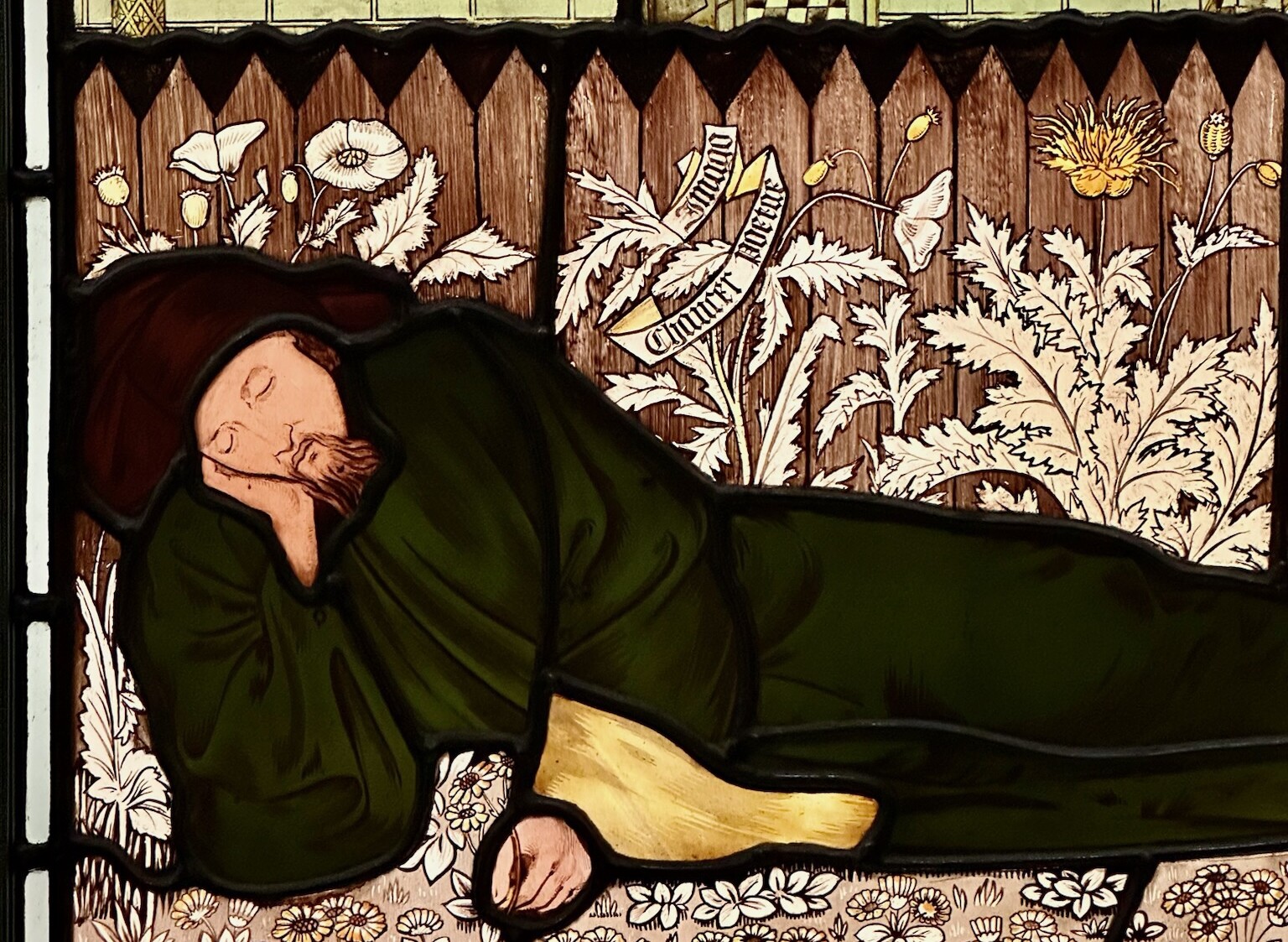


According to recent reports, if you are a student at the University of Nottingham and you are going to sign up for a course on Chaucer, you will be warned beforehand that you may encounter “expressions of Christian faith.” A spokesman for the university, attempting to put a Very Serious Face on this infantilizing of young men and women, said that even Christians will find some features of late medieval Christianity “alienating and strange.” Not “new and fascinating,” not “intriguing, opening up a world of neglected truth,” not “brilliant and full of life,” but “alienating and strange.”
Whence I suggest a new stanza for the school’s song if it has one:
What’s in your brains that’s rotting ’em?
What politics besotting ’em?
If you’re afraid of learning, you
Can rest assured you’ll get your brew
While gulping gobbets of our stew
With other moonshine at the U-
-niversity of Nottingham,
-niversity of Nottingham.
Meanwhile, I am teaching a course at Thales College on medieval thought and literature, to reach its pinnacle in Dante’s La Vita Nuova and Purgatorio, a pinnacle of beauty, artistic brilliance, and profundity of insight into man-made in the image of God. These last two weeks we have been reading Arthurian romances by a genuine titan of literary accomplishment and innovation, the 12th-century Chretien de Troyes.
My most fundamental task is to show the students how to read so strange and ironical a tale as The Knight of the Cart, that is, his Lancelot, in an adulterous love affair with the wife of his king, benefactor, and friend. It is why Chretien, indulging his allegorical fancy and his keen sense of drama, pauses in his tale to tell us about carts in the land long ago and far away, and how they were used to expose traitors and assassins and other such villains to the most shameful reproach.
When Lancelot climbs into the cart, hesitating before he does so, but desperate to learn of the queen’s whereabouts, he is not Christ humbly and triumphantly entering Jerusalem on the foal of an ass. He is, unbeknownst to himself, a figure of ridiculous humility applied to a wrong means to a wrong end.
I have used the phrase “how to read” advisedly. If your approach to Chaucer’s Canterbury Tales is that of a modern reader who turns the page to find out what happens next, and who assumes that details of scenery, clothing, time of day or year, and so on are touches of “realism,” you are not reading Chaucer. The same is true of Chretien and Dante.
When Dante opens his Divine Comedy with the line, Nel mezzo del cammin di nostra vita, he does not simply intend that we understand him as saying that he was about 35 years old, “in the middle of the journey of our life.” The echo of the canticle of King Hezekiah is meant to ring in our ears.
The prophet Isaiah had told the king that he was soon to die, whereupon the king wept and prayed to God to be spared; and the shadow on the sundial moved backward, and the prophet told him he would have another 15 years. Then Hezekiah, in gratitude, sang his prayer which begins with these lines as translated in Jerome’s Latin: In dimidio dierum meorum vadas ad portas inferi, In the middle of my days I went down to the gates of the netherworld. This, of course, is exactly what the pilgrim Dante is about to do, and, like Hezekiah, he will be spared.
But it is not enough to hear the echo. We have to note every change that Dante makes, too. He does not say “my days” or “my life,” but “our life,” signaling to us that in a real sense what he is about to unfold about sin, its effects on the soul, and its eternal consequences applies to everyone.
He does not say “my days” but “the journey,” and that brings into play the motif of the pilgrimage, absolutely crucial for understanding Dante, Chaucer, Langland, Chretien, the Gawain-poet, Wolfram von Eschenbach’s Parzival, and indeed the medieval view of life as a pilgrimage, a view founded in Scripture, for unlike Homer’s Odysseus who seeks his homeland to stay there for good, Abraham the father of all the faithful is instructed to leave his home in Haran, to journey to a place that God will show him.
The journey implies a destination, which for the Christian is union with God: the true Canaan, that Chaucer symbolizes by the cathedral of Canterbury, which comes into view for the pilgrims just as the sun is setting, and the Parson, urged by the Host, tells no story at all, but delivers a long, learned, and often bluff sermon on the seven deadly sins, and how to make a good confession. The sermon echoes much of what we have seen from the pilgrims themselves, many of them embodiments of lust (the Wife of Bath), gluttony (the Miller), avarice (the Reeve), and so forth; and it colors what we have heard from their tales.
At all events, we must do with Chaucer what his Nun’s Priest says about the story he is about to tell of Chaunticleer and the Fox: to “take the fruit and let the chaff be still,” to take the kernel of the grain which lies beneath the integument, as the intent of the artist lies at once within, beneath, and beyond the words of his song, or the colorful shapes on his manuscript, or the figures of saints sculpted on the façade of a cathedral.
Christ taught in parables, and so, instructed by the Master, did the medieval artist.
My students, I sense, are fascinated by this material, which is to say that they are like people entering a strange new land, open to its ways, and grateful because it is new to them. Their reaction, of course, is the normal human one. There is something wrong with you if you do not share it — if you are afraid, let us say, to go to Japan because you might find Japanese people there, doing things in Japanese ways. Which raises the question, “Why would anybody feel threatened by this strange world, the one you might enter, timidly, if you read Chaucer?”
No one, after all, is afraid of learning how medieval Englishmen cooked their food, smelted iron, cobbled their streets, or shod their horses.
We are afraid when we sense that we are weak.
The rickety and pallid city fellow shies away from the sturdy sunburnt farmer in the fields. We cannot keep our sins and our follies forever from our sight, and somehow the sense that they will not stay buried moves us to try our hardest to stay away from anything good, healthy, and sensible that might expose them.
That is the case with sin and folly generally, and in our time, so meager in cultural accomplishment, the last thing that people want, if their sense of worth is bound up in the peculiarities of this age, is to have the meagerness shown up by a Chretien or Dante or Chaucer.
Here is the real trigger warning the shrinking violets at Nottingham should have used: “If you take this course, be prepared to feel small, which by comparison with these giants we all are.”
READ MORE from Anthony Esolen:




















