
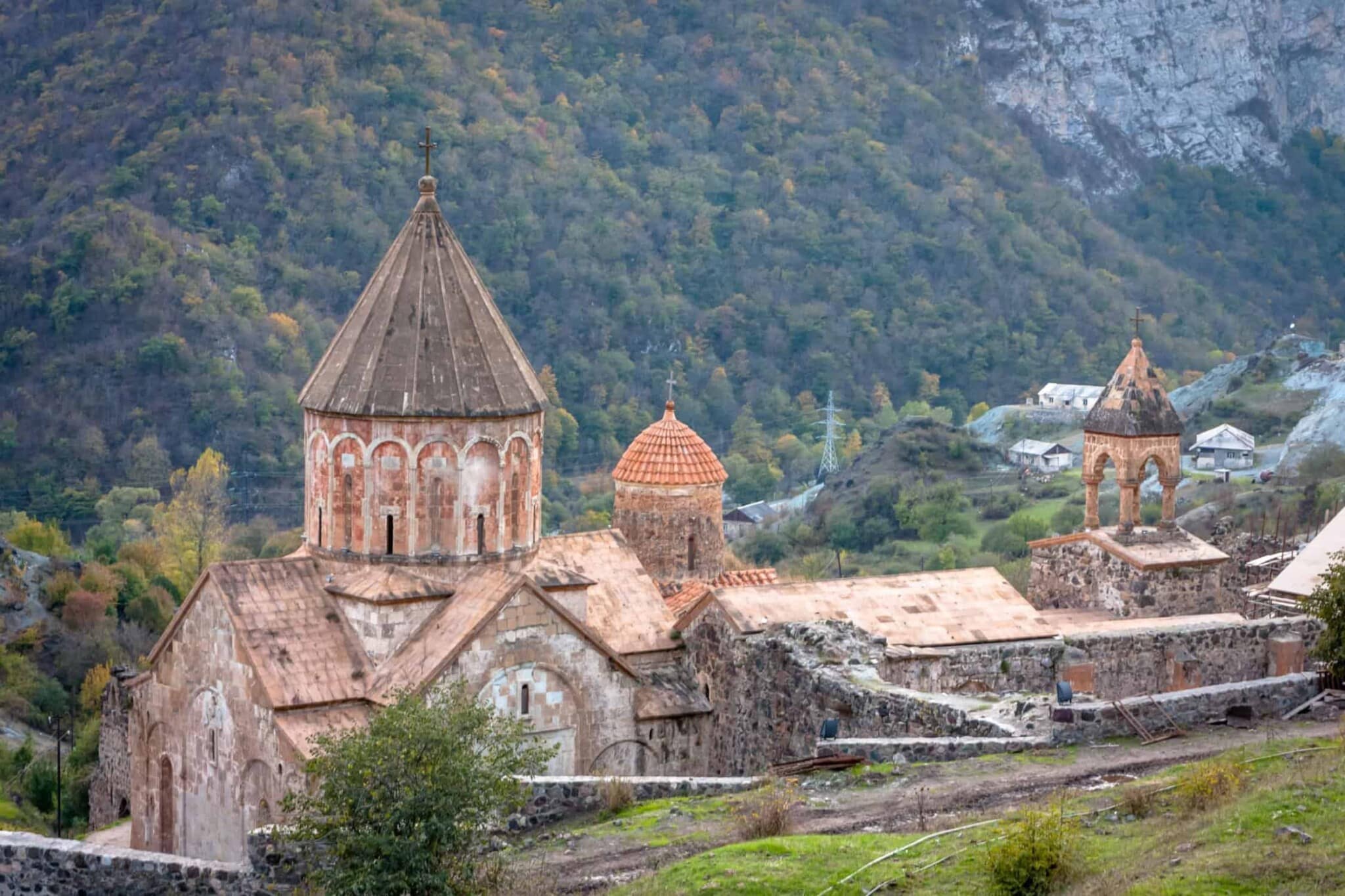


One road connects Armenia to Nagorno-Karabakh — a region of the country that sits like an island surrounded by its neighbor, Azerbaijan. The region would be oddly situated even if the two nations were the best of friends; as it stands, Nagorno-Karabakh could be the site of another genocide.
Eight months ago, the 120,000 Armenian Christians in Nagorno-Karabkh spent Christmas under siege while so-called Azerbaijani “climate activists” blocked food and medical supplies from entering the region. (READ MORE: Pray for the Dead, Pray for Those Who Persecute You)
It became clear that the “climate activists” were actually part of an official government blockade in April, when the Azerbaijani government established a formal military base on the road. “Not even the Azibarjani are pretending that they were environmental protests,” Joel Veldkamp said on the Higher Ground podcast last Thursday.
At this point, Armenian Christians in the region have been without gas since March; access to electricity is spotty, and food is limited. Miscarriage rates for women in the region have tripled, and people are collapsing in the street from hunger, Veldkamp said.
Just this week, a 68-year-old Armenian man was arrested at the blockade while being evacuated by the Red Cross due to a medical condition. Azerbaijan has since claimed that the man was responsible for “war crimes,” and he is now being held for questioning in the nation’s capital. Meanwhile, American and U.N. officials have warned that the blockade could turn into the next Armenian genocide.
“The situation is extremely urgent and existential,” Philos Project President Robert Nicholson said during a press conference in June. “This is the oldest Christian nation facing again for the second time in only about a century the possibility of a genocide.”
The World’s Oldest Christian Community
Armenia lays claim to one of the oldest Christian communities in the world and boasts churches and monasteries dating back over 1,700 years. Traditionally considered to have been evangelized by the apostles Thaddeus and Bartholomew, who were martyred there, Armenia embraced Christianity as its state religion in the early fourth century.
Even today, the country is broadly Christian — over 90 percent of the 2.8 million citizens identified as Christian in 2019, according to the U.S. State Department. “Christians have been ruling themselves in a democracy there for the past 30 years without interruption, and no one else has been able to conquer them,” Veldkamp said. (RELATED: Religious Liberty Under Threat, at Home and Abroad)
Armenia’s close neighbor, Azerbaijan, is more than 98 percent Muslim, according to the Pew Research Center. The nation has “deliberately nurtured a national culture of anti-Armenian hatred,” Veldkamp said, and it has apparently been successful. Veldkamp noted that he met Armenian migrants who had been attacked by ax-wielding Azerbaijani nationals standing outside their homes in France.
In 2004, the hostility between the two nations was displayed internationally when an Azerbaijani lieutenant attacked and killed an Armenian classmate with an ax while attending a military academy in Budapest. The lieutenant was extradited in 2012 and received a full pardon and welcome parade when he arrived in Azerbaijan.
“This is the direction that everything in Azerbaijani culture points to,” Veldkamp said. “Toward the elimination of Armenian Christians as people, as culture, as everything.”
Despite the obvious religious hostility, some have characterized the blockade as part of a territorial dispute. Both nations were part of the USSR, which had put the Nagorno-Karabakh region under the control of the puppet Azerbaijani government. In 1994, Armenia reclaimed the region and a large portion of its surroundings following the dissolution of the Soviet Union.
In September 2020, the Azerbaijani government invaded those territories, and Russia stepped in to broker a deal, which was reached just two months later. That deal essentially created the geographical situation today — Nagorno-Karabakh went to Armenia, an awkward island in the middle of Azerbaijan.
Russia must have known that the solution was temporary, but it was distracted by the Ukrainian war. This was the perfect opportunity for Azerbaijan to create a blockade, essentially strangling the coveted region.
The United States and NATO have denounced the blockade, and former Trump ambassador Sam Brownback called the attack a “religious cleansing” that is being “perpetrated with U.S.-supplied weaponry and backed by Turkey, a member of NATO.”
While Congress has denounced the blockade and threatened to withdraw American support from Azerbaijan and Turkey, very little action has been taken. Instead, Kristina Kvien, the U.S. envoy to Yerevan, the capital of Armenia, has issued a series of broad statements. (READ MORE: Religious Freedom Deserves a Strong Defense)
Kvien stated that all parties should agree that “the rights and security of Nagorno-Karabakh’s residents must be guaranteed.” When the Armenian government pointed out that her statement could mean that she believed Armenian Christians could live safely as Azerbaijani citizens — which is clearly not the case — she clarified her remarks.
“The United States does not presuppose the outcome of negotiations on the future of Nagorno-Karabakh,” she said. It instead “supports an agreement that is durable, sustainable, and lays the foundations for peace.”
The Path to Genocide
Unfortunately, a “durable” agreement may not be reached in the near future, as the Azerbaijani have not displayed any indication that they are considering lifting the blockade.
Some fear that Azerbaijan’s claim that the 68-year-old medical evacuee who was kidnapped this week is a “war criminal” may constitute another step in escalation. Veldkamp pointed out that the man in question served in the military — a requirement for every male in Armenia.
“We’re heading in the direction of all of these men being killed or arrested and put on trial by an extreme dictatorship that does not respect civil liberties, does not respect personal liberties,” he said. “The international community has to get really serious if they want to avoid a genocide.”




















