
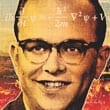



Things the Grandchildren Should Know
By Mark Oliver Everett
(Little, Brown, 256 pages, $23.95)
I’ll bet you can count the number of rock star autobiographies that delve into string theory and the many-worlds interpretation of quantum mechanics on one hand. I say this by way of warning: if you are looking for a rock memoir with tales of cocaine, wild groupies and all-night sexcapades, look elsewhere. Mark Oliver Everett’s memoir, Things the Grandchildren Should Know, explores physics, depression, and, ultimately, the meaning of life. Yes, there is plenty of drug and alcohol abuse, just not by the musicians.
Everett, the frontman for the rock band Eels, grew up within shouting distance of the Pentagon, the only son of the brilliant physicist Hugh Everett II, best known as the originator of the many-worlds interpretation of quantum mechanics. How brilliant? When Hugh Everett was 12, he struck up a correspondence with Albert Einstein regarding irresistible forces and immovable bodies.
As a theory, Many-Worlds should have been huge, so huge in fact it threatened to knock the reigning champs of quantum physics, Niels Bohr and Werner Heisenberg, right off their pedestals. Only Everett’s theory never seemed to get a fair hearing. In 1959, the 19-year-old Princeton graduate visited Bohr and company in Copenhagen where he was given the opportunity to present his theory. Never a great communicator, Everett utterly failed to get his theory across. What’s more, he was roundly dismissed as an impudent upstart. As one prominent attendee recalled: Everett was “indescribably stupid and could not understand the simplest things in quantum mechanics.”
Everett would remain bitter about this lost opportunity as well as his lack of recognition, and spent the rest of his brief life working for the U.S. Defense Department and aiding in the development of Minutemen rockets. A committed atheist, Hugh claimed to have scientifically disproved Christianity and asked that his ashes be dumped in the trash. His request was eventually “honored.”
Hugh Everett was even less successful as a parent. The Everetts seem to have been the stereotypical dysfunctional family. Hugh Everett was a wooden presence in the home, barely acknowledging his wife and children, let alone speaking to them. E’s only memories of his father are of a plump, bespectacled middle-aged man sitting in his Barcalounger scribbling mathematical equations in a notepad and chain-smoking cigarettes, save for the one time he became animated at the mewing of the family cat and screamed, “Shut up or die!” which became the Everett kids favorite catchphrase.
Ironically, just as Hugh Everett’s theories were beginning to catch on — if mainly for their sci-fi or hipster value — he died of a heart attack at the age of 51. Two examples: a 1967 episode of Star Trek featured a plot involving a parallel universe, and the 1991 film Slacker opens with writer-director Richard Linklater doing a long riff in a cab about parallel worlds, which was as good an introduction to the theory as I’ve heard:
[E]very thought you have creates its own reality. Its like every choice and decision you make the thing you choose not to do fractions off and becomes its own reality and it goes on from there—forever. In The Wizard of Oz, when Dorothy meets the Scarecrow and they do that little dance at that crossroads and they think about going in all those directions and end up going that one direction? All those other directions, just because they thought about it, became separate realities. They just went on from there and lived the rest of their lives, entire different movies, but we’ll never see it because we’re trapped in this one reality restriction type of thing.
A FULLER ACCOUNT of Hugh Everett’s story is documented in the excellent film Parallel Worlds, Parallel Lives, in which Everett fils attempts to better understand his father by visiting old Princeton colleagues and trying, somewhat in vain, to comprehend the basics of his father’s theories. Things the Grandchildren Should Know, on the other hand, largely focuses on the funk rather than the physics, and how E’s songs were inspired by the countless tragedies that have visited his life.
There is the memorable account of the 19-year-old E finding Hugh dead in his bedroom. Carrying his father’s corpse to the floor, per the 9-1-1 dispatcher, was one of the few times he remembered having physical contact with the man. More heartbreaks followed in quick succession. E’s beloved older sister Liz battled schizophrenia, drug abuse and alcoholism her entire life until she finally succeeded at one of her many suicide attempts, leaving a weird note about joining her father in a parallel universe. The day before the release of his breakthrough album Beautiful Freak, E’s alcoholic mum succumbs to cancer. His tour manager ODs. Even a cousin dies on September 11, 2001, when her hijacked plane crashes into the Pentagon.
Death and dysfunction aside, E’s story resembles most other rock star memoirs: a misunderstood misfit (in this case one who does not seem to have inherited his father’s mathematical genius) works a series of McJobs until he drifts into music in order to express himself, moves to a basement pad in LA where he writes and records songs on a home-recorder — bypassing the whole playing music live scene, not because he disliked nightclubs, but because he didn’t know that was how it was supposed to be done — handing his song tapes out to anyone and everyone, from Angie Dickinson to random strangers, until he finally gets one into the hands of a music producer who immediately recognizes his musical genius, followed by the usual conflicts with fickle and greedy record producers, and ultimately, the achievement of a precarious level of indie cult stardom.
What’s worth keeping here is the story of how a young man refused to succumb to the recurrent temptation to drive off a bridge, and redirected these thoughts and experiences into his songwriting. His sister Liz’ suicide, for instance, became the inspiration for the brilliant Electro-Shock Blues — an album which critics loved and record producers hated — and which included such gems as “Elizabeth on the Bathroom Floor,” “The Medication Is Wearing Off,” and “Going to Your Funeral, Parts I and II.”
The book’s title is also the title of an Eels song, and the irony, of course, is that E has no children. “I’m just going to skip that and go straight to the grandchildren,” he likes to say. So what is it the grandchildren — and all of us, I suppose — should take from this book? Something about the lows making you better appreciate the highs. Still, I like it better when he puts his thought to music:
So in the end I’d like to say that I’m a very thankful man I tried to make the most of my situations and enjoy what I had I knew true love and I knew passion and the difference between the two and I had some regrets, but if I had to do it all again well, it’s something I’d like to do.
E was only 45 when he wrote his memoirs. Given the tendency of the Everetts to die early he didn’t think it wise to wait. Let’s hope he beats the odds. And, better yet, let’s hope there’s a sequel.















