
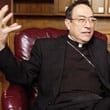


They haven’t gotten much attention, but church leaders in Honduras, while not specifically endorsing the coup, have not condemned the June 28 overthrow of leftist Honduran President Manuel Zelaya.
Óscar Andrés Rodríguez Maradiaga, the Archbishop of Tegucigalpa, and a Cardinal, strongly warned against Zelaya’s return to Honduras, which could lead to a “blood bath.” Rodriguez, in a televised speech on July 4, asked the Organization of American States (OAS), which has demanded Zelaya’s restoration, to examine the “illegal deeds” under Zelaya’s regime.
“To the Organization of American States: we ask that you pay attention to all the was happening outside the law in Honduras and not only what happened starting on June 28,” Cardinal Rodriguez said, reading from a statement approved by the Honduran bishops. “The Honduras people are also asking why the warlike threats against our country have not been condemned,” he continued, by implication referring to invasion threats by Venezuelan strongman Hugo Chavez. “If the inter-American system is limited to protecting the system of ballot boxes but not to monitoring good governance and the prevention of political, economic, and social crises, a belated reaction in the face of these will be worth nothing to the international community.”
In June before the coup, the Honduran Catholic bishops had urged a negotiated settlement between Zelaya, who was pushing a plebiscite to ultimately grant him the right to reelection, and the Honduran Supreme Court and Congress, who insisted the Constitution prohibited such a referendum. Later, the bishops met with Zelaya and urged him to abandon any reelection efforts. Reportedly Zelaya promised to leave office when his term ends in January 2010. When Zelaya then still insisted on a referendum, inciting a mob of supporters to storm a military warehouse and seize the Venezuelan-printed ballots, so the referendum could proceed despite the Supreme Court’s injunction against it, the bishops reportedly felt betrayed by Zelaya.
“We declare the right we have to define our own destiny without unilateral pressure of any sort, seeking solutions which promote the good of all,” said Cardinal Rodriguez in his July 4 broadcast, reading from the bishops’ statement. “We reject threats of force or blockades of any sort which only make the poorest suffer.”
Implicitly defending Zelaya’s ouster by the Supreme Court and Congress, Cardinal Rodriguez said: “Each and every one of the documents which have come into our hands show that the institutions of the Honduran democratic state are valid and that what it has executed in juridical-legal matters has been rooted in law.” Rodriguez noted that the Honduran constitution asserts that “whoever proposes” to change the constitution’s prohibition against presidential reelection “immediately ceases to hold his post and remains disqualified for ten years for any public function.” The Cardinal concluded: “Therefore, the person sought, when he was captured, no longer held the position of President of the Republic.” The Supreme Court had authorized an arrest warrant for the President, he noted.
Cardinal Rodriguez seemed to criticize the coup when he observed that the constitution prohibits expatriation to a “foreign State,” since Zelaya was shipped to Costa Rica. “We believe that we all merit an explication of what happened on June 28,” surmised the Cardinal, who insisted it is “fundamental” to abide by the scheduled election for a new president in November.
A representative of a Catholic missions group in Honduras, Missioners for Christ, was more direct, accusing Zelaya of leading Honduras towards a “socialist dictatorship” while disregarding “democratic rule and practices.” The missionary concluded: “He purports to be a voice for the poor and marginalized but has spoken for them and the country without comprehensive consensus and support.”
The Episcopal Bishop of Honduras was not so explicit but also declined to criticize ousting President Zelaya, who had “pressed on with plans for a nonbinding referendum which opponents said would open the gate for him to rewrite the constitution to run for re-election.” Defying the Congress and Supreme Court, Zelaya had “led a group of protesters to an air force installation and seized the ballot boxes, which the procurator’s office and the electoral tribunal had ordered confiscated.” There are 50,000 Episcopalians in the Diocese of Honduras, which belongs to the U.S. Episcopal Church.
Maybe thanks to the Episcopal Bishop in Honduras, the U.S. Episcopal Church did not join a “faith-based” coup condemnation by officials from other liberal led denominations and left-wing advocacy groups, including the United Methodist Board of Church and Society, the Evangelical Lutheran Church in America Washington Office, Church World Service of the National Council of Churches, the Maryknoll Office for Global Concerns, the Washington Office on Latin America, Witness for Peace, and School of the Americas Watch, among others.
“President Zelaya was forcibly removed from his home by the military and put on a plane to Costa Rica,” the activists complained. “The coup took place on the very day that a controversial non-binding referendum about the Honduran constitution had been scheduled.” The activists insisted that “actions by the Honduran military to arrest the President and force him out of the country cannot be accepted.” Included in the “faith-based” coup coalition were old and nearly forgotten groups not similarly excited since they lobbied for Central American Marxist insurgencies in the 1980s.
Meanwhile, Honduran evangelicals told Christianity Today that the Honduran coup answered prayers. “It’s sad to see the OAS and the UN forcing Honduras to take back this president,” one evangelical told the magazine. “We feel that what has happened is a reply to the fervent prayers of so many Christians. For many of us, it’s not a coup, but the rescue of our country and our democracy.” Before and after the coup, large numbers of evangelicals had demonstrated in Tegucigalpa for the Honduran constitution and against Zelaya.
On June 29, an anonymous Honduran official told the Washington Post, “The decision [against Zelaya] was adopted by unanimity in the Congress. That means all of the political parties. It has been endorsed by sectors that represent a wide array of Hondurans — the Episcopal Church, the Catholic Church. And well, of course, the armed forces.” He added: “The difficult part will be for the international community to see things as the Honduran people see them.”
Whether the “international community,” which continues to demand Zelaya’s return, will heed Hondurans, or their church leaders, is an open question.




















