


(This article appeared in the October 2008 issue of The American Spectator.)
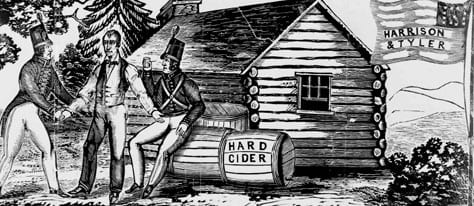
PICKING A PRESIDENT based on his qualifications as a drinking buddy seems like a quintessentially contemporary act, typical of the false familiarity of 21st-century politics. Yet the linkage of booze and ballots is as old as popular democracy itself. In one of the most important elections in American history, enfranchised citizens voted not on the promise of an imaginary Budweiser with the candidate, but because of very real barrels of crisp, refreshing hard cider.
If Americans are aware of the election of 1840, they remember it because the victorious William Henry Harrison dropped dead 30 days into his first term. His opponent, Martin Van Buren, is equally arcane, though this Kinderhook, New York native’s nickname — “Old Kinderhook” — helped spawn the world’s most popular expression: “O.K.” What many forget is the explosive popularity of the campaign and the turnout of three-quarters of eligible voters it engendered, all helped along by Harrison’s association with fermented apple juice. Although big issues were at stake in 1840, Harrison’s image as a simple soldier with a taste for down-home, American cider truly excited voters. When pundits mocked his love of the humble drink, joking, “give him a barrel of cider and he will sit the remainder of his days in his log cabin,” Harrison’s handlers pounced.
From then on Harrison frequently appeared in public clutching a ceramic flagon of cider, flamboyantly swigging the bubbly apple brew mid-speech, to prove his common nature in the face of his opponent’s ostentatious love of Madeira and champagne.
Just as lattes and lagers are powerful cultural symbols today, hard cider made a strong statement in 1840. Cider was probably the most common beverage consumed by early Americans, but so banal that few mentioned it. In a rural nation dotted with orchards, many harvested their own apples and mashed, pressed, and aged them into a fermented brew both sweet and richly pungent. But by 1840 the nation was changing, and increasingly sober, evangelical, and middle-class Americans no longer drank an annual average of seven gallons of pure alcohol per adult. As society commercialized, urbanized, and industrialized, backwoods cider recalled a simpler world of New England settlers and Midwestern pioneers.
At least as important as the actual cider was the statement made by William Henry Harrison’s thirst. Though born to a wealthy Virginia family, Harrison had remade himself as a poor frontier soldier, and drinking cider — like clearing brush — trumpeted his commonness. The culture war between cider and champagne drinkers intertwined with genuine political issues, pitting Harrison’s taste in alcohol against Van Buren’s extreme fiscal conservatism. One Maryland newspaper declared a contest between “the hard money office-holders of the Government and the hard cider party of the people.”
The Harrison campaign did more than publicize its candidate’s love of cider — it dispensed hundreds of gallons of the stuff to thirsty voters. In a corrupt and unequal democracy, Americans openly asked “what their country could do for them,” demanding cushy post office jobs or massive oak barrels of free cider. Though temperance types complained, “men get beastly drunk on cider” at Harrison’s rowdy rallies, most voters were ecstatic. In response to slurred complaints that Van Buren’s dry speeches were “all talk and no cider,” his campaign distributed dark ale, turning the election into a drinking contest between “hard cider Whigs” and “porter-bottle” Democrats. Harrison-supporters joked that “Old Kinderhook” might die of “apple-plexy.”
Come November, Harrison’s approach worked, winning him an astounding 80 percent of the Electoral College and making him the first candidate to earn more than one million votes. Though economics, enslavement, and employment were all major issues, the election was typified by cider. In the words of one newspaper: “We have had almost eleven years experiment of a rum-and- whiskey administration. It is time for a change. Let us try the hard cider.”
CHANGE WAS SHORT-LIVED. Harrison caught a cold, which quickly developed into pneumonia and blood-poisoning, killing him 30 days into his presidency. Yet the campaign launched the popular excitement and record voter turnouts — often helped along by free drinks — that lasted until the start of the 20th century. The inebriated election of 1840 also introduced the term “booze” to the American lexicon, named for the Philadelphia distiller E. G. Booz, who marketed his liquor in log-cabin-shaped glass bottles.
In the years after 1840, cider’s star plummeted. A market flooded with cheap grain and an influx of lager-loving German immigrants helped beer eclipse the apple brew. Temperance and eventually Prohibition finally put an end to candidates’ public exchange of drinks for votes.
For decades hardly any Americans drank hard cider. Yet it has enjoyed a comeback in the last few years, and not just the syrupy concoctions marketed as easy-to-drink alternatives to beer. Perhaps the best is Samuel Smith’s Organic Cider, made by the British company known for its exceptional Oatmeal Stout. This simple, clear, highly carbonated cider would have been perfect for a mid-campaign fish-fry, and is dry enough to refresh on a hot summer afternoon. Doc’s Draft Hard Apple Cider is a smaller-batch, more complex brew from the Hudson Valley, which elegantly combines the freshness of green apples with the funky smoothness of sheep’s milk cheese.
Finally, Michigan’s J.K. Scrumpy’s Organic Hard Cider is a classic fall cider, as sweet, cloudy, and thick as its non-alcoholic cousin. Though far too sugary for most of the year, Scrumpy’s is ideal for the crispness of high autumn, especially paired with a sharp cheddar. It would have been perfect for toasting William Henry Harrison’s November 7 victory.
(This article appeared in the October 2008 issue of The American Spectator.)




















