
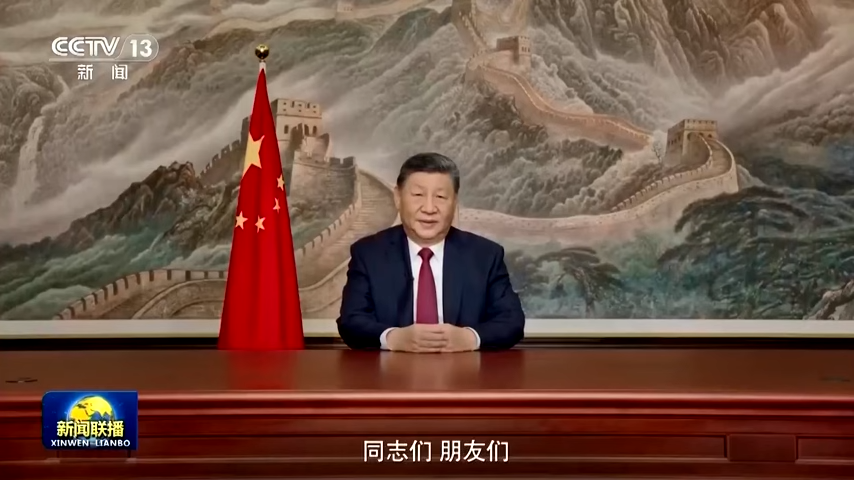


In a New Year’s address to the Chinese people, President Xi Jinping stated that “We Chinese on both sides of the Taiwan Strait share a bond of blood and kinship.” More ominously, Xi said, “The reunification of our motherland … is unstoppable.” Xi’s remarks came shortly after China ended its two-day military “exercise” near and around Taiwan that, according to the Washington Times’ Bill Gertz, involved “record numbers of aircraft and large numbers of warships operating in seven zones encircling most of the island.” The exercises, according to a People’s Liberation Army (PLA) post, said that the drills “are not an act or a bluff — they are a signal.” President Xi explained what the signal is: Taiwan’s reunification with the mainland is “unstoppable.”
Previously, Admiral Samuel Paparo, the head of the U.S. Navy’s Indo-Pacific Command, characterized China’s military exercises around Taiwan as “rehearsals” for attack, invasion, and blockade of the island. The recent military drills, according to Chieh Chung, a defense expert in Taipei, “appear designed to block an advance toward Taiwan by Japanese Self-Defense forces or U.S. forces stationed in Japan.” The drills included live-fire exercises involving rockets based on the coast of Fujian Province, which is located opposite Taiwan. The PLA Navy (PLAN) positioned warships and flew drones east of Taiwan. The New York Times noted that China’s military drills followed shortly after President Xi appointed a new commander for China’s Eastern Theater, and in the wake of President Trump’s decision to sell $11 billion worth of arms to Taiwan.
Jaime Ocon, a fellow at Taiwan Security Monitor, explained that the exercises around Taiwan were the largest since 2022, describing them as a “big escalation.” Ocon also noted that the military drills focused on blockading Taiwan. “This is a clear demonstration of China’s capability to conduct … anti-access aerial denial — making sure that Taiwan can be cut off from the world and that other actors like Japan, the Philippines, or the United States cannot directly intervene.”
A Chinese blockade of Taiwan could set the stage for a Cuban Missile Crisis-like scenario in the western Pacific, where China would play the role of the United States (which blockaded or “quarantined” Cuba in October 1962), while the U.S. would play the role of the Soviet Union (which attempted to challenge the blockade of Cuba). Like the Cuban Missile Crisis, it would be a confrontation between two nuclear-armed powers, but unlike the 1962 crisis, the confrontation here would occur in waters near China instead of near the U.S., giving China geographical and logistical advantages.
Many observers believe that the Soviet Union backed down over Cuba in 1962 because the United States then had overwhelming nuclear superiority to buttress its geographical and logistical advantages. China today is engaged in a significant nuclear weapons buildup that, in a few years, may eliminate the current U.S. lead in such weapons. Sino-U.S. nuclear weapons parity would further embolden the Chinese Communist Party’s (CCP) leadership in its quest to take control of Taiwan.
President Xi’s message was further promoted by an editorial in The Global Times, the English-language propaganda organ of the CCP, which verbally scolded Taiwan’s President for “peddl[ing] the fallacy of ‘Taiwan independence’” and being an “instigator of war.” Echoing Xi Jinping, the editorial proclaimed that “The rejuvenation of the Chinese nation is unstoppable, and the complete reunification of the motherland will surely be realized.”
No sane person wants a kinetic war with China, which is where a blockade of Taiwan might lead us. President Trump has rightly shifted our defense focus away from Europe and Ukraine and the Middle East to the Indo-Pacific. He has been attempting to reach a trade deal with China and to avoid a kinetic war with our principal adversary. He has also strengthened our defense relationships with Japan, the Philippines, and Taiwan — three key allies in the western Pacific. The president has also announced plans to build powerful new battleships and a golden fleet of warships. Now may be the time to end “strategic ambiguity” about Taiwan to send a message to Xi Jinping that reunification with Taiwan is stoppable.
READ MORE from Francis P. Sempa:
The Christmas Gift of Walter Russell Mead



















