
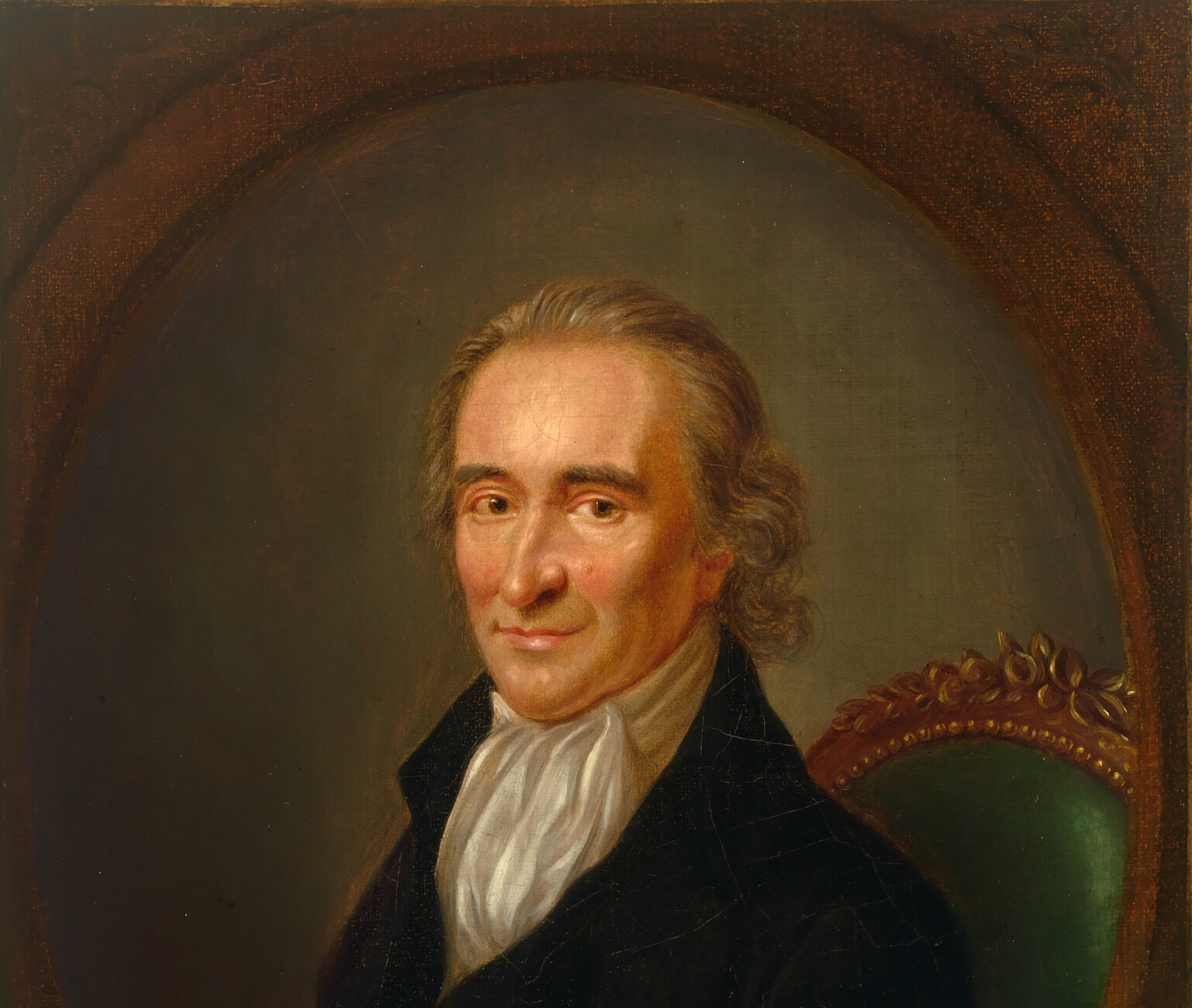


Two hundred fifty years ago on January 10, 1776, Thomas Paine published his influential pamphlet, Common Sense. In today’s words, its publication went “viral” as it was re-printed and distributed throughout the American colonies.
[H]is approach to government was so radical that he was treated with disdain in the United States, Great Britain, and France.
At the time of its circulation, the colonies were in a state of flux. British troops were engaged in active combat against colonial militias and both sides had taken significant casualties. But not all the colonies were in active rebellion. In fact, some colonial leaders sought reconciliation, but everyone realized the military conflict had irreversibly altered the colonists’ relationship with their mother country.
The next steps were uncertain, and no single idea of a way forward captured the imagination of the colonists.
Into this purgatory of crisis of conscience entered Thomas Paine and his thoughts about King George III, Parliament and the idea of monarchy. In many ways, Paine was a Johnny come lately to the American cause. He had only immigrated to the colonies in late 1774 and had not experienced anything but the growing animosity between the colonists and Britain. He had not seen the initial autonomy of the colonies nor felt the symbiotic relationship between local, colonial government and the crown.
Paine was in trouble and not welcomed in Britain. He was a strident critic of his government and advocated any number of radical causes including the elimination of the monarchy. In fact, he spent so much time on political advocacy that he lost his position as a tax collector and the business he inherited from his wife failed. Facing debtors’ prison, he was forced to sell assets and with such financial instability, he became separated from his wife.
Fortunately, Paine was introduced to Benjamin Franklin in London and was encouraged to emigrate to Philadelphia. So, as many others had done, he left his financial and domestic troubles at home, crossed the Atlantic and came to Pennsylvania for a fresh start.
His arrival in Philadelphia came just as the Boston colonists were rattling sabers at Red Coats’ occupation of their town. Once fighting at Lexington and Concord started, Paine was in a unique position to assess and then encourage colonial independence. In the first full year of coming to America, he experienced the anxiety of the colonists with their relationship with Britain. He had witnessed the military conflict in Massachusetts and was in the middle of a political vortex of the colonist’s consideration of what direction to pursue.
Common Sense came at the ideal time as all colonists were questioning not only their relationship with the King and Parliament, but how they would organize to govern and protect themselves. If the road to independence was not clear, Paine provided a shining path.
As a newcomer, Paine published the work anonymously, identifying himself only as “an Englishman,” believing that the appearance of English authorship would confer greater legitimacy on his argument.
His work hit the right nerve. Within a few months more than 100,000 copies of the 47-page pamphlet were in circulation throughout the colonies. Paine’s work seemed to finally supply the organizing principle of independence to the colonists.
Rather than make the distinction that the British Parliament and not King George was the root cause of the colonists’ predicament, Paine directly attacked the King. Lambasting George III was not based on specific actions, but on the idea of the monarchy itself. Paine was a republican and 250 years ago, that meant no hereditary monarchy. Viewing all men as equal he argued that kings were historically the source of trouble for people and should be eliminated.
He further argued that independence was the only course of action to take and that the colonists must separate themselves from the evils of a king, seek self-government, and form a new society.
While the colonists were weary of the king and chaffed under his decrees, they largely blamed the king’s ministers and viewed King George as getting bad advice from poor counselors. Paine disabused the colonist of this notion and pointed out the entire problem was having a king to start with.
His arguments provided a logical basis to consider that being independent of Britain was the only way to resolve the conflict. If people had doubts about the colonists’ end game with their relationship with Britain, Paine gave them moral authority to pursue complete separation.
But Paine’s prescription after independence was a radical government that was more populist and closer to a pure democracy. This ran counter to many of the traditional colonists who had experienced the pre-revolutionary, benign neglect from Britain and simply wanted that again. The more established colonial leadership, while willing to replace the king, wanted to maintain the structure of state centered, colonial government. Many thought that Paine went too far.
Paine’s writing continued to support the Revolution, but once it reached a favorable conclusion, Paine returned to Europe and caught the spirit of the French Revolution. In London, he advocated for the right of the people to overthrow their government. This did not sit well, and Paine was convicted of sedition. He fled to France and was instrumental in supporting that revolution too. But his writings became so radical that he was arrested and was slated for execution. Fortunately, American ambassador James Monroe intervened to save Paine from the guillotine.
Paine would return to what was now the United States, but he became wildly critical of his former friends when he realized they did not fully embrace his ideas of government. As a radical to the end, he could never find comfort with the U.S. Constitution and the stability of divided, co-equal government.
When he died, hardly anyone attended his funeral. While he was a catalyst for shedding the colonists of a king, his approach to government was so radical that he was treated with disdain in the United States, Great Britain, and France. Quite an accomplishment, but a sad ending to such an important advocate for American liberty.
READ MORE from Will Sellers:
A Missed Opportunity: Russia and the Decembrist Revolt
Heinz Rises From Bankruptcy to an American Icon
Ford and the Making of Democracy’s Arsenal
Will Sellers is a graduate of Hillsdale College and is an Associate Justice on the Supreme Court of Alabama. He is best reached at jws@willsellers.com.



















