
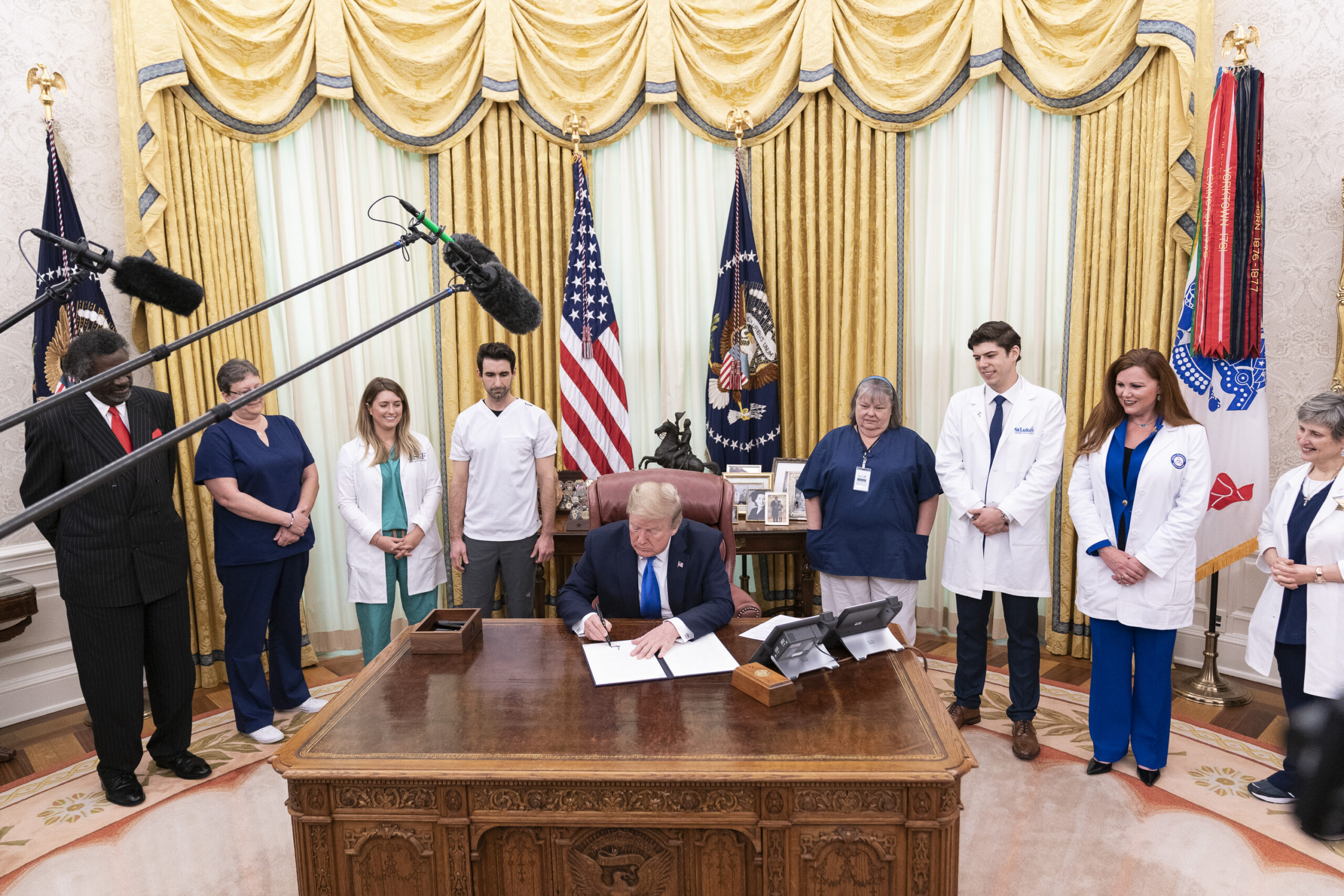


President Trump reentered the healthcare debate with The Great Healthcare Plan (GHP), as families confront another year of rising insurance costs.
After expiration of pandemic-era Obamacare subsidies, millions of Americans are seeing premiums and out-of-pocket costs rising sharply. The immediate response in Washington has been to debate whether those subsidies should be restored.
Lawmakers can either double down on failed policies that raise but hide prices and ration care, or they can pursue reforms that give Americans control over the money.
That debate misses the fundamental question of why health insurance costs keep rising with no end in sight? Why are Americans paying more while getting less (care)?
Trump’s proposal builds on his argument to stop routing taxpayer dollars through insurers and give the money directly to people.
That instinct is sound. Whether it leads to effective use of limited healthcare dollars depends on whether policymakers are willing to tackle politically sensitive structural inefficiencies.
To understand why or how this works (or actually doesn’t), it helps to explain how Obamacare subsidies are determined and who is subsidized.
Under current law, premium assistance is tied to the cost of a government-defined benchmark plan. Consumers never receive these dollars. Instead, the federal government sends subsidy payments straight to insurance companies every month, automatically increasing payments as premiums rise. This structure shields consumers from the true cost of coverage and allows insurers to increase prices without limit.
During the pandemic, Democrats expanded federal ACA subsidies by removing the income cap and reducing the share of income households were expected to pay. People with incomes up to $220,000 received subsidies. More than 20 million Americans, most healthy, often wealthy, were added to subsidy lists. Thus, when insurers increased prices and subsidy payments automatically rose, billions of taxpayer dollars were added to insurance coffers.
When those enhancements expired (December 2025), families were suddenly exposed to the real price of coverage. In many states, average exchange premiums increased by roughly 26 percent. Affected households saw out-of-pocket costs more than double.
And what do people get when paying more? Nothing, except longer wait times for care!
Sticker shock has fueled renewed pressure to restore the subsidies, even as Democrats openly discuss a second government shutdown to force Republicans to renew and extend the enhanced subsidies. But reviving subsidies leaves untouched a financing structure that allows payments to rise indefinitely.
Trump’s GHP proposes to redirect subsidy dollars from insurers to individuals. For current exchange enrollees, those subsidies average $550 per month, or about $6,600 per year, depending on income and location. The question is whether ACA subsidies are the most effective or even a proper use of limited health care dollars intended for the medically vulnerable.
The employer-sponsored health insurance (ESI) is the regulatory machinery that diverts healthcare dollars from care to insurance bureaucracy. The ESI is based on a tax exclusion dating back to a World War II wage freeze accommodation. In 2025, the average ESI payment to insurance companies for family coverage reached nearly $27,000. That is not employer generosity. Those dollars are wages earned by workers they never received because Congress repealed all elements of the WW II Stabilization Act of 1942, except the ESI.
Workers never received ESI funds. Therefore, they had no control over how their money was spent.
If policymakers are serious about giving money to the people instead of insurance companies, the ESI is the place to start. By offering $6,600, Trump’s GHP may help at the margins. Redirecting hidden and denied compensation, averaging nearly $27,000 per person to each of 165 million American workers would fundamentally change incentives across the system, returning market power of money where it belongs — in consumers’ hands.
Access is inseparable from affordability. Across the country, physician appointment wait times are getting longer, particularly for primary care. In extreme cases, patients die while waiting for treatment, a phenomenon increasingly described as death by queue in those with Medicaid or Tricare coverage.
These outcomes are not anomalies. They are predictable, indeed proven, consequences of a system, where federal and state insurance regulations, not patient needs, drive decisions.
Trump’s GHP correctly identifies financial diversion as a core problem. His plan’s limitation is that it stops short of truly effective system reform.
Real reform means aligning incentives with the desired outcome: timely care. Returning control of their health care dollars to patients will allow competition to discipline prices and improve service. Americans can then get the care they need when they need it at prices they can afford.
That framework is outlined in our Empower Patients approach, described in the book Empower PATIENTS: Two Doctors’ Cure for Health Care. Empowering patients would lower costs, improve access, and restore the patient-doctor relationship that has been eroded by third-party control.
Congress already allowed the enhanced Obamacare subsidies to expire. That decision created political pressure, which also created an opportunity. Lawmakers can either double down on failed policies that raise but hide prices and ration care, or they can pursue reforms that give Americans control over the money that already belongs to them.
Finally, as original, pre-Biden ACA subsidies are unaffected by expiration of the enhanced subsidies, more dollars will be available to pay for truly needy, medically vulnerable Americans.
READ MORE:
How Medicaid Made a Billion-Dollar Crime Inevitable
A Thanksgiving ‘What-If’ for American Healthcare
Deane Waldman, M.D., MBA, is professor emeritus of pediatrics, pathology, and decision science; former director of the Center for Healthcare Policy at Texas Public Policy Foundation; former director of the New Mexico Health Insurance Exchange; and author of 14 books. His latest is Empower PATIENTS – Two Doctors’ Cure for Healthcare. Follow him on X.com@DrDeaneW and visit website, www.empowerpatients.info.
Vance Ginn, Ph.D., is president of Ginn Economic Consulting, and previously served as chief economist of the White House’s Office of Management and Budget during the first Trump administration. He co-authored Empower PATIENTS with Dr. Waldman. Follow him on X @VanceGinn and visit vanceginn.com or www.empowerpatients.info.



















