
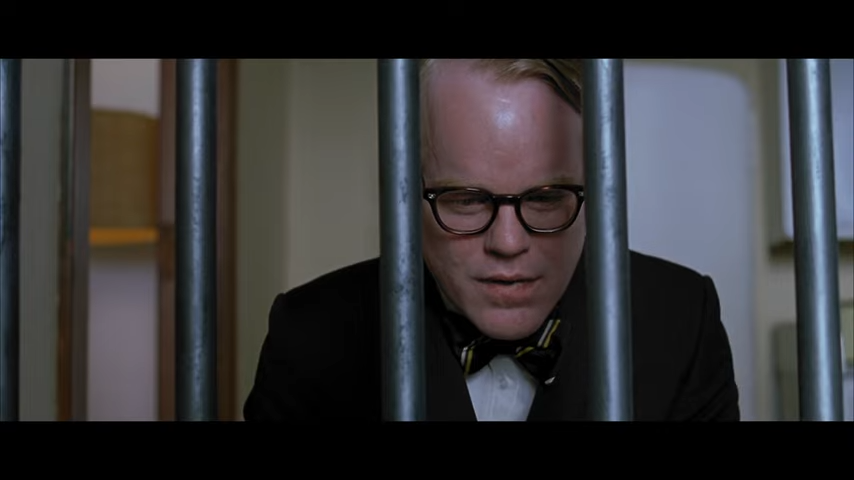


Directed by Bennett Miller from a script by Dan Futterman, the film Capote, which turned 20 years old this year, begins with the discovery, on Nov. 15, 1959, of the brutally butchered bodies of a farm family, the Clutters, in the tiny town of Holcomb, Kansas, which at the time had a population of around 200. From Holcomb we cut to New York, where Capote (Philip Seymour Hoffman) reads about the killings in the New York Times in the comfort of his Brooklyn apartment, then boards a train to Kansas to report about them for The New Yorker. Soon, two lowlife ex-cons, Dick Hickock (Mark Pellegrino) and Perry Smith (Clifton Collins Jr.), are apprehended, tried, and convicted.
And Capote finds himself drawn inexorably to the latter.
Capote already had a devoted partner, Jack Dunphy (Bruce Greenwood), also an author (although a far less successful and far better-adjusted one), who was endlessly tolerant of his many faults and foibles; they’d been a couple for over 20 years and would stay together until Capote’s death in 1984. Yet after a brief time in Holcomb, Capote grows attracted to a likely psychopath who participated in the heartless slaughter of a family. When, at the funeral home, Capote sneaks a peek into the coffins of Herb, his wife, Bonnie, and their two children, 16-year-old Nancy and 15-year-old Kenyon, and then chats intimately with Perry, the juxtaposition, and the moral implications of it all, make one’s skin crawl.
During the next three years or so, Capote travels back and forth between somber Holcomb and gay New York. Now and then the two worlds collide in odd ways. Over dinner in Holcomb, Capote regales police chief Alvin Dewey (Chris Cooper) and his wife (Amy Ryan) with a story about making Beat the Devil in Italy with Humphrey Bogart and John Huston; later, Richard Avedon, the world’s leading fashion photographer, comes to Holcomb to snap portraits of the killers. Meanwhile the line between reporter and friend blurs increasingly: Capote sets the murderers up with a better lawyer and bonds with Perry over their childhoods, telling his friend Nelle Harper Lee (Catherine Keener) that he feels as if he and Perry grew up in the same house, and one day “he went out the backdoor and I went out the front.”
She’s troubled. Because she sees — as he doesn’t — that he’s playing with fire.
Soon, having finished writing a decent chunk of the book, Capote is onstage at the 92nd Street Y, entertaining an eager audience of Manhattan glitterati with a beautifully polished account of his inspection of the coffins. He describes the clothes in which the corpses were dressed. And then he delivers the scene’s coup de grace: “The head of each was completely encased in cotton, a swollen cocoon twice the size of an ordinary blown-up balloon. And the cotton, because it had been sprayed with a glossy substance, twinkled like Christmas-tree snow.”
Having traveled to Holcomb with Capote, as it were, the film viewer is chilled by his dispassionate account of what he’s seen. It’s great writing, yes, but it also feels jarring, wrong, the coldly clinical account forming an uneasy contrast with what we’ve just seen of his warm interaction with Perry — the murderer to whom he’s said, tenderly: “It’s your friend, Truman.”
Yet the fans who fill the audience at the Y experience no emotional conflicts when Capote concludes his reading: they leap from their seats, exploding in deafening applause. For they all realize as one that Capote, who was previously known for such delicate baubles as Other Voices, Other Rooms and Breakfast at Tiffany’s — and who might well, in another universe, have gone on (who knows?) to produce another small, perfect book about the simple and virtuous lives of family very much like the Clutters — has now turned their gruesome deaths into a certifiable Big Book, a substantial, enduring work of American literature, his own Moby-Dick or Grapes of Wrath. This isn’t about the Clutters’ suffering — it’s about Capote’s triumph.
All of which raises some ticklish issues. Even before In Cold Blood came out, Capote was, as we see in the movie, touting it as a “nonfiction novel” — acknowledging its foundation in real events, yes, but at the same time suggesting that, through the magic of his own literary genius, he’d lifted the Clutters and their murderers out of mere reality onto the higher plane of art. He also, by the way, repeatedly insisted that every word in the book was true — which, much later, turned out to be a lie. The question is: did Capote, by writing his book, give the Clutters immortality? Or, by twisting their story for literary purposes, transforming them into characters in a “novel” rather than sticking to the facts, did he subject them, in a sense, to a second death?
Backstage at the Y after his reading, Capote is laughing it up merrily over cocktails with some of his friends — all of them delighted, apparently, to be part of this red-letter day in American letters — when a grim-faced member of the audience appears in the door and breaks the mood: “I’m sorry, if I may. Your portrait of those men was terrifying. Terrifying.” Capote thanks him with a chuckle and a condescending wave, and the man backs timidly out of the doorway.
In waving off that fan, Capote isn’t just dismissing a party pooper. He’s waving off — unconsciously, to be sure — the terrifying darkness into which he’d had to wander in order to create his magnum opus. For now, he’s managed to keep that prairie gloom out of his big-city high life. Instead he’s preoccupied with the book’s sky-high potential: his editor at the New Yorker, William Shawn (Bob Balaban) — who’s really a mash-up of Shawn and Capote’s Random House editor, Joe Fox — tells him excitedly (Shawn was never the excitable sort) that “this book is… going to change how people see your writing. I think it’s going to change how people write!” Well, it arguably made Capote, as the film’s closing title card asserts, the most famous writer in the world. For a while, anyway. It also destroyed him.
If Capote has fascinated filmmakers (Capote was followed, a year later, by another biopic, Infamous, that was also focused on the writing of In Cold Blood, and, last year, by the miniseries Feud: Capote and the Swans), it’s less because of the merits of his work than because he was himself such a unique piece of work, an improbable combination of any number of seemingly contradictory attributes — at once the most deadly serious of writers and the flightiest of bon vivants, tough and fragile, grave and frivolous, brutal and gentle, determined to capture the truth and prepared to invent reams of lies in order to improve on it, as capable of the deepest kind of love as he was skillful at the most cold-blooded brand of betrayal. The profoundly troubled and insecure son of a shallow, neglectful Southern mother, he eventually became the irreverently witty toast of New York, a bottomless font of bon mots, an Oscar Wilde for the Mad Men era. And Hoffman makes it all add up quite powerfully.
And at this point, you ain’t seen nothing yet. As the execution of Dick and Perry keeps being postponed, and with it the publication of In Cold Blood, Hoffman’s performance grows deeper, darker. Increasingly unable to push away the reality of what he’s experienced in Kansas, Capote starts to unravel. And the execution, when it finally comes on April 15, 1965, leaves him shattered. Having gotten his ending, he writes it up, and the book comes out and, yes, he achieves incomparable literary success; but at the same time, he’s lost — no, not his soul — but whatever it was that had kept him glued together throughout the first four decades of his life. Sitting on the edge of a hotel bed in Holcomb immediately after the execution, he tells Nelle on the phone: “I will never get over it.”
On August 25, 1984, 19 years after the publication of In Cold Blood, Capote was found dead, age 59, in the Bel Air home of Johnny Carson’s second wife, Joanne. The cause of death was “liver disease complicated by phlebitis and multiple drug intoxication”; the drugs included barbiturates, Valium, “anti-seizure drugs,” and painkillers. Hoffman, as well, had a dark, lonely, drugged-out end: on Feb. 2, 2014, age 46, six years after winning the Oscar for Capote, he was found dead in his apartment at 35 Bethune Street in the West Village in Manhattan. In his body, the autopsy found heroin, cocaine, benzodiazepines, and amphetamine.
I think most film buffs would agree that Hoffman’s main competition for the Oscar was Heath Ledger, who, in one of the most extraordinary acting achievements ever, had played the heartbreaking fictional character Ennis Del Mar in Brokeback Mountain. On Jan. 22, 2008, less than two years after losing the Oscar to Hoffman, Ledger, age 28, was found dead in his apartment at 419-421 Broome Street in SoHo in Manhattan. In his body, the autopsy found oxycodone, hydrocodone, diazepam, temazepam, alprazolam, and doxylamine.
On the first page of In Cold Blood, Capote writes that the barren part of Kansas where Holcomb is located is known in the state as “out there.” Of course, to New Yorkers who read the New York Times and New Yorker, the whole country between, well, Manhattan and Bel Air was, then as now, “out there” — or, as the coastal elites say, “flyover country.” Brokeback Mountain, like In Cold Blood, tells a tragic story set in a remote part of that flyover country — in, to be specific, a mountainous grazing region of Wyoming — and in its closing minutes, Heath Ledger enacts the brokenness of his character, Ennis Del Mar, as movingly as Hoffman does Capote’s.
One last thought. It’s neither here nor there, I guess, but I’d wager that during their whole lives, none of the Clutters ever imbibed an illegal substance. Nor, I suspect, did Nelle Harper Lee, who, during the fraught period covered by the movie Capote, was completing and publishing her own very fine and very wise first novel; who, unlike her friend Truman, was being thoroughly modest about it until, like In Cold Blood, it took the world by storm; and who, as is clear as day to any reader of To Kill a Mockingbird, was never for a moment confused about which of her characters was the victim and which was the villain.
READ MORE from Bruce Bawer:
Guess What the New Yorker Thinks of the Kennedy Center’s New Name?



















